理查斯特劳斯歌剧《随想曲》
豆瓣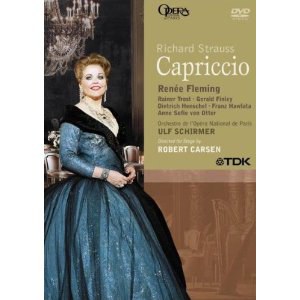
简介
When the curtain fell at the Paris Opera premiere of Capriccio on 16 June 2004, the audiences rose to long and frenetic ovations. They unanimously applauded each singer in a cast of stars, but Renée Fleming was undoubtedly the leading light of this remarkable production. Every one of the performers in this production is outstanding and can be regarded as the best possible singer for the role. Opera fans from all over Europe came to Paris to see the production, a highlight of the international opera season in 2004.
It was the very last opera staging before Hugues R. Gall, who had led the Opera de Paris with eminent success for nearly a decade, went into retirement. Thus, Strauss’ Capriccio – a topical opera on the construction and staging of an opera – can be seen as his legacy to Gerard Mortier who followed him as the director of one of the most prolific and interesting European houses.
This Capriccio also served as a role debut for American star soprano Renée Fleming who took on the role of the Gräfin. The critics celebrated her performance as “ideal” in all aspects: musically, dramatically and above all vocally and she was cheered frenetically by the audience at the Palais Garnier of the Opéra National de Paris.
Dietrich Henschel had critics raving about his sensitively sung Graf, Anne-Sofie von Otter won audiences over with her highly ironic interpretation of the singer Clairon. Rainer Trost presented himself both as a true actor and as a versatile tenor in the role of the composer Flamand, Gerald Finley gave a very convincing poet Olivier and Franz Hawlata was described by a critic as “a glowing” La Roche. Altogether a true ensemble of stars!
The action starts with Renée Fleming sitting among the real audience, from whence she enters the stage, which frames another stage, which in turn looks like the interior of the Opéra Paris – thus setting the scene for a “stage on stage” play that directly reconnects to the real world of opera, opera staging and opera goers.
Robert Carsen, a marvellous director and famous for his mind-opening opera stagings all over the world, interpreted the “stage on stage” action of Capriccio as a brilliant farewell manifesto for Hugues R. Gall. The play on the – seemingly fanciful – question of whether words or music are the most important for an opera reflects one of the most inspiring questions of opera staging today, As Robert Carsen once put it in an interview with the international radio Deutsche Welle: "I start with the words, but it is the music that lends me any particular ideas I have for a scenic solution." "Opera itself is a mixture of head and heart,” he went on. "You have the words which are maybe more intellectually based - they have a more concrete quality - and you have the music that is more emotional. The two together create a tension that allows opera, when it works, to be unbelievably satisfying because you're challenged mentally while, at the same time, being fulfilled emotionally."