Echoes Of Japan
Douban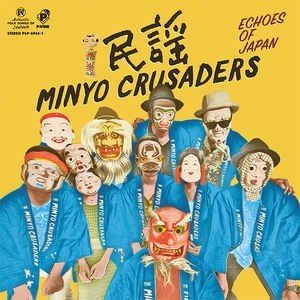
overview
In his short story “The Preserving Machine,” Philip K. Dick wrote that “music is the most perishable of things; fragile and delicate, easily destroyed.” The character who speaks that line sets about turning music into DNA to enable it to survive for future generations. In a manner of speaking, the Tokyo group Minyo Crusaders are pursuing the same ends—albeit without the assistance of a laboratory, or indulging in any gene splicing.
First, some context: “Minyo” are traditional Japanese folk songs, localized bits of pastoral verse and melody, often unique to their hometown or district. Minyo have mostly disappeared from everyday consciousness in 21st century Japan, but on Echoes of Japan, the new album from Minyo Crusaders, they’re given a boisterous afterlife, transformed by arrangements that draw heavily on dub, cumbia, and Afrobeat.
Take “Kushimoto Bushi (Cumbia),” the album’s first single. A slow-scraping cumbia rhythm works as a sort of transport for the song’s hook, a blast of military brass. The syncopation offsets the song’s brittle, eerily beautiful pentatonic wail, while grungy down-chanks of guitar and downbeats give the composition a power greater than its various parts. The sound bristles, but it also slaps. On “Hohai Bushi (Afro),” singer Fredy Tsukomoto’s plaintive, sometimes yipping vocal is underpinned by greasy Afrofunk that suggest early Fela compositions like “Swegbe and Pako.” Though subtitled “Ethiopian Groove,” the sweeping feel of “Akita Nikata Bushi” is more akin to the desert blues of Mali; “Otemoyan (Reggae)” swipes a bit of the riddim from dancehall classics “Ring The Alarm” and “Bam Bam.” Echoes of Japan proves Minyo Crusaders to be masters of many styles and feels, from the frenetic beguine “Mamurogawa Ondo” to the languid bolero treatment of “Yasugi Bushi,” which ends with a Pharoah Sanders-ish flourish on tenor sax.
Preservation is clearly at the heart of the mission, as Crusaders guitarist and co-founder Katsumi Tanaka confirms. “Minyo used to be music for the common people; popular music,” he says, speaking by phone from Tokyo with the help of a translator, “but it doesn’t work like that anymore. It’s regarded as a forgotten, out-of-date music. By comparison, reggae, cumbia, and ska are very well accepted. By combining the two, I believe traditional Japanese song minyo could be revived, bringing back its own charm as a music for the people.”
Most of the minyo in the Crusaders catalog were painstakingly collected by Tanaka, from his own collection of 78 RPM discs and similar recordings uploaded to the web. YouTube, in fact, played a critical role in developing the Minyo Crusaders repertoire. “There, I found lots of different music sources and––even searching for one song—I find that the same song can be arranged very differently depending on the period [it was recorded in]. Minyo was still taken as a very vibrant and popular modern music in certain eras and that was very inspirational. That completely changed my mind about what minyo could be,” says Tanka. Accordingly, Tanaka pulled together the Crusaders current line-up of ace musicians from other bands, specifically seeking players who were adept at Afro-Latin and Caribbean forms to develop this vision of a living minyo. “It’s maybe a good way to provoke the question, What’s Japanese?” he says, “or how we see our identity as Japanese people. We’re enjoying our own Japanese culture as a kind of ‘world music.'”
Such juxtapositions are almost as novel in Japan as they are to listeners outside it. While reggae and other variants of “world music” are extremely popular there, they don’t intuitively mesh with minyo. As Isaku Kageyama, a musician and teacher at L.A.’s Taiko Institute explains, “Minyo uses a similar beat to cumbia, but the feel and groove is totally different. Reggae uses a lot of syncopated melodies, while minyo melodies tend to be very downbeat focused.” Jeremy Freeman, aka Scratch Famous, Tokyo-based proprietor of the reggae soundsystem Deadly Dragon Sound, arrives at a similar conclusion: “The bedrock sound of Jamaican music has always been the ‘heartbeat’ of a kette drum. The taiko drums that I have heard do not have that element.”
Minyo is also not an obvious thematic fit with outlaw artforms like dub and reggae—which is not to say that the urgency of Minyo Crusader’s sound is not powered by an equally strong generational undercurrent. “I may be making a jump here,” says Freeman, “but the 2011 earthquake/tsunami had a profound effect on Japanese society. There was a galvanization of a national consciousness and community. At the same time, there was a marked cynicism in reaction to the government’s handling of the crisis, specifically the transparent falsehoods that were being spread about nuclear safety.
“These two combined forces—a reawakening of a shared Japanese consciousness and a distrust of government—gave rise to a greater sense of concern over all that has been lost in Japan in the decades since World War II,” Freeman concludes. “I suspect Minyo Crusaders felt that as an impetus to revive the folk music of Japan.”
Tanaka himself is quick to admit that, though it may sound like a call to arms, Echoes Of Japan doesn’t constitute message music in the traditional sense. “It’s a very difficult question, because in the lyrics of minyo itself…there’s no message songs. It’s more describing the beautiful countryside in a particular place, a visual image.” But perhaps that image—of Japan, the land itself—is as deserving of preservation as any message. “When Japanese people listen to minyo—it’s more it’s telling like a picture,” Tanaka says. “It’s telling a landscape.”
It wasn’t your looks that charmed me, I liked the silver accessory on your tobacco case” (Lyric from Otemoyan)
Minyo Crusaders rework historic Japanese folk songs (min'yō) with Latin, African, Caribbean and Asian rhythms on their debut album “Echoes of Japan”.
Recent releases from Ryuichi Sakamoto, Haruomi Hosono and Midori Takada have re-ignited global interest in Japanese music and with Ry Cooder, Mario Galeano (Ondatrópica/Frente Cumbeiro) and Clap! Clap! already fans of the ten-piece, “Echoes of Japan” marks the arrival of a big band like no other, where distinctive min'yō vocals glide over grooves that join the dots between cumbia, Ethiopian jazz, Thai pop, Afro funk and reggae.
“For Japanese people, min'yō is both the closest, and most distant, folk music” explains band-leader Katsumi Tanaka: “We may not feel it in our daily, urban lives, yet the melodies, the style of singing and the rhythm of the taiko drums are engrained in our DNA”.
Initially indifferent to min'yō, a tragic event in recent Japanese history set Tanaka on his current path: “Following the Tohoku earthquake of 2011, like many Japanese, I reflected on my life, work and identity. A fan of world music, I began searching for Japanese roots music I could identify with. Discovering mid-late 20th century acts Hibari Misora, Chiemi Eri and the Tokyo Cuban Boys, I was captivated by their eccentric arrangements and how they mixed min'yō with Latin and jazz.” Freddie fell for min'yō after hearing a song from his hometown on a TV competition whilst in a restaurant. It was a revelation - up till then he had been an aspiring jazz singer yet was uncomfortable singing in a foreign language. The restaurateur told him a min'yō teacher was his neighbour, and the rest is history.
Originally sung by fishermen (Kushimoto Bushi; Mamurogawa Ondo), coal miners (Tanko Bushi) and sumo wrestlers (Sumo Jinku), these songs deal with topics such as the returning spirits of ancestors (Hohai Bushi), Japan’s smallest bird (Toichin Bushi) and a bride’s undying love for her husband’s pockmarked face (Otemoyan), evoking nostalgia for a forgotten Japan. “As a traditional performing art, min'yō is considered highbrow, yet these are mainly songs for working, dancing or drinking - we want to return them to their literal meaning as ‘songs of the people’ ”.
In the late 90s Tanaka moved to Fussa, a city in western Tokyo steeped in counter-culture folklore as the home of Eiichi Ohtaki of Japanese rock band Happy End. Tanaka met Tsukamoto playing in a session band where the latter was singing soul. Aware that Freddie’s true passion was min'yō, Tanaka asked him to form a band to revive this style. They invited other musicians such as local drumming legend Sono and for the first few years played low-key shows yet a turning point came when bassist DADDY U, a veteran of the Tokyo roots music scene and the respected Ska Flames, joined. Through him they met keyboard player Moe, the leader of spiritual Caribbean jazz band Kidlat; sax player Koichiro Osawa, a member of Japanese-reggae/ska groups Matt Sounds and J.J. Session and regular pick-up for reggae musicians visiting Japan; trumpeter Yamauchi Stephan, also a member of J.J. Session; percussionist Mutsumi Kobayashi of Tokyo’s cumbia Banda de la Mumbia; Irochi, conga player with Afro Cuban band Cubatumb and vocalist Meg, a member of respected tropical DJ collective Tokyo Sabroso. Since then they have become a fixture on the Tokyo music scene and went national in 2018 through festivals such as Fuji Rock.
With songs encouraging dancing and drinking, the Crusaders are on a mission to bring “highbrow” min'yō back to it's “lowlife” roots -whilst also bringing traditional Japanese music onto the global music stage: “The point is to avoid making it too complicated” adds Tanaka, “since min'yō is for everyday people.”
Minyo Crusaders are (descriptions by Katsumi Tanaka)
Freddie Tsukamoto (vocals): “Stubborn, like an old Japanese man”
Meg (vocals, melodica): “Spiritual jazz lover. Never talks on stage”
Katsumi Tanaka (guitar): “Collector of bizarre Japanese guitars”
DADDY U (bass): “Caribbean music freak”
Moe (keyboards): “Comic collector, synth-head, easy-going”
Sono (timbales): “Dog lover”
Mutsumi Kobayashi (bongos): “Beat master & happy mood maker”
Yamauchi Stephan (trumpet): “Most organised and reliable”
Koichiro Osawa (sax) “The party man and our craziest performer”
Irochi (congas): “Our mascot. Something always happens on tour”
tracks
A1 串本節 = Kushimoto Bushi 5:02
A2 ホーハイ節 = Hohai Bushi 5:08
A3 おてもやん = Otemoyan 5:44
B1 真室川音頭 = Mamurogawa Ondo 4:37
B2 安来節 = Yasugi Bushi 5:54
C1 秋田荷方節 = Akita Nikata Bushi 5:45
C2 といちん節 = Toichin Bushi 5:37
D1 炭坑節 = Tanko Bushi 5:34
D2 会津磐梯山 = Aizubandaisan 5:38
D3 相撲甚句 = Sumo Jinku 3:06