John Williams Greatest Hits 1969 - 1999
豆瓣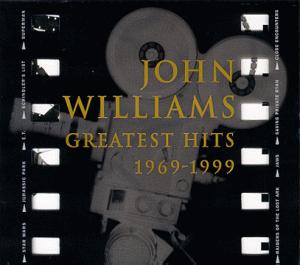
简介
Every fan of STAR WARS - and of great music - is in his debt.
George Lucas
I want to salute John Williams - the quintessential film composer. John has transformed and uplifted every movie that we've made together.
Steven Spielberg
It has been a very special experience to carve out these three films together (Born on the Fourth of July, JFK, Nixon). In each one, John Williams brought to them the soul of a poet. Working with him was like flying through the light. I shall never forget it.
Oliver Stone
In Steven Spielberg's E.T.: The Extra-Terrestrial, the famous "flying" theme - perhaps the most thrilling melody John Williams ever wrote - isn't heard, in its full glory, right at the beginning of the movie. Early on, as the anxious E.T. develops a trusting relationship with ten-year-old Elliott, the theme is suggested in subdued and altered form. Indeed, much of the early music is tentative and anticipatory - say, just a shimmer of strings held in suspension and accompanied by a single flute.
Mixed in with this lovely, evocative music, one can hear no more than a modest version of the flying theme: when Elliott, with E.T.'s help, makes the oranges and limes circle around one another like the planets in the solar system, we hear it; and then again when E.T. makes a plant come to life in Elliott's house. Finally, Elliott and E.T., riding in Elliott's bicycle, take off into the air, passing in front of the face of the moon, and the flying theme which really represents all of E.T.'s creative powers bursts out in the full orchestra.
Over a pulsing, driving, rhythm, the strings soar, the horns leap heroically. It is one of the truly satisfying moments in movies, and the satisfaction is recapitulated and extended, later on, when Elliott, his older brother, Mike, and Mike's friends, all on bicycles, escape the federal agents by flying again - across the setting sun, this time. If one can speak of pure exhilaration, Williams' music, at that moment, has it in spades.
My point in going through this progression is a simple one: John Williams, working with such directors as Spielberg, George Lucas, Oliver Stone and others, uses music with considerable delicacy. It's been said many times that Williams' score for Star Wars signaled a return of the big symphonic sound to Hollywood movies, and this, of course, is true. After hundreds of soundtracks with pop ballads or rock songs, or just a piano and a couple of forlorn winds, or music created by a synthesizer - after all that, it was enormously exciting in the late seventies to suddenly hear the London Symphony in full throated-roar, its brass and timpani pounding, its strings whirling furiously.
But if John Williams writes very well for full symphony orchestra, he also uses smaller, more modest means beautifully too. The opening of the Star Wars score has a heroic and epic cast to it that truly feels like the beginning of a long narrative but once the initial fanfares and the famous vaunting theme have been exhausted, a single woodwind is left behind to graze in the fields of orchestral silence, much as a child might be lost in wonder before the stars.
Over the course of the various Star Wars films, Williams' music has played a major role in allowing Lucas to express not just bombast and grandiosity, but also more serious emotions consider the various yearning themes associated with Princess Leia's desire for the safety of the rebel forces and with Luke's quest for a father, the sinister, jeering, overbearing music of the Empire, and so on. Not only did Williams' score fasten millions of young fans to the grand mythic overtones of the story; it fastened Lucas himself to the mythical and metaphysical notions inherent in his original ideas. The score for the new Phantom Menace recapitulates some of the trilogy's earlier music, but subtly and allusively, and there is much that is new as well, including the extraordinary "Duel of the Fates", in which the chanting chorus is urged on by a furious little motoric figure in the strings and brass - in all, one of the most exciting things Williams has ever written.
Most of the time, listening to Williams' many scores, one is aware of his enormous resourcefulness and professional skill and his way of injecting a little extra edge and excitement into the occasion before him - the aching loneliness of the trumpet solos, for instance, in his music for Born on the Fourth of July; or the heart-rending pathos of the solo violin in Schindler's List; or the scintillating, almost coruscating, brass fanfares in his "Olympic Theme", which inserts the adrenaline of competition right under the listener's scalp; or the airy yet slightly sinister music for Home Alone, which exists half way between Tchaikovsky's sugar-plum-fairy mood in The Nutcracker and the music for a horror film. And who among us does not recall the muted heroic strains of the brass in Saving Private Ryan or the strange little duet between the earthlings and the alien ship in Close Encounters of the Third Kind? Williams has a mischievous side that he indulges only occasionally, but with devastating effect: that notorious rhythmic tugging in the basses and cellos when the shark appears in Jaws gets reinforced by the brass in a way that becomes downright terrifying. If you listen to that episode as a piece of music, the fun of the movie comes back, but so does its vertiginous fear of being pulled under and consumed. John Williams' music can do that to you.
tracks
1-1. Main Title [From Star Wars]
1-2. Flying Theme [From E.t. the Extra-terrestrial]
1-3. Main Title [From Superman]
1-4. Parade of the Slave Children {From Indiana Jones and the Temple of Doo}
1-5. Theme [From Sugarland Express]
1-6. Theme [From Jaws]
1-7. Bugler's DreamOlympic Fanfare and Theme
1-8. Return Of The Jedi Luke And Leia
1-9. Main Title [From Thr Reivers]
1-10. Imperial March [From The Empire Strikes Back]
1-11. Scherzo for Motorcycle and Orchestra {From Indiana Jones and the Last}
1-12. Cadillac of the Skies [From Empire of the Sun]
1-13. Raiders March [From Raiders of the Lost Ark]
1-14. Suite [From Close Encounters of the Third Kind]
2-1. Hymn to the Fallen [From Saving Private Ryan]
2-2. Theme [From Jurassic Park]
2-3. Theme [From Schindler's List]
2-4. Flight to Neverland [From Hook]
2-5. Prologue [From Jfk]
2-6. Days Between [From Stepmom]
2-7 March [From 1941]
2-8. Somewhere in My Memory {Main Title From Home Alone}
2-9 Summon the Heroes
2-10 Look Down, Lord [Reprise and Finale from Rosewood]
2-11. Theme [From Far and Away]
2-12. Theme [From Born on the Fourth of July]
2-13. Duel of the Fates [From Star Wars Episode 1]