沃尔夫冈·里姆《圣路加受难曲》
Douban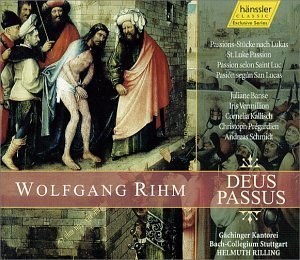
overview
Last fall, a series of modern masterworks were premiered as the capstone of the yearlong commemoration of the death of Johann Sebastian Bach. Four settings of the Good Friday narrative were commission by four of the world's leading composers: Sofia Gubaidulina, Tan Dun, Osvaldo Golijov and Wolfgang Rihm.
First to be released by the international award winning Hanssler Classic label is Wolfgang Rihm's transcendent requiem of Reconciliation, DEUS PASSUS.
For those familiar with Rihm's earlier work, DEUS PASSUS constitutes a new direction in his stylistic development. Absent are the violent juxtapositions and bold gestures of Rihm's earlier work. In their place, a delicate, carefully chosen almost “impressionistic” palette has been selected. This impressionistic approach applies equally to the texts that Rihm selected to set. Consciously selecting St. Luke's account of Jesus' death, specifically for it's lack of anti-Semitic content, Rihm deleted all non dialogue material and supplemented his Passion fragment with selections from the Catholic lectionary, the Stabat Mater and poetic interpolations, concluding with a moving setting of Paul Celan's inverted prayer, TENEBRAE.
Grammy Award winning conductor, Helmuth Rilling delivers one of the finest performances of his career, directing the Gachinger Kantorei, the Bach-Collegium Stuttgart and stellar soloists Juliane Banse, Iris Vermillion, Cornelia Kallisch, Christoph Prégardien and Andreas Schmidt in a score that rightfully takes it's place with the 20th century's other great St. Luke Passion, the Penderecki; Passio et more domini nostri Jesu Christi secundum Lucam.
tracks
RIHM: Deus Passus, "St. Luke Passion"
Disc 1
Rihm, Wolfgang
Deus Passus, "St. Luke Passion"
Banse, Juliane - soprano
Vermillion, Iris - alto
Kallisch, Cornelia - alto
Pregardien, Christoph - tenor
Schmidt, Andreas - baritone
Stuttgart Gachinger Kantorei
Stuttgart Bach Collegium
Rilling, Helmuth - Conductor
1. » Das ist mein Leib (Soprano, Mezzo-Soprano, Alto, Tenor, Bass) 00:03:08
2. » Potum meum (Mezzo-Soprano) 00:02:36
2. » Crux fidelis (Tenor) 00:02:14
3. » Langsam und schwer 00:02:23
4. » Und er ging hinaus (Soprano, Mezzo-Soprano, Alto, Tenor, Bass) 00:04:17
5. » Domine, audivi auditum tuum (Tenor, Bass) 00:03:17
6. » Siehe, da kam die Schar (Chorus) 00:02:01
7. » Eripe me, Domine (Chorus) 00:01:26
8. » Sie griffen ihn aber (Soprano, Alto, Tenor, Bass) 00:04:03
9. » Die Manner aber, die Jesum hielten (Bass) - Weissage, wer ist's (Chorus) 00:01:02
10. » Qui cogitaverunt malitias in corde (Soprano) 00:01:10
11. » Und als es Tag ward (Chorus) 00:05:28
12. » Und sie fuhrten ihn vor Pilatus (Chorus) 00:02:18
13. » Da aber Herodes Jesum sah (Alto, Bass) 00:02:19
14. » Pilatus aber sprach (Chorus) 00:04:29
15. » Popule meus (Mezzo-Soprano) 00:02:15
16. » Und als sie ihn hinfuhrten (Alto) - Ihr Tochter von Jerusalem (Chorus) - Es wurden aber auch hingefuhrt (Chorus) 00:06:28
Disc 2
Rihm, Wolfgang
Deus Passus, "St. Luke Passion"
Banse, Juliane - soprano
Vermillion, Iris - alto
Kallisch, Cornelia - alto
Pregardien, Christoph - tenor
Schmidt, Andreas - baritone
Stuttgart Gachinger Kantorei
Stuttgart Bach Collegium
Rilling, Helmuth - Conductor
1. » Und als sie kamen an die Statte (Chorus) 00:05:26
3. » Er hat anderen geholfen (Chorus) 00:00:57
4. » Hic acetum, fel, arundo (Soprano) 00:01:30
5. » Es war aber uber ihm geschrieben (Chorus) - Und es ward eine Finsternis (Chorus) 00:03:23
6. » Und Jesus rief laut (Chorus) - Vater, ich befehle meinen Geist (Soprano, Mezzo-Soprano, Alto, Tenor, Bass) - Und verschied (Chorus) 00:04:30
7. » Flecte ramos, arbor alta (Soprano) 00:02:51
8. » Stabat mater dolorosa (Mezzo-Soprano, Alto) 00:04:54
9. » Und alles Volk, das dabei war (Bass) - Furwahr, er trug unsre Krankheit (Chorus) 00:04:32
10. » Joseph von Arimathia ging zu Pilatus (Bass) - Aber am ersten Tage der Woche (Soprano, Mezzo-Soprano, Alto) 00:02:45
11. » Nah sind wir, Herr (Chorus) 00:08:39