库塔格《卡夫卡断章》
Douban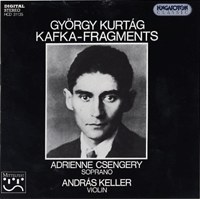
overview
Kurtág was born in Lugoj, Banat (Romania), not far from the birthplace of fellow Hungarian György Ligeti. Both young composers hoped to study with Béla Bartók in Budapest in 1945, but Bartók died in the United States and Kurtág went on to study piano, composition and chamber music with other teachers at the Franz Liszt Academy of Music in Budapest. Among his early works was a Korean Cantata, which expressed solidarity with the North Koreans in their War of 1950-1953, but he reached the age of thirty-three before he was willing to give any of his works opus numbers.In the early 1950s the Communist regime in Hungary proscribed Bartók's later works, and immediately his music became a rallying call for artists taking a stand against authoritarianism. Also banned in Hungary until the mid-1950s was the music of Arnold Schoenberg, and middle and late-period Igor Stravinsky. To escape this pressure, Kurtág moved to France in 1957, studying music in Paris with Olivier Messiaen, Darius Milhaud and Max Deutsch. He also had consultations with the Hungarian art psychologist Marianne Stein, and it was her advice that would prove most influential on his future development. While in Paris he wrote his first String Quartet, designating it "opus 1" to mark a decisive break from his compositions to date. He returned to Budapest in 1958, stopping for a few days in Cologne, where he first heard recordings of Karlheinz Stockhausen's Gruppen and Ligeti's recent electronic music. This experience would also prove important in formulating his new compositional voice.
Kurtag: Kafka Fragments, Banse/ Keller(ECM)
Andrew Clements
The Guardian, Friday 17 February 2006
Sunday will be György Kurtag's 80th birthday. It's odd that such a chance to celebrate the achievement of one of the leading European composers of our time has been passed up altogether in Britain - but the release of this wonderful CD, recorded under Kurtag's supervision, is significant compensation. The hour-long Kafka Fragments, completed in 1986, is his biggest work to date: it's a characteristic cycle of 40 tiny movements, scored for soprano voice and violin, that adds up to something far greater than the sum of its parts.
The text is a mosaic of quotations from Kafka's writings, diaries and letters. The cycle is divided into four parts, articulated by the two longest movements; they draw a huge range of expression from soprano Juliane Banse and violinist Andras Keller. Banse's nuances of vocal colouring are wonderfully subtle, while Keller can conjure up huge intensity from a single musical gesture. They show Kafka Fragments to be a quiet masterpiece of richness and emotional power.
tracks
GYORGY KURTAG
Kafka-Fragmente (Kafka-Fragments), Op. 24
01. Part 1: No. 1. Die Guten gehen im gleichen Schritt… (The good march in step…) 01:06
02. Part 1: No. 2. Wie ein Weg im Herbst (Like a pathway in autumn) 00:32
03. Part 1: No. 3. Verstecke (Hiding-places) 00:20
04. Part 1: No. 4. Ruhelos (Restless) 00:17
05. Part 1: No. 5. Berceuse I 00:57
06. Part 1: No. 6. Nimmermehr (Nevermore) (Excommunicatio) 01:30
07. Part 1: No. 7. "Wenn er mich immer fragt" ("But he just won't stop asking me.") 00:31
08. Part 1: No. 8. Es zupfte mich jemand am Kleid (Someone tugged at my clothes) 00:10
09. Part 1: No. 9. Die weissnaherinnen (The seamsresses) 00:21
10. Part 1: No. 10. Szene am Bahnhof (Scene at the station) 00:12
11. Part 1: No. 11. Sonntag, den 19. Juli 1910 (Sunday, 19th July 1910) (Berceuse II, Hommage a Jeney) 01:22
12. Part 1: No. 12. Meine Ohrmuschel… (My ear…) 00:13
13. Part 1: No. 13. Einmal brach ich mir das Bein (Chassidischer Tanz) (Once I broke my leg (Chassidic Dance)) 00:42
14. Part 1: No. 14. Umpanzert (Enarmoured) 00:22
15. Part 1: No. 15. 2 Spazerstocke (Authentisch-plagal) (2 walking-sticks (Authentic-plagal)) 01:00
16. Part 1: No. 16. Keine Ruckkehr (No going back) 01:05
17. Part 1: No. 17. Stolz (1910/15. November, zehn Uhr) (Pride (15th November 1910, 10 o'clock)) 00:40
18. Part 1: No. 18. Traumend hing die Blume (The flower hung dreamily) (Hommage a Schumann) 02:04
19. Part 1: No. 19. Nichts dergleichen (Nothing of the kind) 01:12
20. Part 2. Der wahre Weg (The true path) (Hommage-message a Pierre Boulez) 07:00
21. Part 3: No. 1. Haben? Sein? (To have? To be?) 00:40
22. Part 3: No. 2. Der Coitus als Bestrafung (Coitus as punishment) (Canticulum Mariae Magdalenae) 00:20
23. Part 3: No. 3. Meine Festung (My fortrerss) 00:52
24. Part 3: No. 4. Schmutzig bin ich, Milena… (I am dirty, Milena…) 01:48
25. Part 3: No. 5. Elendes Leben (Miserable life) (Double) 00:16
26. Part 3: No. 6. Der begrenzte Kreis (The closed circle) 00:31
27. Part 3: No. 7. Ziel, Weg, Zogern (Destination, path, hesitation) 00:42
28. Part 3: No. 8. So fest (As tightly) 00:43
29. Part 3: No. 9. Penetrant Judisch (Offensively Jewish) 00:21
30. Part 3: No. 10. Verstecke (Hiding-places) (Double) 00:58
31. Part 3: No. 11. Staunnend sahen wir deas grosse Pferd (Amazed, we saw the gret horse) 02:13
32. Part 3: No. 12. Szene in de Elektrischen, 1910 (Scene on a tram, 1910) 03:30
33. Part 4: No. 1. Zu spat (22. Oktober 1913) (Too late (22nd October 1913) 03:09
34. Part 4: No. 2. Eine lange Geschichte (A long story) 00:56
35. Part 4: No. 3. In memoriam Robert Klein 00:33
36. Part 4: No. 4. Aus einem alten Notizbuch (From an old notebook) 00:44
37. Part 4: No. 5. Leoparden (Leopards) 01:47
38. Part 4: No. 6. In memoriam Joannis Pilinszky 02:41
39. Part 4: No. 7. Wiederum, wiederum (Again, again) 01:29
40. Part 4: No. 8. Es blendete uns die Mondnacht (The moonlit night dazzled us) 06:24
Adrienne Csengery, soprano / Andras Keller, violin