War over Words
豆瓣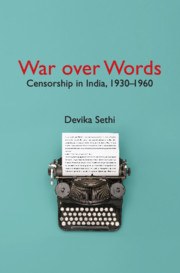
Censorship in India
Devika Sethi
简介
Censorship has been a universal phenomenon through history. However, its rationale and implementation have varied, and public reaction to it has differed across societies and times. In this book I recover, narrate, and interrogate the history of censorship of publications in India over three crucial decades—encompassing the Gandhian anti-colonial movement, the Second World War, Partition, and the early years of independent India. In doing so, I examine state policy and practice, as also its subversion, in a tumultuous period of transition from colonial to self-rule in India. Populated with an array of powerful and powerless individuals, the story of Indians grappling with free speech and (in)tolerance is a fascinating one, and deserves to be widely known.
Drawing upon a range of sources as diverse as the banned material itself, legal judgments, legislative debates, memoirs and biographies, contemporary newspaper reports and letters to editors, government papers and reports, first-person accounts, and empirical and theoretical works by scholars of censorship across the world, I focus attention both on censors and the censored. I explore the diverse mechanisms and motivations for censorship and its role in the shaping of the modern Indian republic.
目录
Table of Contents
Introduction
Part I. Guarding the State, Protecting the Public: Censorship Policies and Practices in the 1930s
1. The Power of Print
2. Provincial Autonomy (1937–1939) and Free Speech Controversies
Part II. Protests and Publicity: Banning Non-Indian Authors
3. Critiques of Indian Society: Katherine Mayo's Long Shadow
4. ‘Hurt' or ‘Hatred'? Publications by Non-Indians Offensive to Indian Muslims
Part III. Political or Military? Censorship in India during the Second World War
5. Blue Pencils, Red Pencils: Censoring the News in Wartime
6. A Contradiction in Terms? ‘Voluntary Censorship'
Part IV. The Censored Turn Censors: Freedom and Free Speech
7. Free Speech or Hate Speech? Partition and Censorship
8. ‘An Education in Realism': The First Amendment to the Indian Constitution
9. The 'Living Biographies of Religious Leaders' Controversy (1956)
Conclusion
Epilogue