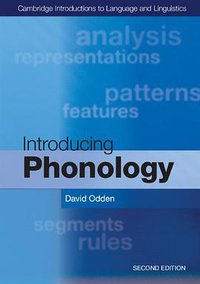
Introducing Phonology
豆瓣
David Odden
简介
This accessible textbook provides a clear and practical introduction to phonology, the study of sound patterns in language. Designed for students with only a basic knowledge of linguistics, it teaches in a step-by-step fashion the logical techniques of phonological analysis and the fundamental theories that underpin it. Through over sixty graded exercises, students are encouraged to make their own analyses of phonological patterns and processes, based on extensive data and problems sets from a wide variety of languages. Introducing Phonology equips students with the essential analytical skills needed for further study in the field, such as how to think critically and discover generalizations about data, how to formulate hypotheses, and how to test them. Providing a solid foundation in both the theory and practice of phonology, it is set to become the leading text for any introductory course, and will be invaluable to all students beginning to study the discipline.
• Accessibly written, assuming no prior knowledge of phonology or phonetics • Equips students with the essential analytical skills needed for further study in phonology • Contains over sixty graded exercises based on a variety of data, with further exercises, useful links and password protected solutions on the accompanying web site
---
Contents
1. What is phonology?;
2. Phonetic transcriptions;
3. Allophonic relations;
4. Underlying representations;
5. Interacting processes;
6. Feature theory;
7. Doing an analysis;
8. Phonological typology and naturalness;
9. Abstractness and psychological reality;
10. Nonlinear representations.
---
Reviews
‘An excellent introduction to phonology. Difficult ideas are presented in an accessible manner - a plus for any textbook. It covers a variety of interesting phonological facts from typologically different languages. Using this text will acquaint students with the essence of theoretical concepts and phonological analyses.’ Shosuke Haraguchi, Meikai University
‘This book is a godsend for those of us in search for an introduction to phonology … Odden provides the entire package of tools and raw materials that the student needs.’ Lee Bickmore, Program in Linguistics and Cognitive Science, Albany University
‘Odden‘s book stands out among phonology textbooks thanks to its focus on data and analysis. … Students of phonology and phonetics would benefit … and will find … some explanations that are clearly better than those available elsewhere.‘ Times Higher Education Supplement
目录
About this book
Acknowledgments
A note on languages
List of abbreviations
1 What is phonology?
1.1 Concerns of phonology
1.2 Phonetics - what is physical sound?
1.3 The symbolic representation of speech
Summary
Exercises
Notes to this chapter
Suggestions for further reading
2 Phonetic transcriptions
2.1 Vowels: their symbols and properties
2.2 Consonants: their symbols and properties
2.3 IPA symbols
2.4 Illustrations with English transcription
Summary
Exercises
Notes to this chapter
Suggestions for further reading
3 Allophonic relations
3.1 English consonantal allophones
3.2 Allophony in other languages
Summary
Exercises
Notes to this chapter
Suggestions for further reading
4 Underlying representations
4.1 The importance of correct underlying forms
4.2 Refining the concept of underlying form
4.3 Finding the underlying form
4.4 Practice at problem solving
4.5 Underlying forms and sentence-level phonology
4.6 Underlying forms and multiple columns
in the paradigm
Summary
Exercises
Notes to this chapter
Suggestions for further reading
5 Interacting processes
5.1 Separating the effects of different rules
5.2 Different effects of rule ordering
Summary
Exercises
Notes to this chapter
Suggestions for further reading
6 Feature theory
6.1 Scientific questions about speech sounds
6.2 Distinctive feature theory
6.3 Features and classes of segments
6.4 Possible phonemes and rules - an answer
6.5 The formulation of phonological rules
6.6 Changing the theory
Summary
Exercises
Notes to this chapter
Suggestions for further reading
7 Doing an analysis
7.1 Yawelmani
7.2 Hehe
7.3 Icelandic
7.4 Modern Hebrew
7.5 Japanese
Summary
Exercises
Notes to this chapter
Suggestions for further reading
8 Phonological typology and naturalness
8.1 Inventories
8.2 Segmental processes
8.3 Prosodically based processes
8.4 Why do things happen?
Summary
Notes to this chapter
Suggestions for further reading
9 Abstractness and psychological reality
9.1 Why limit abstractness?
9.2 Independent evidence: historical restructuring
9.3 Well-motivated abstractness
9.4 Grammar-external evidence for abstractness
9.5 How abstract is phonology?
Exercises
Notes to this chapter
Suggestions for further reading
10 Nonlinear representations
10.1 The autosegmental theory of tone: the beginnings of change
10.2 Extension to the segmental domain
Summary
Exercises
Notes to this chapter
Suggestions for further reading
Glossary
References
Index of languages
General Index