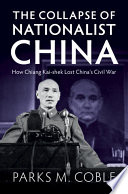
How Chiang Kai-shek Lost China's Civil War
Parks M. Coble
简介
When World War II ended Chiang Kai-shek seemed at the height of his power-the leader of Nationalist China, one of the victorious Allied Powers in 1945 and with the financial backing of the US. Yet less than four years later, he lost the China's civil war against the communists. Offering an insightful chronological treatment of the years 1944-1949, Parks Coble addresses why Chiang was unable to win the war and control hyperinflation. Using newly available archival sources, he reveals the critical weakness of Chiang's style of governing, the fundamental structural flaws in the Nationalist government, bitter personal rivalries and Chiang's personal lack of interest in finance. This major work of revisionist scholarship will engage all those interested in the shaping of twentieth-century history.
目录
List of Figures page vi
Acknowledgements vii
Introduction
1 Ichigo and Its Aftermath - 18
2 Hyperinflation and the Rivalry between T. V. Soong and H. H. Kung - 41
3 Sudden Surrender and Botched Liberation - 80
4 1946: Failure to Revive the Economy in the Aftermath of War - 111
5 1947: Speeding toward Disaster - 131
6 1948: The Collapse of Fabi and the Gold Yuan Reform Disaster - 165
Conclusion - 203
Glossary 212
Notes 215
Bibliography 254
Index 265