Diagnosing Social Pathology
豆瓣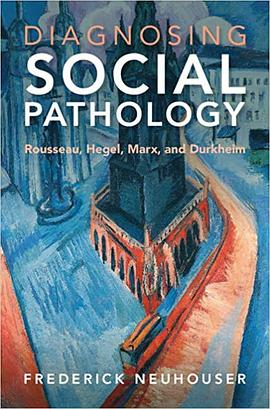
Rousseau, Hegel, Marx, and Durkheim
Fred Neuhouser
简介
Can a human society suffer from illness like a living thing? And if so, how does such a malaise manifest itself? In this thought-provoking book, Fred Neuhouser explains and defends the idea of social pathology, demonstrating what it means to describe societies as 'ill', or 'sick', and why we are so often drawn to conceiving of social problems as ailments or maladies. He shows how Rousseau, Hegel, Marx, and Durkheim – four key philosophers who are seldom taken to constitute a 'tradition' – deploy the idea of social pathology in comparable ways, and then explores the connections between societal illnesses and the phenomena those thinkers made famous: alienation, anomie, ideology, and social dysfunction. His book is a rich and compelling illumination of both the idea of social disease and the importance it has had, and continues to have, for philosophical views of society.
目录
1. Can Societies Be Ill?
2. Society as Organism?
3. Marx: Pathologies of Capitalist Society
4. Marx: Labor in Spiritual Life and Social Pathology
5. Plato: Human Society as Organism
6. Rousseau: Human Society as Artificial
7. Durkheim's Predecessors: Comte and Spencer
8. Durkheim: Functionalism
9. Durkheim: Solidarity, Moral Facts, and Social Pathology
10. Durkheim: A Science of Morality
11. Hegelian Social Ontology I: Objective Spirit
12. Hegelian Social Ontology II: The Living Good
13. Hegelian Social Pathology
14. Conclusion: On Social Ontology