Inscribing Knowledge in the Medieval Book
豆瓣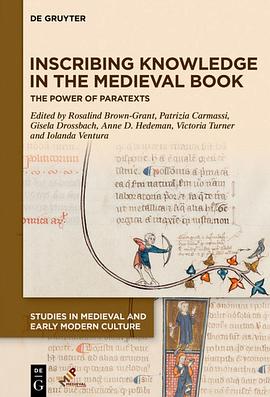
The Power of Paratexts
Rosalind Brown-Grant, Patrizia Carmassi, Gisela Drossbach, Anne D. Hedeman, Victoria Turner, and Iolanda Ventura Medieval Institute Publications
简介
This collection of essays examines how the paratextual apparatus of medieval manuscripts both inscribes and expresses power relations between the producers and consumers of knowledge in this important period of intellectual history. It seeks to define which paratextual features – annotations, commentaries, corrections, glosses, images, prologues, rubrics, and titles – are common to manuscripts from different branches of medieval knowledge and how they function in any particular discipline. It reveals how these visual expressions of power that organize and compile thought on the written page are consciously applied, negotiated or resisted by authors, scribes, artists, patrons and readers. This collection, which brings together scholars from the history of the book, law, science, medicine, literature, art, philosophy and music, interrogates the role played by paratexts in establishing authority, constructing bodies of knowledge, promoting education, shaping reader response, and preserving or subverting tradition in medieval manuscript culture.
目录
Frontmatter
Page Range: I–IV
PDF
FREE ACCESS
Contents
Page Range: V–VIII
PDF
FREE ACCESS
List of Figures
Page Range: IX–XVI
PDF
FREE ACCESS
Editorial Principles
Page Range: XVII–XVIII
PDF
FREE ACCESS
Preface and Acknowledgments
Page Range: XIX–XX
PDF
FREE ACCESS
Introduction
Page Range: 1–18
PART 1: CONSTRUCTING BODIES OF KNOWLEDGE
1. Juridical Late Medieval Paratexts and the Growth of European Jurisprudence
Mario Ascheri and Paola Maffei
Page Range: 21–45
2. Prefaces in Canon Law Books
Gisela Drossbach
Page Range: 46–55
3. “Depingo ut ostendam, depictum ita est expositio:” Diagrams as an Indispensable Complement to the Cosmological Teaching of the Liber Nemroth de astronomia
Isabelle Draelants
Page Range: 56–92
PART 2: NEGOTIATING TRADITION, CREATING PRACTICE
4. From Text to Diagram: Giambattista Da Monte and the Practice of Medicine
Concetta Pennuto
Page Range: 95–116
5. Immortal Souls and an Angel Intellect: Some Thoughts on the Function and Meaning of Christian Iconography in Medieval Aristotle Textbooks
Hanna Wimmer
Page Range: 117–140
6. Writing in the Margin – Drawing in the Margin: Reading Practices of Medieval Jurists
Joanna Frońska
Page Range: 141–159
7. Structuring, Stressing, or Recasting Knowledge on the Page? Rubrication in the Manuscript Copies of the Pèlerinage de l’âme by Guillaume de Deguileville
Géraldine Veysseyre
Page Range: 160–182
PART 3: FRAMING KNOWLEDGE, EMPOWERING READERS
8. From Troy to Aachen: Ancient Rome and the Carolingian Reception of Vergil
Sinéad O’Sullivan
Page Range: 185–196
9. Translating Prologues and Prologue Illustration in French Historical Texts
Anne D. Hedeman
Page Range: 197–223
10. Paratext and the Politics of Conquest: Questing Knights and Colonial Rule in Le Canarien
Victoria Turner
Page Range: 224–246
11. Prologues and Frontispieces in Prose Romance Manuscripts
Rosalind Brown-Grant
Page Range: 247–264
PART 4: APPROPRIATING TRADITION, EXPRESSING OWNERSHIP, EMBODYING THE BOOK
12. Visualizing Pontifical Power: Paratextual Elements in Some French Liturgical Books, Thirteenth–Fifteenth Centuries
Alison Stones
Page Range: 267–288
13. Paratext in the Manuscripts of Hartmann Schedel
Outi Merisalo
Page Range: 289–303
14. Book Material, Production, and Use from the Point of View of the Paratext
Patrizia Carmassi
Page Range: 304–330
List of Manuscripts and Early Printed Editions Cited
Page Range: 331–338
Bibliography
Page Range: 339–380
Notes on Contributors and Editors
Page Range: 381–386
Index
Page Range: 387–396