Permanent Revolution
Douban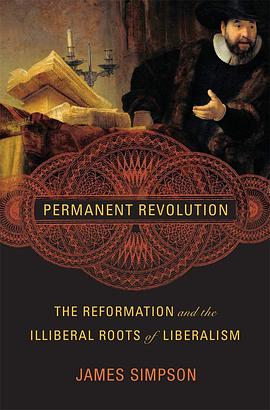
The Reformation and the Illiberal Roots of Liberalism
overview
How did the Reformation, which initially promoted decidedly illiberal positions, end up laying the groundwork for Western liberalism?
The English Reformation began as an evangelical movement driven by an unyielding belief in predestination, intolerance, stringent literalism, political quietism, and destructive iconoclasm. Yet by 1688, this illiberal early modern upheaval would deliver the foundations of liberalism: free will, liberty of conscience, religious toleration, readerly freedom, constitutionalism, and aesthetic liberty. How did a movement with such illiberal beginnings lay the groundwork for the Enlightenment? James Simpson provocatively rewrites the history of liberalism and uncovers its unexpected debt to evangelical religion.
Sixteenth-century Protestantism ushered in a culture of permanent revolution, ceaselessly repudiating its own prior forms. Its rejection of tradition was divisive, violent, and unsustainable. The proto-liberalism of the later seventeenth century emerged as a cultural package designed to stabilize the social chaos brought about by this evangelical revolution. A brilliant assault on many of our deepest assumptions, Permanent Revolution argues that far from being driven by a new strain of secular philosophy, the British Enlightenment is a story of transformation and reversal of the Protestant tradition from within. The gains of liberalism were the unintended results of the violent early Reformation.
Today those gains are increasingly under threat, in part because liberals do not understand their own history. They fail to grasp that liberalism is less the secular opponent of religious fundamentalism than its dissident younger sibling, uncertain how to confront its older evangelical competitor.
contents
Preface
Regnal Dates
Introduction
I. Religion as Revolution
1. Revolutionary Religion
2. Permanently Revolutionary Religion
II. Working Modernity’s Despair
3. Modernizing Despair
4. Modernizing Despair: Narrative and Lyric Entrapment
5. Modernizing Despair’s Epic Non-Escape
III. Sincerity and Hypocrisy
6. Pre-Modern and Henrician Hypocrisy
7. The Revolutionary Hypocrite: Elizabethan Hypocrisy
8. Managing Hypocrisy?: Shakespeare, Milton, Bunyan, 1689
IV. Breaking Idols
9. Liberating Iconoclasm
10. Saving Images and the Calvinist Hammer
11. One Last Iconoclastic Push?
V. Theater, Magic, Sacrament
12. Religion, Dramicide, and the Rise of Magic
13. Enemies of the Revolution: Magic and Theater
14. Last Judgement: Stage Managing the Magic
VI. Managing Scripture
15. Scripture: Institutions, Interpretation, and Violence
16. Private Scriptural Anguish
17. Escaping Literalism’s Trap
VII. Liberty and Liberties
18. Liberty Taking Liberties
Conclusion
Note on Texts and Citations
Abbreviations
Notes
Index