Heritage Languages and their Speakers
豆瓣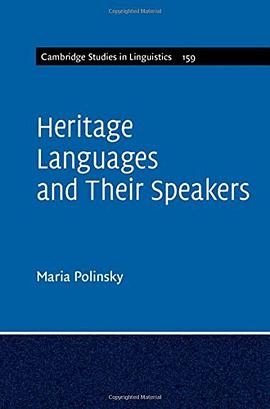
Maria Polinsky
简介
This book provides a pioneering introduction to heritage languages and their speakers, written by one of the founders of this new field. Using examples from a wide range of languages, it covers all the main components of grammar, including phonetics and phonology, morphology and morphosyntax, semantics and pragmatics, and shows easy familiarity with approaches ranging from formal grammar to typology, from sociolinguistics to child language acquisition and other relevant aspects of psycholinguistics. The book offers analysis of resilient and vulnerable domains in heritage languages, with a special emphasis on recurrent structural properties that occur across multiple heritage languages. It is explicit about instances where, based on our current knowledge, we are unable to reach a clear decision on a particular claim or analytical point, and therefore provides a much-needed resource for future research.
‘Maria Polinsky has written a comprehensive and authoritative work that will be an indispensable point of reference for future research on heritage languages. Her book takes a very detailed look at heritage languages, but it never loses sight of a central question for all linguists: what does it mean to be a speaker of a language?'
Grant Goodall - University of California, San Diego
目录
Preface Page xiii
Acknowledgments xix
List of Abbreviations xxi
1 Who Are These Speakers, Where Do They Come From,
and How Did They Get to Be the Way They Are? 1
1.1 Setting the Stage 1
1.2 The Main Players 9
1.2.1 Heritage Language Speakers 9
1.2.2 Baseline Speakers 10
1.2.3 Homeland Speakers 13
1.3 Main Outcomes in Heritage Grammars 17
1.3.1 Transfer from the Dominant Language 18
1.3.2 Attrition 22
1.3.3 Divergent Attainment 24
1.4 Main Sources of Divergence in Heritage Grammars 28
1.4.1 Amount and Type of Input 29
1.4.2 Incipient Changes in the Input 33
1.4.3 Resource Constraints 35
1.4.4 Universal Principles of Language Structure 36
2 Heritage English 38
2.1 Prologue 38
2.2 Heritage English: Historical Records 43
2.3 Heritage English: Current Production Data 46
2.3.1 Some Statistics 47
2.3.2 Changes in Morphology 49
2.3.3 Fillers 50
2.3.4 Verb–Particle Combinations 52
2.3.5 Relative Clauses 58
2.3.6 What They Get Right 60
2.4 Linguistic Properties of Heritage English: Comprehension Data 65
2.4.1 Processing Limitations 66
2.4.2 Beyond Processing Limitations 69
2.5 Summary 73
3 How to Study Heritage Speakers: Observations
on Methodologies and Approaches 76
3.1 General Remarks 76
3.2 Methodological Considerations Specific to Heritage Populations 78
3.2.1 Choice of Production Tasks 78
3.2.2 The Production–Comprehension Divide 86
3.2.3 Use of Grammaticality Judgment Tasks 95
3.3 Assessment Methodologies 101
3.3.1 Biographic and Demographic Questionnaires 102
3.3.2 Linguistic Assessment of Heritage Speakers 105
4 Phonetics and Phonology 114
4.1 “Heritage Accent” 116
4.2 Production in the Heritage Language: Segments 123
4.3 Production in the Dominant Language: Segments 138
4.4 Production: Tone, Stress, and Prosody 147
4.5 Perception: Segmental Phonology 153
4.6 Perception: Tone, Stress, and Prosody 158
4.7 Summary 162
5 Morphology and Morphosyntax 164
5.1 The Fate of Paradigms 165
5.1.1 Salience 165
5.1.2 Overregularization and Overmarking 173
5.1.3 Increased Analyticity 183
5.2 Structural Indeterminacy and Ambiguity 184
5.2.1 Production Data 184
5.2.2 Restructuring of Featural Oppositions 187
5.3 Morphology Encoding Relationships between Two Constituents 197
5.3.1 Case Marking 197
5.3.2 Agreement 204
5.3.3 What About Isolating Languages? 215
5.4 Summary 219
6 Syntax 222
6.1 Some Things Never Change? Parts of Speech 223
6.2 A-Dependencies 230
6.2.1 Unaccusativity 230
6.2.2 Other A-Dependencies 236
6.3 Beyond A-Dependency: Other Valency Alternations 238
6.4 A-Bar Dependencies 241
6.4.1 Relative Clauses: Production 241
6.4.2 Relative Clauses: Comprehension 244
6.4.3 Other A-Bar Dependencies 248
6.5 The Silent Problem 253
6.5.1 Referential Pronouns: General Remarks 253
6.5.2 Referential Pronouns: An Example 260
6.5.3 Bound Variables 261
6.5.4 Ellipsis 263
6.6 Binding 270
6.7 Word Order 273
6.7.1 General Considerations 273
6.7.2 Ignore Morphology, Alter Your Word Order 275
6.7.3 Discontinuous Relationships between Elements
of Structure 277
6.7.4 Germanic Languages in Contact: Changes in V2 281
6.8 Transfer Effects? 286
6.9 Summary 288
7 Semantics and Pragmatics 291
7.1 Lexical Systems and Word Meaning 292
7.2 Propositional Semantics 298
7.2.1 Genericity, Specificity, Definiteness 298
7.2.2 Scope 304
7.3 Information Structure and Pragmatics 310
7.3.1 Topic 310
7.3.2 Focus 316
7.4 Social Pragmatics 323
7.5 Summary 327
8 Heritage Languages and Their Speakers in Unexpected
Places 329
8.1 Preliminary Remarks 329
8.2 Heritage Speakers among Endangered Language Speakers? 333
8.2.1 Biographical Data 333
8.2.2 Structural Signs of Endangerment 334
8.2.3 Variation in Judgments 345
8.3 Coping Strategies 346
Conclusions 349
References 354
General Index 405
Language Index 408