Miłosz
Douban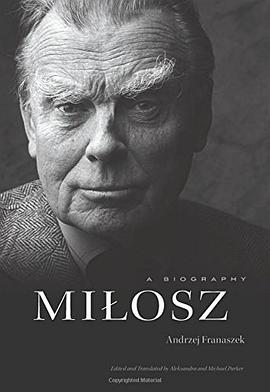
A Biography
Andrzej Franaszek Aleksandra Parker / Michael Parker
overview
Andrzej Franaszek’s award-winning biography of Czeslaw Milosz—the great Polish poet and winner of the Nobel Prize in Literature in 1980—offers a rich portrait of the writer and his troubled century, providing context for a larger appreciation of his work. This English-language edition, translated by Aleksandra Parker and Michael Parker, contains a new introduction by the translators, along with historical explanations, maps, and a chronology.
Franaszek recounts the poet’s personal odyssey through the events that convulsed twentieth-century Europe: World War I, the Bolshevik revolution, the Nazi invasion and occupation of Poland, and the Soviet Union’s postwar dominance of Eastern Europe. He follows the footsteps of a perpetual outsider who spent much of his unsettled life in Lithuania, Poland, and France, where he sought political asylum. From 1960 to 1999, Milosz lived in the United States before returning to Poland, where he died in 2004.
Franaszek traces Milosz’s changing, constantly questioning, often skeptical attitude toward organized religion. In the long term, he concluded that faith performed a positive role, not least as an antidote to the amoral, soulless materialism that afflicts contemporary civilization. Despite years of hardship, alienation, and neglect, Milosz retained a belief in the transformative power of poetry, particularly its capacity to serve as a source of moral resistance and a reservoir of collective hope. Seamus Heaney once said that Milosz’s poetry is irradiated by wisdom. Milosz reveals how that wisdom was tempered by experience even as the poet retained a childlike wonder in a misbegotten world.
contents
Abbreviations
Maps
Partitioned Poland and its neighbours, 1914
Second Polish Republic, 1922, and its neighbours following the Polish–Soviet War
Poland’s new borders, as ratified at Potsdam Conference, August 1945
Introduction by Michael Parker
1. The Garden of Eden, 1911–1920
‘Darkness…split by distant flashes, illuminations’
The Earthly Paradise
Good and Bad Blood
A Grenade under the Bed
2. The Young Man and the Mysteries, 1921–1929
The Apartment with Fig-Plants
Tomcat
Doctor Catchfly
Manichean Poisons
Early Literary Tastes (and Russian Roulette)
Inside the Lodge
The Rushing Heraclitean River
3. Black Ariel, 1930–1934
‘I devote too little time to study’
Egg-Man
The Cezary Baryka Complex
Friday Seminars, Literary Wednesdays
Leviathan’s Wardens
A Bridge Suspended in Mid-Air
The Devil’s See-Saw
‘If early love had lasted…’
‘To the left, to the right’
4. The Country of the First Emigration, 1935–1939
‘A certain student in the city of Paris’
‘The whole cosmos revolves within us’
‘On black meadows’
Publican
‘A handful of unearthly truths’
‘Siena descends into gleams’
‘In my homeland, to which I will not return’
Warsaw Friendships
Janka
Coming Down to Earth
A Blood-Red Star
5. Voices of Poor People, 1939–1945
Medals in the Suitcase
Reflections on the Inferno
The Theory of the Last Złoty
Miranda’s Island
Gniewosz
‘A Poor Christian Looks at the Ghetto’
Noah’s Ark
6. In Partibus Daemonis, 1945–1951
‘We are from Lublin’
Robinson Crusoe from Warsaw
A Pact with the Devil
Mother’s Grave
Rescue
Chochoły
‘A passion for doing something useful’
Open-Source Intelligence
‘We are slaves here!’
Dry Flame
Slaughterhouse
7. A Story of One Particular Suicide Case, 1951–1960
‘And you are a deserter’
Rock Bottom
‘The enemy of order—humankind’
Exorcisms
Daughter of Prophets
‘Beyond tears’
‘Enough of this lethargy and fighting’
‘To be able to earn a living through writing’
Les grands seigneurs
‘To you, sweetheart, I cannot say hello’
Eternal Moment
A Place on Earth
8. The Magic Mountain, 1961–1980
Grizzly Peak
Settling Accounts on Two Fronts
Wilderness
Letters to Oneself
An American in Paris
Second Space
Prisoners of Ulro
‘Perhaps only my reverence will save me’
‘One of the greatest poets of our time, if not the greatest’
Job
9. The Nobel and the Poet’s Later Years, 1980–2004
Remembering the Wounds
‘This crown keeps slipping over my ears’
Heloise
‘I will haunt you with my strange love’
The Dragon
Provinces
‘One bright point’
Chronology
Notes
Bibliography
Acknowledgements
Illustration Credits
Index