Great Masters: Tchaikovsky
豆瓣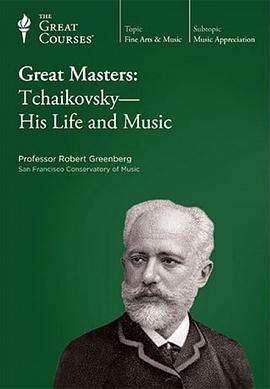
His Life and Music
Robert Greenberg
简介
The life of Peter Ilyich Tchaikovsky (1840–1893) exhibits as close a link as you will find anywhere between an artist's inner world and the outward products of that artist's creative activity.
As a man, Tchaikovsky was defined by and indivisible from his music, which became an outlet for all the shifting moods of his turbulent soul. As Professor Robert Greenberg says, "If Tchaikovsky felt it, it found a way into his music."
As an artist—and it is worth recalling that he was the first full-time, formally trained, professional composer in Russian history—Tchaikovsky walked a fine and difficult line between his Romantic penchant for expression and the demands of Classical structure.
This delicate balancing act—between heart and head, emotion and reason, release and control, Russian expressive content and German technique—is a key to his music that you find amply illustrated by Professor Greenberg's musical selections and commentary.
目录
# Introduction and Early Life (info)
2. A Career in Music
According to Tchaikovsky, Mozart's Don Giovanni was the inspiration for his musical career. After a brief turn as a civil servant, he joined the teaching faculty at the new Moscow Conservatory, and in 1868 his First Symphony was premiered. He was the only composer in Russia at that time with the education, craft, and talent to combine the best of Western European compositional technique with his own Russian heritage.
# A Career in Music (info)
3. The First Masterworks
The Russian nationalist composer Mili Balakirev championed Tchaikovsky's music and suggested the idea for Tchaikovsky's first masterwork, the Overture-Fantasy Romeo and Juliet of 1869. Tchaikovsky's first two symphonies and the iconoclastic First Piano Concerto were written between 1868 and 1872. His success allowed him to acquire his own apartment, freeing him to lead a double life as a homosexual. Yet he feared public exposure in a country that severely punished homosexuality.
# The First Masterworks (info)
4. Maturity
Tchaikovsky took a number of structural liberties with his First Piano Concerto that drew criticism as well as praise. It soon became a favorite throughout Europe and the Americas. Despite his success, Tchaikovsky lacked confidence in his creative abilities and felt alienated by his homosexuality, which may have forced him to turn inward to a world of self-expression. Swan Lake, written in 1876, revolutionized the way ballet depicted mood, dramatic action, and characters in the tragic story.
# Maturity (info)
5. Three Women—Tatyana, Antonina, and Nadezhda
In 1877, Tchaikovsky wrote Eugene Onegin, an opera inspired by Pushkin's tale of unrequited love. In July 1877, he married a former conservatory student, Antonina Milyukova. The marriage was such a disaster that Tchaikovsky would attempt suicide. He separated from her that October. He was then exchanging letters with a wealthy widow, Nadezhda von Meck, who became his patroness and lifeline for the next 14 years.
# Three Women—Tatyana, Antonina, and Nadezhda (info)
6. “My Great Friend”
With the generous financial support of Nadezhda von Meck, Tchaikovsky lived abroad, and in 1878 resigned from the Moscow Conservatory to compose full time. His Fourth Symphony was premiered in Moscow and was quickly followed by the brilliant Violin Concerto in D Major, which became a pillar of the repertoire within a few years.
# “My Great Friend” (info)
7. “A Free Man”
Tchaikovsky's masterwork of 1879–80 is the Serenade for Strings, for which he himself had a special affection. In the 1880s, Tchaikovsky became an international celebrity. He conquered his fear of conducting and promoted his music across Europe. Yet he was still unhappy due to depression and anxiety over public discovery of his homosexuality. In the late 1880s he wrote the Fifth Symphony.
# “A Free Man” (info)
8. The Last Years, or Don't Drink the Water
In 1890, Tchaikovsky lost his patroness, Nadezhda von Meck; she could no longer support him. In 1891, he made a highly successful conducting tour of the United States. He was awarded an honorary doctorate by Cambridge University. In August 1893, he completed his Sixth Symphony. On November 4, 1893, he died of self-inflicted arsenic poisoning. It was publicly announced that he had died of cholera. Tchaikovsky's music endures—a unique marriage of Western European compositional technique and passionate Russian nationalism.
# The Last Years, or Don't Drink the Water (info)