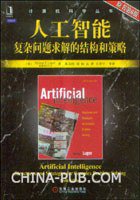
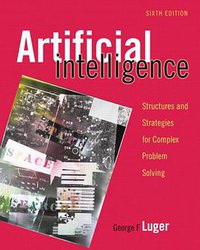
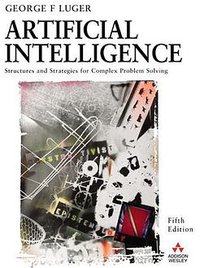
人工智能 复杂问题求解的结构和策略 英文版 第6版
Douban
复杂问题求解的结构和策略
Artificial Intelligence:Structures And Strategies For Complex Problem Solving
卢格尔
overview
《人工智能:复杂问题求解的结构和策略(英文版)(第6版)》英文影印版由PearsonEducationAsiaLtd授权机械工业出版社独家出版。未经出版者书面许可,不得以任何方式复制或抄袭《人工智能:复杂问题求解的结构和策略(英文版)(第6版)》内容。
仅限于中华人民共和国境内(不包括中国香港、澳门特别行政区和中国台湾地区)销售发行。
《人工智能:复杂问题求解的结构和策略(英文版)(第6版)》封面贴有PearsonEducation(培生教育出版集团)激光防伪标签,无标签者不得销售。
contents
Preface
Publisher's Acknowledgements
PART Ⅰ ARTIFIClAL INTELLIGENCE:ITS ROOTS AND SCOPE
1 A1:HISTORY AND APPLICATIONS
1.1 From Eden to ENIAC:Attitudes toward Intelligence,Knowledge,andHuman Artifice
1.2 0verview ofAl Application Areas
1.3 Artificial Intelligence A Summary
1.4 Epilogue and References
1.5 Exercises
PART Ⅱ ARTIFlClAL INTELLIGENCE AS REPRESENTATION AN D SEARCH
2 THE PREDICATE CALCULUS
2.0 Intr0血ction
2.1 The Propositional Calculus
2.2 The Predicate Calculus
2.3 Using Inference Rules to Produce Predicate Calculus Expressions
2.4 Application:A Logic-Based Financial Advisor
2.5 Epilogue and References
2.6 Exercises
3 STRUCTURES AND STRATEGIES FOR STATE SPACE SEARCH
3.0 Introducfion
3.1 GraphTheory
3.2 Strategies for State Space Search
3.3 using the state Space to Represent Reasoning with the Predicate Calculus
3.4 Epilogue and References
3.5 Exercises
4 HEURISTIC SEARCH
4.0 Introduction
4.l Hill Climbing and Dynamic Programmin9
4.2 The Best-First Search Algorithm
4.3 Admissibility,Monotonicity,and Informedness
4.4 Using Heuristics in Games
4.5 Complexity Issues
4.6 Epilogue and References
4.7 Exercises
5 STOCHASTIC METHODS
5.0 Introduction
5.1 The Elements ofCountin9
5.2 Elements ofProbabilityTheory
5.3 Applications ofthe Stochastic Methodology
5.4 Bayes'Theorem
5.5 Epilogue and References
5.6 Exercises
6 coNTROL AND IMPLEMENTATION OF STATE SPACE SEARCH
6.0 Introduction l93
6.1 Recursion.Based Search
6.2 Production Systems
6.3 The Blackboard Architecture for Problem Solvin9
6.4 Epilogue and References
6.5 Exercises
PARTⅢ CAPTURING INTELLIGENCE:THE AI CHALLENGE
7 KNOWLEDGE REPRESENTATION
7.0 Issues in Knowledge Representation
7.1 A BriefHistory ofAI Representational Systems
7.2 Conceptual Graphs:A Network Language
7.3 Alternative Representations and Ontologies
7.4 Agent Based and Distributed Problem Solving
7.5 Epilogue and References
7.6 Exercises
8 STRONG METHOD PROBLEM SOLVING
8.0 Introduction
8.1 Overview ofExpert Sygem Technology
8.2 Rule.Based Expert Sygems
8.3 Model-Based,Case Based and Hybrid Systems
8.4 Planning
8.5 Epilogue and References
8.6 Exercises
9 REASONING IN UNCERTAIN STUATIONS
9.0 Introduction
9.1 Logic-Based Abductive Inference
9.2 Abduction:Alternatives to Logic
9.3 The Stochastic Approach to Uncertainty
9.4 Epilogue and References
9.5 Exercises
PART Ⅳ
MACHINE LEARNING
10 MACHINE LEARNING:SYMBOL-BASED
10.0 Introduction
10.1 A Framework for Symbol based Learning
10.2 version Space Search
10.3 The ID3 Decision Tree Induction Algorithm
10.4 Inductive Bias and Learnability
10.5 Knowledge and Learning
10.6 Unsupervised Learning
10.7 Reinforcement Learning
10.8 Epilogue and Referenees
10.9 Exercises
11 MACHINE LEARNING:CONNECTIONtST
11.0 Introduction
11.1 Foundations for Connectionist Networks
11.2 Perceptron Learning
11.3 Backpropagation Learning
11.4 Competitive Learning
11.5 Hebbian Coincidence Learning
11.6 Attractor Networks or“Memories”
11.7 Epilogue and References
11.8 Exercises 506
12 MACHINE LEARNING:GENETIC AND EMERGENT
12.0 Genetic and Emergent MedeIs ofLearning
12.1 11Ic Genetic Algorithm
12.2 Classifier Systems and Genetic Programming
12.3 Artmcial Life and Society-Based Learning
12.4 EpilogueandReferences
12.5 Exercises
13 MACHINE LEARNING:PROBABILISTIC
13.0 Stochastic andDynamicModelsofLearning
13.1 Hidden Markov Models(HMMs)
13.2 DynamicBayesianNetworksandLearning
13.3 Stochastic Extensions to Reinforcement Learning
13.4 EpilogueandReferences
13.5 Exercises
PART Ⅴ
AD,ANCED TOPlCS FOR Al PROBLEM SOLVING
14 AUTOMATED REASONING
14.0 Introduction to Weak Methods inTheorem Proving
14.1 TIIeGeneralProblem SolverandDifiel"enceTables
14.2 Resolution TheOrem Proving
14.3 PROLOG and Automated Reasoning
14.4 Further Issues in Automated Reasoning
14.5 EpilogueandReferences
14.6 Exercises
15 UNDERs-rANDING NATURAL LANGUAGE
15.0 TheNaturalLang~~geUnderstandingProblem
15.1 Deconstructing Language:An Analysis
15.2 Syntax
15.3 TransitionNetworkParsers and Semantics
15.4 StochasticTools forLanguage Understanding
15.5 Natural LanguageApplications
15.6 Epilogue and References
15.7 Exercises
……
PART Ⅵ EPILOGUE
16 ARTIFICIAL INTELLIGENCE AS EMPIRICAL ENQUIRY