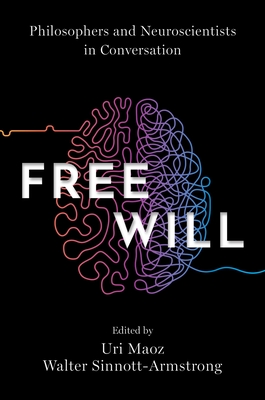
Philosophers and Neuroscientists in Conversation
Uri Maoz / Walter Sinnott-Armstrong
简介
What is free will? Can it exist in a determined universe? How can we determine who, if anyone, possesses it? Philosophers have debated the extent of human free will for millennia. In recent decades neuroscientists have joined the fray with questions of their own. Which neural mechanisms could
enable conscious control of action? What are intentional actions? Do contemporary developments in neuroscience rule out free will or, instead, illuminate how it works? Over the past few years, neuroscientists and philosophers have increasingly come to understand that both fields can make substantive
contributions to the free-will debate, so working together is the best path forward to understanding whether, when, and how our choices might be free
This book contains thirty bidirectional exchanges between neuroscientists and philosophers that focus on the most critical questions in the neurophilosophy of free will. It mimics a lively, interdisciplinary conference, where experts answer questions and follow-up questions from the other field,
helping each discipline to understand how the other thinks and works. Each chapter is concise and accessible to non-experts-free from disciplinary jargon and highly technical details-but also employs thorough and up-to-date research from experts in the field. The resulting collection should be
useful to anyone who wants to get up to speed on the most fundamental issues in the rising field of the neurophilosophy of free will. It will interest experts from philosophy or neuroscience who want to learn about the other discipline, students in courses on a host of related topics, and lay
readers who are fascinated by these profound issues.
目录
<Part I. Questions from neuroscientists for philosophers. >
-Section I. Questions about will.
What is an intention? / Gideon Yaffe --
What is a will? / Pamela Hieronymi --
When is an action voluntary? / Pamela Hieronymi --
-Section II. Questions about freedom.
What is freedom? / Walter Sinnott-Armstrong --
What is free will? / Timothy O'Connor --
Can there be free will in a determined universe? / Timothy O'Connor --
Does free will come in degrees? / Jonathan Hall and Tillmann Vierkant --
-Section III. Questions about scientific evidence.
How can we determine whether or not we have free will? / Alfred R. Mele --
What kind of neuroscientific evidence, if any, could determine whether anyone has free will? / Adina L. Roskies --
What kind of behavioral experiments, if any, could determine whether anyone has free will? / Tim Bayne --
Can a robot with artificial intelligence have free will? / Jonathan Hall and Tillmann Vierkant --
-Section IV. Questions about consciousness.
Do conscious decisions cause physical actions? / Ned Block --
How is consciousness related to freedom of action or will? / Tim Bayne --
-Section V. Questions about responsibility and reasons-responsiveness.
How is responsibility related to free will, control, and action? / Gideon Yaffe --
What are reasons? / Walter Sinnott-Armstrong --
<Part II. Questions from philosophers for neuroscientists. >
-Section I. Questions about will.
What are the main stages in the neural processes that produce actions? / Patrick Haggard and Elisabeth Parés-Pujolràs --
Does the will correspond to any clearly delineated brain area or activity? / Gabriel Kreiman --
How are the neural processes for deciding when to move similar to and different from those for deciding what or how to move? / Antonio Ivano Triggiani and Mark Hallett --
How are arbitrary and deliberate decisions similar and different? / Jye lyn Bold, Liad Mudrik, and Uri Maoz --
How do higher-level brain areas exert control over lower-level brain areas? / Mark Hallett --
-Section II. Questions about intention.
What are intentions and intentional actions? / Elisabeth Parés-Pujolràs and Patrick Haggard --
What evidence is there that intentions are represented in the brain? / John-Dylan Haynes --
What is known about the neural correlates of specific beliefs and desires that inform human choices? / Amber Hopkins and Uri Maoz --
-Section III. Questions about consciousness.
How can we determine whether or not an agent is conscious of a bit of information relevant to an action? / Liad Mudrik and Aaron Schurger --
Which neural mechanisms could enable conscious control of action? / Jake Gavenas, Mark Hallett, and Uri Maoz --
How does the absence of a consensus about the neural basis of consciousness and volition affect theorizing about conscious volition? / Amber Hopkins, Liad Mudrik, and Uri Maoz --
-Section IV. Questions about neuroscience methods.
How can we determine the precise timing of brain events related to action? / Mark Hallett and Aaron Schurger --
How can we determine the precise timing of mental events related to action? / Sae Jin Lee, Sook Mun (Alice) Wong, Uri Maoz, and Mark Hallett --
Are any neural processes truly random (or stochastic)? / Hans Liljenström --
How can computational models help us understand free will? / Gabriel Kreiman, Hans Liljenström, Aaron Schurger, and Uri Maoz.