Handbook of Bilingualism
豆瓣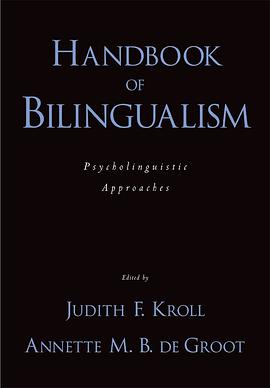
Psycholinguistic Approaches
Eds. Judith F. Kroll / Annette M. B. De Groot
简介
Until recently, cognitive science virtually ignored the fact that most people of the world are bilingual. During the past ten years this situation has changed markedly. There is now an appreciation that learning and using more than one language is the more natural circumstance of cognition. As a result, there is a wealth of new research on second-language learning and bilingualism that provides not only crucial evidence for the universality of cognitive principles, but also an important tool for revealing constraints within the cognitive architecture.
In this volume, Judith Kroll and Annette de Groot have brought together the scientists at the forefront of research on second-language learning and bilingualism to present chapters that, rather than focusing simply on their own research, provide the first comprehensive overviews of this emerging field. Bilingualism provides a lens through which each of the central questions about language and cognition can be viewed. The five sections of this book focus on different facets of those questions: How is language acquired when infants are exposed to multiple-language input from birth, and how is it acquired when adults are required to learn a second language after early childhood? How do adult bilinguals comprehend and produce words and sentences when their two languages are potentially always active and in competition with one another? What are the neural mechanisms that underlie proficient bilingualism? What are the general consequences of bilingualism for cognition and for language and thought? This handbook will be essential reading for cognitive psychologists, linguists, applied linguists, and educators who wish to better understand the cognitive basis of bilingualism and the logic of experimental and formal approaches to language science.
Without a doubt, this book will become the primary textbook for graduate courses in psycholinguistics. It is likely to end up on the required reading list for most active researchers with an interest in psycholinguistics specifically and in cognitive science in general. (PsycCritiques)
This volume presents a thorough coverage of the entire field of psycholinguistic research on bilingualism, from lexical access to functional neuroimaging. All the articles are by experts in their area and were written expressly for this volume. It is hard to imagine a better or more useful contribution to the field. (Kenneth I. Forster, Professor of Psychology, University of Arizona)
This very first handbook on bilingualism will be an indispensable beacon and a source of inspiration for all students of the bilingual mind. The editors created a transparent and coherent framework for the worlds experts to review the booming psycholinguistics and cognitive neuroscience of bilingual acquisition, comprehension and production. (Willem J. M. Levelt, Director of the Max Planck Institute for Psycholinguistics)
The Handbook of Bilingualism is essential reading for anyone interested in questions about learning and using a second language. It addresses all the classic questions and raises new ones that have begun to be answered with new methods of brain imaging. The editors of this handbook are both outstanding investigators, and the 26 chapters provide a comprehensive review of theories and experimental studies of bilingualism. The book is beautifully written, in many cases in an authors second language. As islands of monolingualism such as those in parts of the United States increasingly give way to the bilingualism and multilingualism of most people in the world, a scientific understanding of the nature of bilingualism and the ways a second language is acquired becomes even more important. This handbook is a comprehensive resource for that enterprise. I recommend it with the greatest enthusiasm. (Mary C. Potter, Professor of Psychology, MIT)
Kroll and de Groot have been two of the most prolific and influential researchers in the psycholinguistic investigation of bilingualism. In this book, they have brought together a truly impressive group of researchers. As the editors note, studies of bilingualism from a cognitive-science perspective have exploded in the last decade, as scientists have come to appreciate how normal bilingual language use is. Thus, the cutting-edge work presented in this collection should be of great interest to anyone who is looking for a better understanding of human language, and of cognition more broadly. (Arthur Samuel, Professor of Psychology, SUNY Stony Brook)
"well-done" - Vivian Cook, Language vol. 84, no. 1, 2008
目录
Part 1: Acquisition
1: The learning of foreign language vocabulary
Syntax
2: Early bilingual acquisition: Focus on morphosyntax and the separate development hypothesis
3: A unified model of language development
4: Phonology and bilingualism
Biological bases
5: What does the critical period really mean?
6: Interpreting age effects in second language acquisition
7: Processing constraints on L1 transfer
8: Models of monolingual and bilingual language acquisiton
Part 2: Comprehension
9: Bilingual visual word recognition and lexical access
10: Computational models of bilingual comprehension
11: The representation of cognate and noncognate words in bilingual memory: Can cognate status be characterized as a special kind of morphological relation?
12: Bilingual semantic and conceptual representation
13: Ambiguities and anomalies: What can eye-movements and event-related potentials reveal about second language sentence processing
Part 3: Production and Control
14: Selection processes in monolingual and bilingual lexical access
15: Lexical access in bilingual production
16: Supporting a differential access hypothesis: Codeswitching and other contact data
17: Language selection in bilinguals: Mechanisms and processes
18: Automatically in bilingualism and second language learning
19: Being and becoming bilingual: Individual differences and consequences for language production
Part 4: Aspects and Implications of Bilingualism
Cognitive consequences
20: Consequences of bilingualism for cognitive development
21: Bilingualism and thought
22: Simultaneous interpreting: A cognitive perspective
Cognitive neuroscience approaches
23: Clearing the cobwebs from the study of the bilingual brain: Converging evidence from laterality and electrophysiological research
24: What can functional neuroimaging tell us about the bilingual brain?
25: The neurocognition of recovery patterns in bilingual aphasics
26: Models of bilingual representation and processing: Looking back and to the future