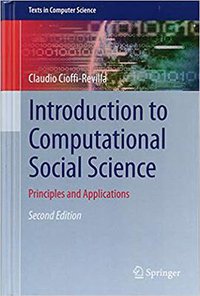
Introduction to Computational Social Science
Douban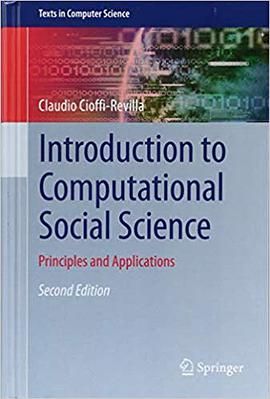
Principles and Applications(2nd ed. 2017 Edition)
Claudio Cioffi-Revilla
overview
This textbook provides a comprehensive and reader-friendly introduction to the field of computational social science (CSS). Presenting a unified treatment, the text examines in detail the four key methodological approaches of automated social information extraction, social network analysis, social complexity theory, and social simulation modeling. This updated new edition has been enhanced with numerous review questions and exercises to test what has been learned, deepen understanding through problem-solving, and to practice writing code to implement ideas. Topics and features: contains more than a thousand questions and exercises, together with a list of acronyms and a glossary; examines the similarities and differences between computers and social systems; presents a focus on automated information extraction; discusses the measurement, scientific laws, and generative theories of social complexity in CSS; reviews the methodology of social simulations, covering both variable- and object-oriented models.
This indispensable textbook/reference provides a comprehensive and reader-friendly introduction to the emerging field of computational social science (CSS). Presenting a unified treatment, the text examines in detail the four key methodological approaches of automated social information extraction, social network analysis, social complexity theory, and social simulation modeling. This updated and expanded new edition has been enhanced with numerous review questions and exercises to test what has been learned, deepen understanding through problem-solving, and to practice writing code to implement ideas and further explore the concepts.
Topics and features:
Contains more than a thousand problem questions and exercises, together with a list of acronyms and a glossary of terms
Presents an introduction to the main areas, core concepts, and historical development of CSS, providing examples of a range of CSS investigations
Examines the key similarities and differences between computers and social systems, from an information-processing perspective
Presents a focus on automated information extraction, beginning with its roots in linguistics
Introduces the fundamental elements of social network analysis, and computational approaches to analyzing social complexity
Discusses the measurement, scientific laws, and generative theories of social complexity in CSS
Reviews the methodology of social simulations, covering in detail both variable-oriented and object-oriented models
This unique, clearly-written textbook is essential reading for graduate and advanced undergraduate students planning on embarking on a course on computational social science, or wishing to refresh their knowledge of the fundamental aspects of this exciting field.
“This book is organized in a rigorous manner: each chapter includes an introductory abstract, a short chronology of the main achievements related to the chapter’s topic, well-balanced formalized-intuitive knowledge content, a significant number of questions … and finally a list of future readings. … I think Claudio Cioffi-Revilla’s work hits its assumed target: to be an affordable textbook for students and, at the same time, a useful support manual for instructors interested in learning or teaching computational social science.” (Valentin V. Inceu, Computing Reviews, February, 2019)