Gilbert Simondon's Psychic and Collective Individuation
Douban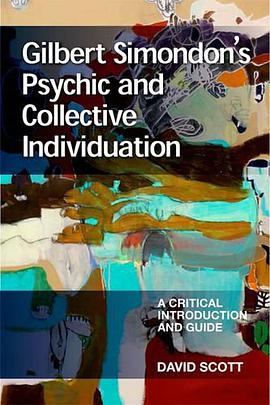
A Critical Introduction and Guide
overview
This is the first critical commentary on Simondon's seminal work, unpacking its rich potential for students and scholars. One of the most innovative and brilliant philosophers of his generation, but largely neglected until he was brought to public attention by Gilles Deleuze, Gilbert Simondon presents a challenge to nearly every category and method of traditional philosophy. Simondon's 1989 book Psychic and Collective Individuation is undoubtedly his most important work and its influence, clearly felt in Stiegler and DeLanda, has continued to grow. This first critical textbook to Psychic and Collective Individuation will both guide new readers through the text and inspire future research. It introduces Simondon's challenging text by clarifying its complex terminology and structure through a chapter-by-chapter commentary. It invites a dialogue with thinkers like Bergson, Deleuze, Heidegger, Sartre, Merleau-Ponty and Negri. It presents the historical context as well as directs you to those aspects that claim its relevance in current discussions on the biopolitical and speculative materialism.
Review
"The English-speaking public is still waiting for a full translation of [Gilbert Simondon's] Psychic and Collective Individuation (L'individuation psychique et collective). As a foretaste, however, Edinburgh University Press has published David Scott's book, which serves as an introduction and a guide, providing a chapter-by-chapter commentary on Simondon's important work. As Scott follows the structure of Simondon's work very closely, this book will be useful for a parallel reading with Psychic and Collective Individuation ... Scott positions Simondon well in his intellectual and historical context, including a description of his philosophical trajectories ... At the end of the book, Scott suggests possible topics for further research, which could also be very useful for advanced students looking for possible lines of convergence in their research."--Iwona Janicka, University of Cambridge, Notre Dame Philosophical Reviews