Writing and Materiality in China
豆瓣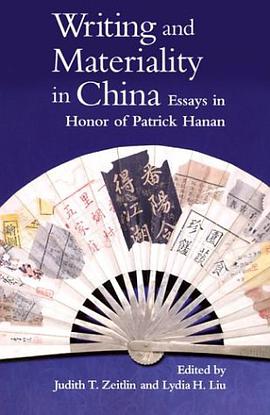
Essays in Honor of Patrick Hanan
Judith Zeitlin / Lydia H. Liu
简介
Speaking about Chinese writing entails thinking about how writing speaks through various media. In the guises of the written character and its imprints, traces, or ruins, writing is more than textuality. The goal of this volume is to consider the relationship of writing to materiality in China's literary history and to ponder the physical aspects of the production and circulation of writing. To speak of the thing-ness of writing is to understand it as a thing in constant motion, transported from one place or time to another, one genre or medium to another, one person or public to another.
Thinking about writing as the material product of a culture shifts the emphasis from the author as the creator and ultimate arbiter of a text's meaning to the editors, publishers, collectors, and readers through whose hands a text is reshaped, disseminated, and given new meanings. By yoking writing and materiality, the contributors to this volume aim to bypass the tendency to oppose form and content, words and things, documents and artifacts, to rethink key issues in the interpretation of Chinese literary and visual culture.
目录
Illustrations
Preface [Ellen Widmer]
Contributors
Introduction [Lydia H. Liu and Judith T. Zeitlin]
I. The Circulation of Writing
1. On Rubbings: Their Materiality and Historicity [Wu Hung]
2. Disappearing Verses: Writing on Walls and Anxieties of Loss [Judith T. Zeitlin]
3. The Literary Consumption of Actors in Seventeenth-Century China [Sophie Volpp]
II. Print Culture and Networks of Reading
4. Jin Ping Mei and Late Ming Print Culture [Shang Wei]
5. Duplicating the Strength of Feeling: The Circulation of Qingshu in the Late Ming [Kathryn Lowry]
6. Considering a Coincidence: The “Female Reading Public” circa 1828 [Ellen Widmer]
III. The Late Qing Periodical Press: New Images, New Fiction
7. The New Novel Before the New Novel: John Fryer’s Fiction Contest [Anonymous]
8. The Weird in the Newspaper [Rania Huntington]
9. Creating the Urban Beauty: The Shanghai Courtesan in Late Qing Illustrations [Catherine Vance Yeh]
IV. Ethnography, Media, and Ideology
10. Texts on the Right and Pictures on the Left: Reading the Qing Record of Frontier Taiwan [Emma J. Teng]
11. Tope and Topos: The Leifeng Pagoda and the Discourse of the Demonic [Eugene Y. Wang]
12. A Folksong Immortal and Official Popular Culture in Twentieth-Century China [Lydia H. Liu]
Reference Matter
Index