Brian May — Author (6)
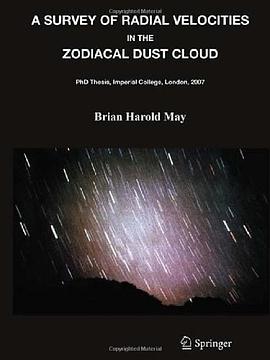
A Survey of Radial Velocities in the Zodiacal Dust Cloud [Book] Douban
The Zodiacal Light, that misty diffuse cone of light seen in the West after Sunset and the East before Sunrise, is a beautiful and intriguing phenomenon. Even though everyone can enjoy the sight from a suitably dark location, it is poorly understood, and has been the subject of relatively little research. Brian May began his research into the subject in 1970, and was finally awarded his PhD in 2007, after a hiatus of more than 30 years pursuing his other career as guitarist with his rock band Queen. This book is Brian s thesis, and as such presents the results of his research for astronomers. This thesis documents the building of a pressure-scanned Fabry-Perot Spectrometer, equipped with a photomultiplier and pulse-counting electronics, and its deployment at the Observatorio del Teide at Izana in Tenerife, at an altitude of 7,700 feet (2,567 m), to record high-resolution spectra of the Zodiacal Light. The aim was to achieve the first systematic mapping of the Magnesium I (MgI) absorption line in the night sky. More than 250 scans of both morning and evening Zodiacal Light were obtained, in two observing periods in 1971 and 1972. The scans showed profiles modified by various Doppler-shifted components with respect to the unshifted shape seen in daylight. The set of spectra obtained is compared with predictions made from a number of different models of a dust cloud, assuming various distributions of dust density as a function of position and particle size, and differing assumptions about their speed and direction. The observations fit predominantly prograde models fairly well, but show a morning-evening asymmetry, different in the two observing periods. Models are investigated containing various components, including prograde and retrograde orbiting dust around the Sun, a drift of interstellar material though the Solar System, and light from distant emitting matter. The implications for possible asymmetries of the Zodiacal Cloud are discussed. Other researches on the Zodiacal Dust Cloud are reviewed, including recent insights into its structure, orientation, and evolution. Brian s observations are evaluated in this context.
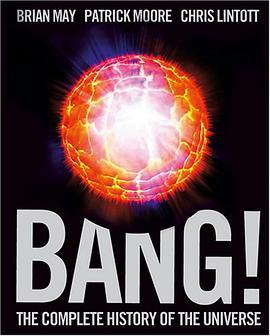
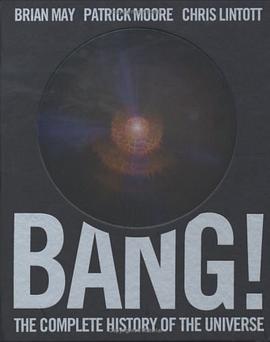
Bang! [Book] Douban
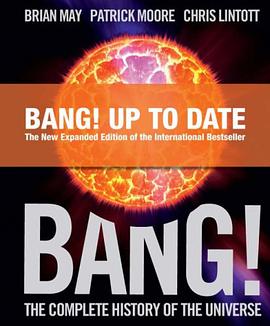
Who knows what Brian May was thinking when he wrote "We Will Rock You" for Queen? As a lifelong astrophysics aficionado, he may have been thinking about the origins of the universe. He's certainly been thinking about it lately. May, a freshly minted astrophysics Ph.D., joins forces with legendary astronomer Patrick Moore and astrophysicist Chris Lintott in Bang to consider the history of the universe from the Big Bang to Heat Death.Space, time, and matter were birthed 13.7 billion years ago and will continue on longer than we are able to comprehend. Infinitesimally small at first, the Universe is immense and ever expanding. Bang explains how it all started, takes you on a tour of what is known about the evolution of the Universe, and posits how the end of time will come about. This fascinating book includes photographs, short biographies of key figures, an at-a-glance timeline, a glossary of terms, and suggested resources for further exploration. Based on the work of history's most brilliant scientific minds, this amazing story features clear, straightforward discussions of the most perplexing and compelling aspects of existence -- from the formation of stars, planets, and other galactic bodies to black holes, quasars, anti-matter, and dark matter to the emergence of life and the possibility that it could exist elsewhere.Pick up a copy of Bang It will, it will rock you.
大爆炸 [Book] Douban
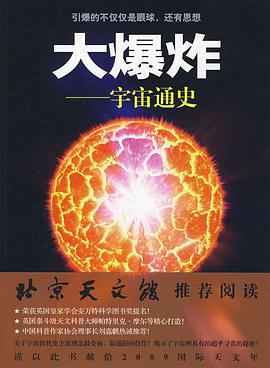
《大爆炸:宇宙通史》:像听故事一样了解宇宙演化史!一百年前,我们甚至不知道银河系的存在,而今天我们已经知道宇宙大约起源于137亿年前,它由数以十亿的星系组成;一百年前,我们还无从判断宇宙中是否有其他类似太阳系的行星系统,而现在我们已经找到了200多颗围绕银河系其他恒星旋转的行星,并且在探索生命起源的征途中,我们正不断的向前迈进;一百年前,我们还只能用光学望远镜和照相干板研究天空,而现在我们采用最尖端的科技,从射电波段到伽马射线,从地面和空间来观测宇宙。为什么会选择“大爆炸”这个题目?为什么背景截然不同的三个人会聚集到一起,满怀热情地花费两年时间,反复推敲,完成了这部关于“大爆炸”的著作?因为他们相信,每一个聪慧而好奇的人都应有机会听到它——这个用一种通俗易懂的语言来讲述的奇异故事。这就是“宇宙通史”——其中的理论只是在最近才开始被人们所接受。这是一场“大爆炸”!空间、时间、物质以至宇宙都诞生在137亿年前。从这个不可思议的渺小的起始,以令人难以置信的速度膨胀着。布赖恩•梅、帕特里克•摩尔和克里斯•林陶特一起解释了这一切是如何发生的:从空间和时间开始存在的那一刻,到第一批恒星、星系和行星的形成,以及人类演化到能够反省自身的来历和归宿;在此之后,直到无限遥远的未来,那时地球早已被变成红巨星的太阳所吞没。这个故事是用清晰而直截了当的词语讲述的,严格按照事件发生的顺序,没有用到晦涩的数学。“大爆炸”是一个引人入胜的故事。这是一部虚构的小说吗?作者们希望不是,因为它是建立在像阿尔伯特•爱因斯坦、斯蒂芬•霍金这样的伟大科学家们毕生的研究工作的基础上,其中也包含着我们这个地球成千上万个杰出头脑的贡献。
一起来欣赏这个故事,并让你的想象飞翔吧!
一起来欣赏这个故事,并让你的想象飞翔吧!