Yunxiang Yan — 作者 (2)
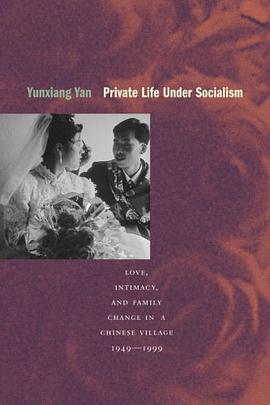
Private Life under Socialism [图书] 豆瓣 Goodreads
作者: Yunxiang Yan publishing house: Stanford University Press 2003 - 3 其它标题: Private Life under Socialism: Love, Intimacy, and Family Change in a Chinese Village, 1949-1999
For seven years in the 1970s, the author lived in a village in northeast China as an ordinary farmer. In 1989, he returned to the village as an anthropologist to begin the unparalleled span of eleven years’ fieldwork that has resulted in this book―a comprehensive, vivid, and nuanced account of family change and the transformation of private life in rural China from 1949 to 1999. The author’s focus on the personal and the emotional sets this book apart from most studies of the Chinese family. Yan explores private lives to examine areas of family life that have been largely overlooked, such as emotion, desire, intimacy, privacy, conjugality, and individuality. He concludes that the past five decades have witnessed a dual transformation of private life: the rise of the private family, within which the private lives of individual women and men are thriving.
The Flow of Gifts [图书] 豆瓣 Goodreads
作者: Yunxiang Yan publishing house: Stanford University Press 1996 - 5 其它标题: The Flow of Gifts: Reciprocity and Social Networks in a Chinese Village
Gift-giving is a classic topic in anthropology, where on-going debates involve the principle of reciprocity, the spirit of the gift, and the relationship between gifts and commodities. In this study, the author examines the gift-giving and related social activities that pervade daily life in China, focusing on routine activities - visits between relatives, exchanges of food and labour between neighbours, gift-giving between friends - while not ignoring such special occasions as weddings and funerals. He constructs a classification of exchange behaviour in village society, examining the items of presentation, the types of gift-giving activities, and the hierarchical arrangement of givers and receivers. He also presents new interpretations of key concepts involved in Chinese gift-giving: guanxi (social networks), renqing (norms of interpersonal behaviour), mianzi (face), and bao (reciprocity). The book concludes by showing how the village gift economy has adjusted and survived in response to the radical social changes engendered by four decades of socialism.