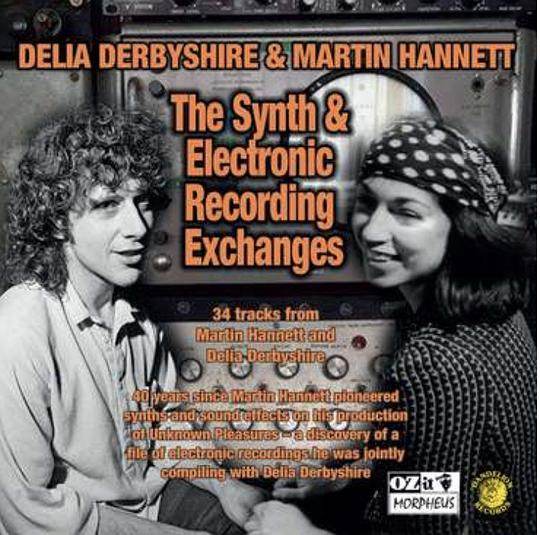
Delia Derbyshire was born in Coventry, England, in 1937. Educated at Coventry Grammar School and Girton College, Cambridge, where she was awarded a degree in mathematics and music.
In 1959, on approaching Decca records, Delia was told that the company DID NOT employ women in their recording studios, so she went to work for the UN in Geneva before returning to London to work for music publishers Boosey & Hawkes.
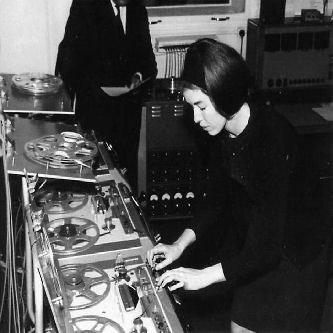
In 1960 Delia joined the BBC as a trainee studio manager. She excelled in this field, but when it became apparent that the fledgling Radiophonic Workshop was under the same operational umbrella, she asked for an attachment there - an unheard of request, but one which was, nonetheless,granted. Delia remained 'temporarily attached' for years, regularly deputising for the Head, and influencing many of her trainee colleagues.
To begin with Delia thought she had found her own private paradise where she could combine her interests in the theory and perception of sound; modes and tunings, and the communication of moods using purely electronic sources. Within a matter of months she had created her recording of Ron Grainer's Doctor Who theme, one of the most famous and instantly recognisable TV themes ever. On first hearing it Grainer was tickled pink: "Did I really write this?" he asked. "Most of it," replied Derbyshire.
Thus began what is still referred to as the Golden Age of the Radiophonic Workshop. Initially set up as a service department for Radio Drama, it had always been run by someone with a drama background. Derbyshire was the first person there with any higher music qualifications, but as she wasn't supposed to be doing music, much of her early work remained anonymous under the umbrella credit 'special sound by BBC Radiophonic Workshop'.
Before long the Workshop's TV output had overtaken work produced specifically for radio broadcast. Derbyshire was called upon to do music for drama and documentary programmes set in the distant past, the unseen future or deep in the human psyche - in fact any area where an orchestra would be out of place. Science, arts and educational programmes also benefited from her abstract style. Her work with Barry Bermange on the four Inventions for Radio is perhaps the best illustration of Delia's intuitive way with soundscaping.
Derbyshire soon gained a reputation for successfully tackling the impossible. When asked to "make some TV title music using only animal sounds" - much thought and ingenuity resulted in Great Zoos of the World. Delia always managed to soften her purist mathematical approach with a sensitive interpretative touch - 'very sexy' said Michael Bakewell on first hearing her electronic music for Cyprian Queen.
Radiophonic Workshop, Maida Vale
Derbyshire also worked with the composers Sir Peter Maxwell Davies, Roberto Gerhard (on his 1965 Prix Italia winning 'Anger of Achilles'), and Ianni Christou, doing sound treatments of their orchestral music. She was also assistant to Luciano Berio at the 1962 Dartington summer school.
On being told at the Workshop that her music was 'too lascivious for 11 year olds' and 'too sophisticated for the BBC2 audience', Delia found other fields where the directors were less inhibited - film, theatre, 'happenings' and original electronic music events, as well as pop music and avant garde psychedelia. To do this she encouraged the establishment of Unit Delta Plus, Kaleidophon and Electrophon, private electronic music studios where she worked with Peter Zinovieff [composer and inventor], David Vorhaus and Brian Hodgson.
Delia's works from the 60s and 70s continue to be used on radio and TV some 30 years later, and her music has given her legendary status with releases in Sweden and Japan. She is also constantly mentioned, credited and covered by bands from Add n to (x) and Sonic Boom to Aphex Twin and The Chemical Brothers.
A recent Guardian article called her 'the unsung heroine of British electronic music', probably because of the way her infectious enthusiasm subtly cross-pollinated the minds of many creative people. She had exploratory encounters with Paul McCartney, Karlheinz Stockhausen, George Martin, Pink Floyd, Brian Jones, Anthony Newley, Ringo Starr and Harry Nilsson.
------
Delia believed that the way the ear / brain perceives sound should have dominance over any basic mathematical theory, but as with most things in life it is important to know the rules in order to advantageously bend or break them.
A complete list of her works has yet to be compiled, but amongst other things she has mentioned doing: Special works and soundtracks for the Brighton Festival, the City of London Festival, Yoko Ono's "Wrapping Event", the award winning "Circle of Light", music for Peter Hall's "Work is a 4 Letter Word" starring Cilla Black, The White Noise LP "An Electric Storm", special sound and music for plays at the RSC Stratford, Greenwich Theatre, Hampstead Theatre and the Chalk Farm Roundhouse.
Derbyshire was also involved in several of the earliest electronic music events in England, including shows at the Watermill Theatre, Nr Newbury, the Chalk Farm Roundhouse [with Paul McCartney], The Royal Festival Hall and the first electronic music fashion show!
Work from Delia's engagement at the BBC has also been published on numerous Radiophonic Workshop and Doctor Who LPs and CDs.
By the mid 1970s Derbyshire was disillusioned by the apparent future of electronic music and withdrew from the medium. In the musical dark ages to follow, she worked in a bookshop, an art gallery and a museum. In the mid 90s she noticed a change in the air and became aware of a return to the musical values she held so dear.
Delia passed away in Northampton, England, on July 3rd 2001.
Shortly before Delia died, she wrote the following: "Working with people like Sonic Boom on pure electronic music has re-invigorated me. He is from a later generation but has always had an affinity with the music of the 60s. One of our first points of contact - the visionary work of Peter Zinovieff, has touched us both, and has been an inspiration. Now without the constraints of doing 'applied music', my mind can fly free and pick-up where I left off."