埃德温·鲍特 — 导演 (29)
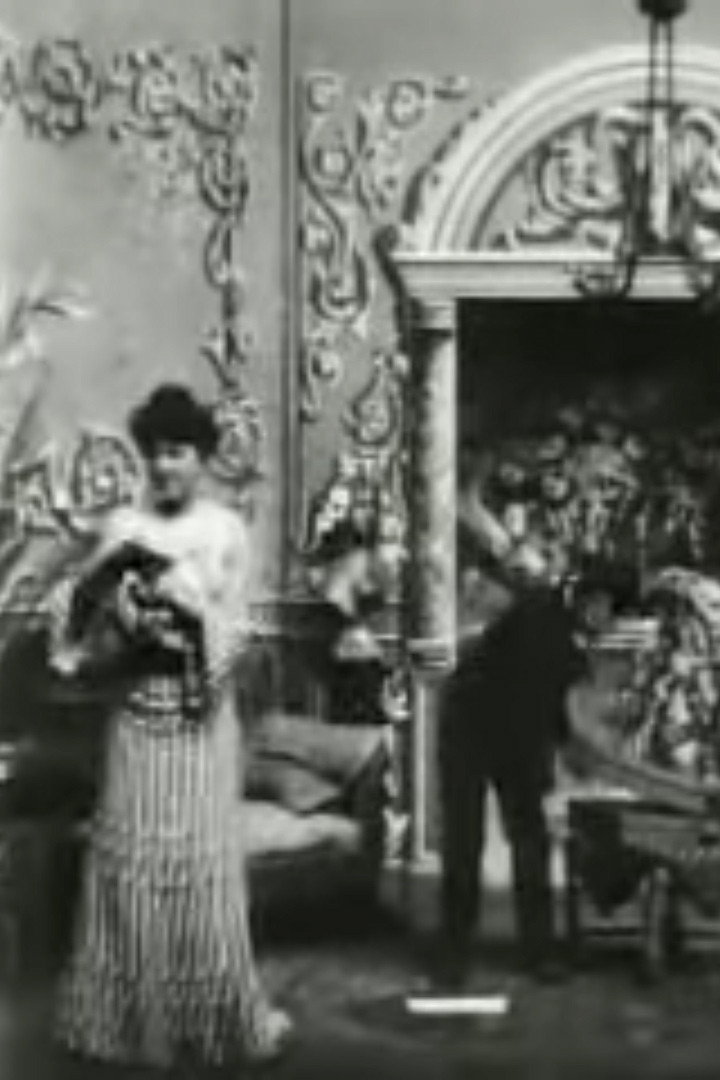
Faust and Marguerite (1900) [电影] TMDB IMDb 维基数据
Faust and Marguerite
导演: Edwin S. Porter
Marguerite is seated in front of the fireplace, Faust standing by her side. Mephistopheles enters and offers his sword to Faust, commanding him to behead the fair Marguerite. Faust refuses, whereupon Mephistopheles draws the sword across the throat of the lady and she suddenly disappears and Faust is seated in her place.
Three American Beauties (1906) [电影] 豆瓣 IMDb
Three American Beauties
导演: 埃德温·鲍特 演员: Blanche Dayo
In this color-tinted short, we first see a close-up of a red rose, perfectly formed. Then, we see the rose held by a young woman who is wearing a bright yellow dress. She's the second beauty. Behind her is a slow dissolve to the US flag, tinted in red, white, and blue, blowing in the wind. Behind the flag is a star-lit sky.
艺术家的困境 (1901) [电影] 豆瓣 IMDb
The Artist's Dilemma
其它标题: The Artist's Dilemma / The Artist's Dilemma; or, What He Saw in a Nightmare
In the artist's studio, he asleep in his chair. A large old fashioned clock opens and a young lady comes out and awaking the artist, requests him to paint her picture. While the artist is executing the work a clown comes from the clock, takes in the situation and begins to make love to the lady. The artist detects him and compels him to desist his love making. He continues to paint. The clown becomes interested and asks the artist to allow him to paint the picture, and begins smearing a whitewash brush over the canvas, and a most perfect image of the young lady appears. The image then steps down from the frame, joins the young lady in the studio, and the figures, each a perfect counterpart of the other begin to dance to the great astonishment of the artist. The clown waves his hand causing the figures of the two girls to merge into one. The artist then assumes his seat and awakens in shock. The film was a Vitagraph production, but later acquired and copyrighted by the Edison Company.
A Romance of the Rail (1903) [电影] 豆瓣 IMDb TMDB
A Romance of the Rail
导演: Edwin S. Porter 演员: Marie Murray
其它标题: 邮递员的罗曼史
An engaged couple, dressed in white, meet each other at a train station. When the train arrives, they board, and later they enjoy the sights from their car's platform. They are married by a minister and soon, arrive at their destination.
Circular Panorama of Electric Tower (1901) [电影] 维基数据 IMDb TMDB
Circular Panorama of Electric Tower
导演: Edwin S. Porter
其它标题: Circular Panorama of the Electric Tower and Pond
A most interesting picture at the Pan-American Exposition. The picture was taken from the north side of the Electric Tower. It presents the most perfect and diversified views of the Transportation Building, Mexican Plaza, the Stadium and the north side of the Electric Tower. (Edison Catalog, 1902)
Terrible Teddy, the Grizzly King (1901) [电影] 维基数据 IMDb TMDB
Terrible Teddy, the Grizzly King
导演: Edwin S. Porter
Our presidential hunter runs across the landscape and falls down in the snow, gets up with his rifle, and gazes upward at a treed animal which isn't in the camera's view. He fires a shot into the tree, then leaps on the ground to grab the fallen prey, a domestic cat, finishing it off with wild blows of his hunting knife while his companions, a photographer and a press agent, record the event that will be reported far and wide as a manly moment. Teddy then rides out of the forest followed by two companions afoot, never mind that they all originally arrived afoot. Perhaps it was funnier in its day than it is now, but apparently shooting cats was regarded as funny in those days. The larger point was to use a minor whimsy as a political criticism, in this case of Teddy Roosevelt's easy manipulations of the press. It was based on two frames of a political cartoon that had appeared in the paper a mere week before the film was made.
一个法国贵族如何通过《纽约先驱报》的个人专栏得到一个妻子 (1904) [电影] 豆瓣
How a French Nobleman Got a Wife Through the 'New York Herald' Personal Columns
其它标题: How a French Nobleman Got a Wife Through the 'New York Herald' Personal Columns
CREATED/PUBLISHED
United States : Edison Manufacturing Co., 1904.
SUMMARY
From Edison films catalog: The picture opens with a "Personal" advertisement which actually appeared in the New York Herald of August 25th, 1904: "Young French Nobleman, recently arrived, desires to meet wealthy American girl; object matrimony; will be at Grant's Tomb at 10 this morning, wearing boutonniere of violets." The first scene shows the young "Nobleman" in his dressing room. He picks up the "Herald," and finally locates his "ad" with evident satisfaction. He then fastens a large bunch of violets to the lapel of his coat and departs for rendezvous. The next scene shows the "Nobleman" at Grant's Tomb, pacing impatiently back and forth. Soon a handsome young lady passes him, and seeing the violets, mutual recognition quickly follows. Another lady soon arrives, and others in rapid succession until the young Frenchman is completely surrounded. He finally escapes and runs for his life down the Riverside Drive, pursued by a dozen or more of his fair would-be captors, a stout lady in white bringing up the rear. He leads the girls a merry chase over sand banks, fallen trees, through bushes, over rail fences, and finally escapes, as he thinks, by wading into a pond up to his waist. The girls finally reach the pond and stand on the bank, imploring him to come ashore. But the Frenchman pays no heed to them. Finally the stout lady, who has been last throughout the entire race, arrives upon the scene, and without hesitating for an instant she dashes into the water and finally captures first prize and a titled husband in the bargain, again proving the old adage that "The race is not always to the swift." 675 Ft. B. $81.00.
NOTES
Copyright: Thomas A. Edison; 26Aug1904; H49524.
Duration: 4:03 (part 1), 4:17 (part 2), and 2:35 (part 3) at 16 fps.
Filmed August 1904.
骑士的梦想 (1898) [电影] 豆瓣 IMDb 维基数据 TMDB
The Cavalier's Dream
导演: Edwin S. Porter
其它标题: The Cavalier's Dream
"He sits asleep at a bare table; old witch enters, raps three times, then disappears; cavalier sees table spread for a sumptuous repast. Mephistopheles appears; then the old witch, who suddenly changes to a beautiful young girl. The changes and magical appearances are startling and instantaneous."
不相信圣诞老人的小女孩 (1907) [电影] 豆瓣
A Little Girl Who Did Not Believe in Santa Claus
导演: J·塞尔·道利 / 埃德温·鲍特 演员: Gitchner Hartman / Mr. Lehapman
其它标题: A Little Girl Who Did Not Believe in Santa Claus
A generous boy tries to help a girl who does not believe in Santa Claus because of her family's poverty.
乔许叔叔的梦魇 (1900) [电影] 豆瓣
Uncle Josh's Nightmare
其它标题: Uncle Josh's Nightmare
Nightmare Theatre
Nightmare Theatre
Nightmare Theatre was one of the more prominent late-night horror programs of the 1960s and 1970s. During its fourteen-year run, this show introduced several generations of television viewers to the horror films of yesteryear across the Pacific Northwest. Produced by Seattle-based KIRO-TV, and utilizing much of the same cast and crew as the similarly popular The J.P. Patches Show, Nightmare Theatre reached an audience that stretched as far north as Alaska, as far east as Idaho, and south into Oregon. Its residential horror host, The Count, has accrued a cult following over the years, much in the same vein as his make-up laden peers Maila Nurmi ("Vampira"), John Zacherle ("Zacherley"), and Cassandra Peterson ("Elvira").
Contents
1 Early history
2 Opening Sequence
3 The End of Nightmare Theatre
4 Lost Footage
5 Joe Towey
6 References
7 External links and additional references
Early history
Late night horror programs had become immensely popular during the 1960s, so KIRO-TV decided to tap into a market virtually untouched by the Pacific Northwest stations at the time. Nightmare Theatre was conceptualized by Joe Towey, who not only functioned as the director of The J.P. Patches Show for its entire twenty-three years, but who also played a host of characters on the long-running children's program. (Just a few of his recurring characters include the klutzy handyman Mal Content, and J.P. Patches' evil twin brother, I.M. Rags.)
Nightmare Theatre debuted on September 25, 1964, with the 1958 low budget shocker The Screaming Skull. By April 1965, the program began playing double-bills which stretched into the early morning hours. The show proved popular among children and teenagers, but it found a ratings booster when it introduced its mascot a few years later. The Count (played by Towey) didn't actually appear in front of the camera until Halloween of 1968, but the character proved an instant success with viewers lucky enough to be able to tune in. Nightmare Theatre aired every Friday night on Channel 7 in the 11:30 pm time slot for most of its run, but was aired progressively later during the 1970s. KIRO-TV attempted to phase out the program on several occasions, but audience pressure forced them to revive it time and again.
Opening Sequence
For most of its run, the late-night program opened with a shot of a mist-shrouded castle (in actuality, a touched-up Addams Family Haunted House Aurora model kit), accompanied by sound effects borrowed from Walt Disney's Chilling, Thrilling Sounds of the Haunted House and music pilfered from Neal Hefti's score for the 1966 Roddy McDowall film Lord Love a Duck. Within its mouldering recesses, the camera settled onto a coffin, which opened to reveal a skeleton. A clever camera fade transformed the bones into The Count, a dime-store Dracula whose shtick was worse than his bite. (A fallible bloodsucker, any attempts to frighten his younger viewers would be undermined by such antics as slamming his fingers beneath his coffin lid.) Armed with a battery of bad puns and a mock Transylvanian accent, The Count would introduce double-features that usually consisted of low-budget horror and science-fiction fare, although occasionally it would be padded out by poverty-row thrillers from the 1930s and 1940s. During its leaner years, only a single film was aired, usually a tiring re-run which regular fans had already seen far too many times. KIRO-TV had one of the largest libraries of old films at its disposal, including all of the classic Universal monster movies, which they showed with some regularity.
The End of Nightmare Theatre
From 1971 to 1975, KIRO-TV and The Count found themselves facing competition from KTVW-TV and horror host Robert O. Smith aka Dr. ZinGRR. Broadcast on Channel 13, the station had less of a reach than Channel 7, but Smith's cadre of characters—The Dream Maker, Peter Gorre, the Masked Doily, Count Lickula, et al.--proved popular among horror fans in the Seattle area. Dr. ZinGRR retired only a year after The Count in 1976.
Although The Count hung up his cape in 1975 as far as Nightmare Theatre was concerned, the program continued for several more years without his presence. (Like his early-morning compatriot J.P. Patches, The Count had become a local celebrity and pop-culture icon.) His retirement—and the fact that horror cinema had lost favor with an audience now more interested in modern science fiction fare like Star Wars--spelled the inevitable death knell of Nightmare Theatre. Towey returned in full regalia for a one-off televised Halloween special in 1978, which also marked the official end of Nightmare Theatre.
Lost Footage
Because the live wraparound sequences for Nightmare Theatre was shot on half-inch videotape, the master cassettes were regularly recycled by the program's producers for economical reasons. Thus, very little of Towey's televised performances survive today, far less than what remains of The J.P. Patches Show. The only introduction from Nightmare Theatre known to exist—about two minutes worth of footage—has been saved for posterity on the J.P. Patches: Memories video and the J.P. Patches DVD Collection. A few audio clips have survived as well, recorded by young fans with portable tape recorders during its original run, which have recently surfaced on the Internet.
Joe Towey
After the show ended in 1978, Joe continued to make live appearances as The Count for such special events as parties and charity auctions in Washington State, usually alongside longtime friend and partner-in-crime Chris Wedes aka J.P. Patches. (Chris made at least one guest appearance on Nightmare Theatre, but he never directed the show as some sources erroneously claim.) Towey died in 1989 at the age of 55, having been in ill health for more than a year. During his thirty-year stay at KIRO-TV, Joe Towey received two Emmy Awards for his work as director on The J.P. Patches Show, and another for set designer on Nightmare Theatre.
References
J.P. Patches DVD Collection [City Dump Productions; 2005]
J.P. Patches: Memories VHS [City Dump Productions; 1991]
J.P. Patches: Northwest Icon by Chris Wedes (aka Julius Pierpont Patches) & Bryan Johnston [J.P. Patches Publishing; 2003]
Television Horror Movie Hosts by Elena M. Watson [McFarland and Company, Inc.; 1991]
Trashfiend: Disposable Horror Fare from the 1960s & 1970s by Scott A. Stine [Critical Vision; 2008]
Pan-American Exposition by Night (1901) [电影] 豆瓣 维基数据 IMDb TMDB
Pan-American Exposition by Night
A great feature of the Pan-American Exposition, as unanimously conceded by all visitors, was the electric illumination of the Exposition grounds at night. After a great deal of experimenting and patience, we succeeded in securing an excellent picture of the buildings at the Pan-American as they appeared when lighted up at night.
爱丽丝梦游仙境 (1910) [电影] 豆瓣
Alice's Adventures in Wonderland
导演: 埃德温·鲍特 演员: 葛莱蒂丝·哈利特
其它标题: Alice's Adventures in Wonderland
Alice and her big sister are sitting on the side of a hill overlooking the lake, the big sister busy with her book...
圣诞夜 (1905) [电影] 豆瓣
The Night Before Christmas
其它标题: The Night Before Christmas
This is a classic from Edwin S. Porter, the man who gave us The Great Train Robbery [1903].
It's December 24th, and 'Santa Claus' is busy feeding his reindeer and finishing up the toys that he will soon deliver. Meanwhile, the children in a large family hang their stockings over the fireplace, and then are put to bed. But the restless children cannot sleep, and they soon start a lively pillow fight. Back at his workshop, Santa loads up everything and begins his journey. Written by Snow Leopard