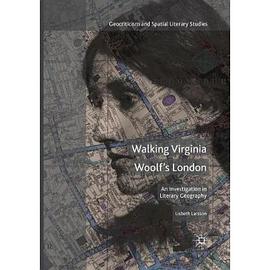
Walking Virginia Woolf’s London [Book] Douban
Walking Virginia Woolf’s London: An Investigation in Literary Geography
employs theoretical tools from the field of literary geography to explore Virginia Woolf’s writing and the ways in which she constructs her human subjects.
The city of London is the main setting in Woolf’s novels. They abound with names of streets, parks and monuments, and her characters are continuously walking about in London. By following their routes, turns, shortcuts, dead ends, resting points and stops on the map of London, one becomes aware that Woolf constructs the characters in her stories in a very politically conscious way. None of Woolf’s characters are able to walk just anywhere, at any time in history or at any time of the day. Time, place and gender/class form the conditions of life that the characters have to deal with, accept or challenge.
Written in an abundant and easy to read language, Walking Virginia Woolf’s London: An Investigation in Literary Geography could be read both as a new kind of introduction to Woolf’s work and an innovative and original contribution to the research on Woolf’s writing.
This innovative volume employs theoretical tools from the field of literary geography to explore Virginia Woolf's writing and the ways in which she constructs her human subjects. It follows the routes of characters from The Voyage, Jacob's Room, Mrs. Dalloway, To the Lighthouse and more as they walk around London, demonstrating how Woolf constructs the characters in her stories in a very politically conscious way. As Larsson argues, none of Woolf's characters are able to walk just anywhere, at any time in history, or at any time of the day. Time, place, gender, and class form the conditions of life that the characters must accept or challenge. Featuring an array of detailed maps, Walking Virginia Woolf's London: An Investigation in Literary Geography brings a fascinating new perspective to Virginia Woolf's work. It is essential reading for scholars of modernist literature or geocriticism.
employs theoretical tools from the field of literary geography to explore Virginia Woolf’s writing and the ways in which she constructs her human subjects.
The city of London is the main setting in Woolf’s novels. They abound with names of streets, parks and monuments, and her characters are continuously walking about in London. By following their routes, turns, shortcuts, dead ends, resting points and stops on the map of London, one becomes aware that Woolf constructs the characters in her stories in a very politically conscious way. None of Woolf’s characters are able to walk just anywhere, at any time in history or at any time of the day. Time, place and gender/class form the conditions of life that the characters have to deal with, accept or challenge.
Written in an abundant and easy to read language, Walking Virginia Woolf’s London: An Investigation in Literary Geography could be read both as a new kind of introduction to Woolf’s work and an innovative and original contribution to the research on Woolf’s writing.
This innovative volume employs theoretical tools from the field of literary geography to explore Virginia Woolf's writing and the ways in which she constructs her human subjects. It follows the routes of characters from The Voyage, Jacob's Room, Mrs. Dalloway, To the Lighthouse and more as they walk around London, demonstrating how Woolf constructs the characters in her stories in a very politically conscious way. As Larsson argues, none of Woolf's characters are able to walk just anywhere, at any time in history, or at any time of the day. Time, place, gender, and class form the conditions of life that the characters must accept or challenge. Featuring an array of detailed maps, Walking Virginia Woolf's London: An Investigation in Literary Geography brings a fascinating new perspective to Virginia Woolf's work. It is essential reading for scholars of modernist literature or geocriticism.