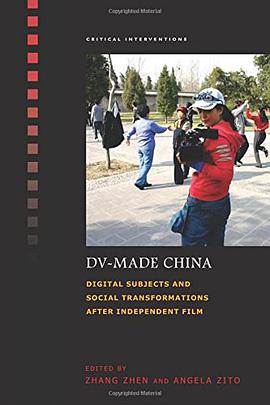
DV-Made China [Book] Google Books Douban
author:
张珍
/
Angela Zito
publishing house:
University of Hawaii Press
2015
- 4
other title:
DV-Made China
In 1990s post-Reform China, a growing number of people armed with video cameras poured out upon the Chinese landscape to both observe and contribute to the social changes then underway. Happening upon the crucial platform of an older independent film movement, this digital turn has given us a "DV China" that includes film and media communities across different social strata and disenfranchised groups, including ethnic and religious minorities and LGBTQ communities. DV-Made China takes stock of these phenomena by surveying the social and cultural landscape of grassroots and alternative cinema practices after the digital turn around the beginning of the new century.
The volume shows how Chinese independent, amateur, and activist filmmakers energize the tension between old and new media, performance and representation, fiction and non-fiction, art and politics, China and the world. Essays by scholars in cinema and media studies, anthropology, history, Asian and Tibetan studies bring innovative interdisciplinary methodologies to critically expand upon existing scholarship on contemporary Chinese independent documentary. Their inquiries then extend to narrative feature, activist video, animation, and other digital hybrids. At every turn, the book confronts digital ironies: On the one hand, its portability facilitates forms of radically private film production and audience habits of small-screen consumption. Yet it also simultaneously links up makers and consumers, curators and censors allowing for speedier circulation, more discussion, and quicker formations of public political and aesthetic discourses.
DV-Made China introduces new frameworks in a Chinese setting that range from aesthetics to ethical activism, from digital shooting and editing techniques to the politics of film circulation in festivals and online. Politics, the authors urge, travels along paths of aesthetic excitement, and aesthetic choices, conversely, always bear ethical consequences. The films, their makers, their audiences and their distributional pathways all harbor implications for social change that are closely intertwined with the fate of media culture in the new century of a world that both contains and is influenced by China.
The volume shows how Chinese independent, amateur, and activist filmmakers energize the tension between old and new media, performance and representation, fiction and non-fiction, art and politics, China and the world. Essays by scholars in cinema and media studies, anthropology, history, Asian and Tibetan studies bring innovative interdisciplinary methodologies to critically expand upon existing scholarship on contemporary Chinese independent documentary. Their inquiries then extend to narrative feature, activist video, animation, and other digital hybrids. At every turn, the book confronts digital ironies: On the one hand, its portability facilitates forms of radically private film production and audience habits of small-screen consumption. Yet it also simultaneously links up makers and consumers, curators and censors allowing for speedier circulation, more discussion, and quicker formations of public political and aesthetic discourses.
DV-Made China introduces new frameworks in a Chinese setting that range from aesthetics to ethical activism, from digital shooting and editing techniques to the politics of film circulation in festivals and online. Politics, the authors urge, travels along paths of aesthetic excitement, and aesthetic choices, conversely, always bear ethical consequences. The films, their makers, their audiences and their distributional pathways all harbor implications for social change that are closely intertwined with the fate of media culture in the new century of a world that both contains and is influenced by China.