其它标题:
Les Maîtres fous
/
通灵仙师
…
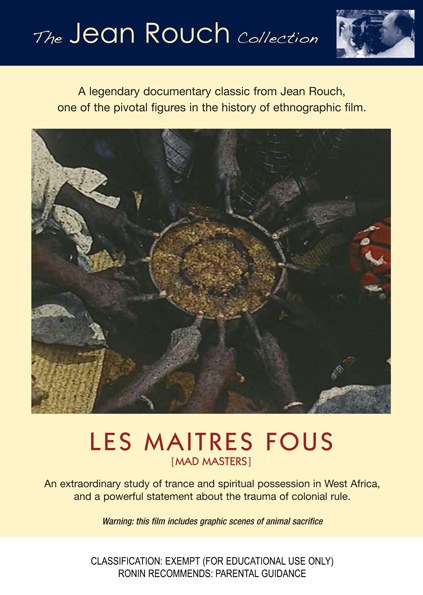
Les Maitres Fous is about the ceremony of a religious sect, the Hauka, which was widespread in West Africa from the 1920s to the 1950s. Hauka participants were usually rural migrants from Niger who came to cities such as Accra in Ghana (then Gold Coast), where they found work as laborers in the city's lumber yards, as stevedores at the docks, or in the mines. There were at least 30,000 practicing Hauka in Accra in 1954 when Jean Rouch was asked by a small group to film their annual ceremony During this ritual, which took place on a farm a few hours from the city, the Hauka entered trance and were possessed by various spirits associated with the Western colonial powers: the governorgeneral, the engineer, the doctor's wife, the wicked major, the corporal of the guard.
The roots of the Hauka lie in traditional possession cults common among the Songhay and Djerma peoples of the Niger River basin. Gifted men and women may enter trance and become possessed by any of a number of strong gods, such as Dongo, god of thunder and the sky.Supplicants consult the god through the trancing medium and receive advice about their problems, cures for diseases, comfort and support, or reprimands for their wrongdoings. Like these traditional possession cults, the Hauka sect co-existed with Islam and incorporated many Islamic saints and heroes into its rituals. Most of its adherents were Muslims.
Hauka first appeared in Niger, it is thought, in the person of a former soldier who participated in the savage battles of the second German offensive of World War I in 1917 and 1918, in which West African troops were decimated despite their spectacular performance. This soldier made the pilgrimage to Mecca and returned to Niger in the 1920s. In his village, in Rouch's account, he found the people "doing a traditional dance and the soldier was possessed, very violently possessed, and while possessed he said 'I am the avant-garde of the new gods who are coming from Malia [the Red Sea]. My name is Governor Malia and I am the first of the new gods who are coming and they are the gods of strength'."
The Hauka were quickly suppressed by the French authorities in Niger, with the support of traditional chiefs and priests who feared the popularity of the new movement and its challenge to established authority. But the Hauka cult spread, even within the jail walls, and by 1935 the British administration in Ghana again attempted to suppress it and to jail the cultists. Fires broke out in response throughout Accra, and eventually there was an agreement that Hauka priests would limit their ceremonies to certain places and to Saturdays and Sundays. This was still the case in 1954 when Rouch filmed Les Maitres Fous, which was banned by the colonial government in 1955.
The Hauka movement was a phenomenon of the colonial era. After the independence of Ghana in 1957, migration was controlled and many Hauka who had settled in Accra returned to Niger. Niger itself gained independence three years later, and the Hauka began to subside and to be absorbed into the traditional religious system. Dongo, for example, the old god of thunder, is now considered the father of the Hauka. As Rouch has pointed out, "there was no more colonial power and there never was a Hauka called Kwame N'krumah." The events filmed represent the end of the Hauka development. Today the film is shown in the villages of Ghana and in the Niger Cultural Center.
The imagery in Les Maitres Fous is powerful and often disturbing: possessed men with rolling eyes and foaming at the mouth, eating a sacrificed dog (in violation of taboo), burning their bodies with naming torches. Beyond the imagery, the themes are also powerful, and have had an impact in our own culture:Jean Genet's The Blacks was modeled upon the Hauka inversion in which blacks assume the role of masters, and Peter Brook's Marat/Sade was influenced by the theatricality and invented language of Hauka possession. Yet, as Rouch reminds us in an interview in Cineaste, possession for the Hauka cultists was not theater but reality. The significance of this reality is left ambiguous in the film, although Rouch's commentary suggests that the ritual provides a psychological release which enables the Hauka to be good workers and to endure a degrading situation with dignity. The unexplored relation of the Hauka movement to their colonial experience 1-S perhaps the most intriguing issue raised by this ceremony in which the oppressed become, for a day, the possessed and the powerful.