Jay Hunter Morris — 演员 (8)
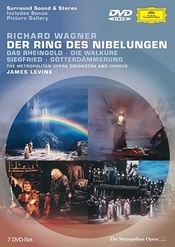
尼伯龙人的指环 2010-2012年大都会歌剧团版 [演出] 豆瓣
所属 演出: 尼伯龙人的指环
语言: 德语 german 剧团: Metropolitan Opera Orchestra 大都会歌剧团管弦乐团 ; Metropolitan Opera Chorus 大都会歌剧团合唱团 剧院: Metropolitan Opera House 大都会歌剧院 导演: Robert Lepage
其它标题: 2010-2012年大都会歌剧团版 编剧: Richard Wagner 作曲: Richard Wagner 演员: Deborah Voigt / Jay Hunter Morris
The plot revolves around a magic ring that grants the power to rule the world, forged by the Nibelung dwarf Alberich from gold he stole from the Rhine maidens in the river Rhine. The Ring itself as described by Wagner is a Rune-magic taufr ("tine", or "talisman") intended to rule the feminine multiplicative power by a fearful magical act termed as 'denial of love' ("Liebesverzicht"). With the assistance of the god Loge, Wotan – the chief of the gods – steals the ring from Alberich, but is forced to hand it over to the giants, Fafner and Fasolt in payment for building the home of the gods, Valhalla, or they will take Freia, who provides the gods with the golden apples that keep them young. Wotan's schemes to regain the ring, spanning generations, drive much of the action in the story. His grandson, the mortal Siegfried, wins the ring by slaying Fafner (who slew Fasolt for the ring) – as Wotan intended – but is eventually betrayed and slain as a result of the intrigues of Alberich's son Hagen, who wants the ring for himself. Finally, the Valkyrie Brünnhilde – Siegfried's lover and Wotan's daughter who lost her immortality for defying her father in an attempt to save Siegfried's father Sigmund – returns the ring to the Rhine maidens as she commits suicide on Siegfried's funeral pyre. Hagen is drowned as he attempts to recover the ring. In the process, the gods and Valhalla are destroyed.
Details of the storylines can be found in the articles on each music drama.
Wagner created the story of the Ring by fusing elements from many German and Scandinavian myths and folk tales. The Old Norse Edda supplied much of the material for Das Rheingold, while Die Walküre was largely based on the Völsunga saga. Siegfried contains elements from the Eddur, the Völsunga saga and Thidrekssaga. The final Götterdämmerung, draws from the 12th-century German poem, the Nibelungenlied, which appears to have been the original inspiration for the Ring.
The Ring has been the subject of myriad interpretations. For example, George Bernard Shaw, in The Perfect Wagnerite, argues for a view of The Ring as an essentially socialist critique of industrial society and its abuses. Robert Donington in Wagner's Ring And Its Symbols interprets it in terms of Jungian psychology, as an account of the development of unconscious archetypes in the mind, leading towards individuation.
漂泊的荷兰人 2015年华盛顿国家歌剧团版 [演出] 豆瓣
所属 演出: 漂泊的荷兰人
剧团: Washington National Opera Orchestra 华盛顿国家歌剧团管弦乐团 ; Washington National Opera Chorus 华盛顿国家歌剧团合唱团 剧院: John F. Kennedy Center for the Performing Arts 约翰 • F • 肯尼迪表演艺术中心 导演: Stephen Lawless
其它标题: 2015年华盛顿国家歌剧团版 编剧: Richard Wagner 作曲: Richard Wagner 演员: Eric Owens / Alan Held / Christiane Libor / Jennifer Root
Place: On the coast of Norway
Act 1
On his homeward journey, the sea captain Daland is compelled by stormy weather to seek a port of refuge near Sandwike in southern Norway. He leaves the helmsman on watch and he and the sailors retire. (Song of the helmsman: "Mit Gewitter und Sturm aus fernem Meer" — "With tempest and storm on distant seas.") The helmsman falls asleep. A ghostly vessel appearing astern is dashed against Daland's vessel by the sea and the grappling irons hold the two ships together. Invisible hands furl the sails. A man of pale aspect, dressed in black, his face framed by a thick black beard, steps ashore. He laments his fate. (Aria: "Die Frist ist um, und abermals verstrichen sind sieben Jahr" — "The time has come and seven years have again elapsed") Because he once invoked Satan, the ghost captain is cursed to roam the sea forever without rest. An angel brought to him the terms of his redemption: Every seven years the waves will cast him upon the shore; if he can find a wife who will be true to him he will be released from his curse.
Daland wakes up and meets the stranger. The stranger hears that Daland has an unmarried daughter named Senta, and he asks for her hand in marriage, offering a chest of treasure as a gift. Tempted by gold, Daland agrees to the marriage. The southwind blows and both vessels set sail for Daland's home.
Act 2
A group of local girls are singing and spinning in Daland's house. (Spinning chorus: "Summ und brumm, du gutes Rädchen" — "Whir and whirl, good wheel") Senta, Daland's daughter, dreamily gazes upon a gorgeous picture of the legendary Dutchman that hangs from the wall; she desires to save him. Against the will of her nurse, she sings to her friends the story of the Dutchman (Ballad with the Leitmotiv), how Satan heard him swear and took him at his word. She vows to save him by her fidelity.
The huntsman Erik, Senta's former boyfriend, arrives and hears her; the girls depart, and the huntsman, who loves the maiden, warns her, telling her of his dream, in which Daland returned with a mysterious stranger, who carried her off to sea. She listens with delight, and Erik leaves in despair.
Daland arrives with the stranger; he and Senta stand gazing at each other in silence. Daland is scarcely noticed by his daughter, even when he presents his guest as her betrothed. In the following duet, which closes the act, Senta swears to be true till death.
Act 3
Later in the evening, the local girls bring Daland's men food and drink. They invite the crew of the strange vessel to join in the merry-making, but in vain. The girls retire in wonder; ghostly forms appear at work upon the vessel The Flying Dutchman, and Daland's men retreat in fear.
Senta arrives, followed by Erik, who reproves her for deserting him, as she had formerly loved him and vowed constancy. When the stranger, who has been listening, hears these words, he is overwhelmed with despair, as he thinks he is now forever lost. He summons his men, tells Senta of the curse, and to the consternation of Daland and his crew declares that he is the "Flying Dutchman".
As the Dutchman sets sail, Senta throws herself into the sea, claiming that she will be faithful to him unto death. This is his salvation. The spectral ship disappears, and Senta and the Dutchman are seen ascending to heaven.
特里斯坦与伊索尔德 2017年中国国家大剧院版 [演出] 豆瓣
所属 演出: 特里斯坦与伊索尔德
语言: german 德语 剧团: 中国国家大剧院管弦乐团;中国国家大剧院合唱团;北京管乐交响乐团 剧院: 中国国家大剧院 导演: Mariusz Treliński
其它标题: 2017年中国国家大剧院版 编剧: Richard Wagner 作曲: Richard Wagner 演员: Jay Hunter Morris / Ann Petersen
Act 1
Isolde, promised to King Marke in marriage, and her handmaid, Brangäne, are quartered aboard Tristan's ship being transported to the king's lands in Cornwall. The opera opens with the voice of a young sailor singing of a "wild Irish maid", ("Westwärts schweift der Blick") which Isolde construes to be a mocking reference to herself. In a furious outburst, she wishes the seas to rise up and sink the ship, killing herself and all on board ("Erwache mir wieder, kühne Gewalt"). Her scorn and rage are directed particularly at Tristan, the knight responsible for taking her to Marke, and Isolde sends Brangäne to command Tristan to appear before her ("Befehlen liess' dem Eigenholde"). Tristan, however, refuses Brangäne's request, claiming that his place is at the helm. His henchman, Kurwenal, answers more brusquely, saying that Isolde is in no position to command Tristan and reminds Brangäne that Isolde's previous fiancé, Morold, was killed by Tristan ("Herr Morold zog zu Meere her").
Brangäne returns to Isolde to relate these events, and Isolde, in what is termed the "narrative and curse", sadly tells her of how, following the death of Morold, she happened upon a stranger who called himself Tantris. Tantris was found mortally wounded in a barge ("von einem Kahn, der klein und arm") and Isolde used her healing powers to restore him to health. She discovered during Tantris' recovery, however, that he was actually Tristan, the murderer of her fiancé. Isolde attempted to kill the man with his own sword as he lay helpless before her. However, Tristan looked not at the sword that would kill him or the hand that wielded the sword, but into her eyes ("Er sah' mir in die Augen"). His action pierced her heart and she was unable to slay him. Tristan was allowed to leave with the promise never to come back, but he later returned with the intention of marrying Isolde to his uncle, King Marke. Isolde, furious at Tristan's betrayal, insists that he drink atonement to her, and from her medicine chest produces a vial to make the drink. Brangäne is shocked to see that it is a lethal poison.
Kurwenal appears in the women's quarters ("Auf auf! Ihr Frauen!") and announces that the voyage is coming to an end. Isolde warns Kurwenal that she will not appear before the King if Tristan does not come before her as she had previously ordered and drink atonement to her. When Tristan arrives, Isolde reproaches him about his conduct and tells him that he owes her his life and how his actions have undermined her honour, since she blessed Morold's weapons before battle and therefore she swore revenge. Tristan first offers his sword but Isolde refuses; they must drink atonement. Brangäne brings in the potion that will seal their pardon; Tristan knows that it may kill him, since he knows Isolde's magic powers ("Wohl kenn' ich Irland's Königin"). The journey almost at its end, Tristan drinks and Isolde takes half the potion for herself. The potion seems to work but it does not bring death but relentless love ("Tristan!" "Isolde!"). Kurwenal, who announces the imminent arrival on board of King Marke, interrupts their rapture. Isolde asks Brangäne which potion she prepared and Brangäne replies, as the sailors hail the arrival of King Marke, that it was not poison, but rather a love potion.
Act 2
King Marke leads a hunting party out into the night, leaving Isolde and Brangäne alone in the castle, who both stand beside a burning brazier. Isolde, listening to the hunting horns, believes several times that the hunting party is far enough away to warrant the extinguishing of the brazier – the prearranged signal for Tristan to join her ("Nicht Hörnerschall tönt so hold"). Brangäne warns Isolde that Melot, one of King Marke's knights, has seen the amorous looks exchanged between Tristan and Isolde and suspects their passion ("Ein Einz'ger war's, ich achtet' es wohl"). Isolde, however, believes Melot to be Tristan's most loyal friend, and, in a frenzy of desire, extinguishes the flames. Brangäne retires to the ramparts to keep watch as Tristan arrives.
The lovers, at last alone and freed from the constraints of courtly life, declare their passion for each other. Tristan decries the realm of daylight which is false, unreal, and keeps them apart. It is only in night, he claims, that they can truly be together and only in the long night of death can they be eternally united ("O sink' hernieder, Nacht der Liebe"). During their long tryst, Brangäne calls a warning several times that the night is ending ("Einsam wachend in der Nacht"), but her cries fall upon deaf ears. The day breaks in on the lovers as Melot leads King Marke and his men to find Tristan and Isolde in each other's arms. Marke is heartbroken, not only because of his nephew's betrayal but also because Melot chose to betray his friend Tristan to Marke and because of Isolde's betrayal as well ("Mir – dies? Dies, Tristan – mir?").
When questioned, Tristan says he cannot answer to the King the reason of his betrayal since he would not understand. He turns to Isolde, who agrees to follow him again into the realm of night. Tristan announces that Melot has fallen in love with Isolde too. Melot and Tristan fight, but, at the crucial moment, Tristan throws his sword aside and allows Melot to severely wound him.
Act 3
Kurwenal has brought Tristan home to his castle at Kareol in Brittany. A shepherd pipes a mournful tune and asks if Tristan is awake. Kurwenal replies that only Isolde's arrival can save Tristan, and the shepherd offers to keep watch and claims that he will pipe a joyful tune to mark the arrival of any ship. Tristan awakes ("Die alte Weise – was weckt sie mich?") and laments his fate – to be, once again, in the false realm of daylight, once more driven by unceasing unquenchable yearning ("Wo ich erwacht' weilt ich nicht"). Tristan's sorrow ends when Kurwenal tells him that Isolde is on her way. Tristan, overjoyed, asks if her ship is in sight, but only a sorrowful tune from the shepherd's pipe is heard.
Tristan relapses and recalls that the shepherd's mournful tune is the same as was played when he was told of the deaths of his father and mother ("Muss ich dich so versteh'n, du alte, ernst Weise"). He rails once again against his desires and against the fateful love potion ("verflucht sei, furchtbarer Trank!") until, exhausted, he collapses in delirium. After his collapse, the shepherd is heard piping the arrival of Isolde's ship, and, as Kurwenal rushes to meet her, Tristan tears the bandages from his wounds in his excitement ("Hahei! Mein Blut, lustig nun fliesse!"). As Isolde arrives at his side, Tristan dies with her name on his lips.
Isolde collapses beside her deceased lover just as the appearance of another ship is announced. Kurwenal spies Melot, Marke and Brangäne arriving ("Tod und Hölle! Alles zur Hand!"). He believes they have come to kill Tristan and, in an attempt to avenge him, furiously attacks Melot. Marke tries to stop the fight to no avail. Both Melot and Kurwenal are killed in the fight. Marke and Brangäne finally reach Tristan and Isolde. Marke, grieving over the body of his "truest friend" ("Tot denn alles!"), explains that Brangäne revealed the secret of the love potion and that he had come not to part the lovers, but to unite them ("Warum Isolde, warum mir das?"). Isolde appears to wake at this and in a final aria describing her vision of Tristan risen again (the "Liebestod", "love death"), dies ("Mild und leise wie er lächelt").

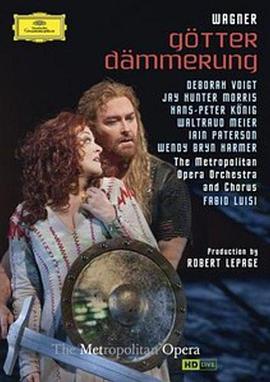
众神的黄昏 2012年大都会歌剧团版 [演出] 豆瓣
所属 演出: 众神的黄昏
语言: german 德语 剧团: Metropolitan Opera Orchestra 大都会歌剧团管弦乐团 ; Metropolitan Opera Chorus 大都会歌剧团合唱团 剧院: Metropolitan Opera House 大都会歌剧院 导演: Robert Lepage
其它标题: 2012年大都会歌剧团版 编剧: Richard Wagner 作曲: Richard Wagner 演员: Deborah Voigt / Jay Hunter Morris
Prologue
The three Norns, daughters of Erda, gather beside Brünnhilde's rock, weaving the rope of Destiny. They sing of the past and the present, and of the future when Wotan will set fire to Valhalla to signal the end of the gods. Without warning, their rope breaks. Lamenting the loss of their wisdom, the Norns disappear.
As day breaks, Siegfried and Brünnhilde emerge from their cave, high on a mountaintop surrounded by magic fire. Brünnhilde sends Siegfried off to new adventures, urging him to keep their love in mind. As a pledge of fidelity, Siegfried gives her the ring of power that he took from Fafner's hoard. Bearing Brünnhilde's shield and mounting her horse Grane, Siegfried rides away as an orchestral interlude (Siegfried's Journey to the Rhine) starts.
Act 1
The act begins in the Hall of the Gibichungs, a population dwelling by the Rhine. Gunther, lord of the Gibichungs, sits enthroned. His half-brother and chief minister, Hagen, advises him to find a wife for himself and a husband for their sister Gutrune. He suggests Brünnhilde for Gunther's wife, and Siegfried for Gutrune's husband. He reminds Gutrune that he has given her a potion that she can use to make Siegfried forget Brünnhilde and fall in love with Gutrune; under its influence, Siegfried will win Brünnhilde for Gunther. Gunther and Gutrune agree enthusiastically with this plan.
Siegfried appears at Gibichung Hall, seeking to meet Gunther. Gunther extends his hospitality to the hero, and Gutrune offers him the love potion. Unaware of the deception, Siegfried toasts Brünnhilde and their love. Drinking the potion, he loses his memory of Brünnhilde and falls in love with Gutrune instead. In his drugged state, Siegfried offers to win a wife for Gunther, who tells him about Brünnhilde and the magic fire which only a fearless person can cross. They swear blood-brotherhood (Hagen holds the drinking horn in which they mix their blood, but he does not join in the oath) and leave for Brünnhilde's rock. Hagen, left on guard duty, gloats that his so-called masters are unwittingly bringing the ring to him (Monologue: Hagen's watch).
Meanwhile, Brünnhilde is visited by her Valkyrie sister Waltraute, who tells her that Wotan returned from his wanderings with his spear shattered. Wotan is dismayed at losing his spear, as it has all the treaties and bargains he has made—everything that gives him power—carved into its shaft. Wotan ordered branches of the World tree, to be piled around Valhalla; sent his magic ravens to spy on the world and bring him news; and currently waits in Valhalla for the end. Waltraute begs Brünnhilde to return the ring to the Rhinemaidens, since the ring's curse is now affecting their father, Wotan. However, Brünnhilde refuses to relinquish Siegfried's token of love, and Waltraute rides away in despair.
Siegfried arrives, disguised as Gunther by using the Tarnhelm, and claims Brünnhilde as his wife. Though Brünnhilde resists violently, Siegfried overpowers her, snatching the ring from her hand and placing it on his own.
Act 2
Hagen, waiting by the bank of the Rhine, is visited in his semi-waking sleep (sitting up, eyes open, but motionless) by his father, Alberich. On Alberich's urging, he swears to kill Siegfried and acquire the ring. Alberich exits as dawn breaks. Siegfried arrives via Tarnhelm-magic, having resumed his natural form and left Brünnhilde on the boat with Gunther. Hagen summons the Gibichung vassals to welcome Gunther and his bride. He does this by sounding the war-alarm. The vassals are surprised to learn that the occasion is not battle, but their master's wedding and party.
Gunther leads in a downcast Brünnhilde, who is astonished to see Siegfried. Noticing the ring on Siegfried's hand, she realizes she has been betrayed—that the man who conquered her was not Gunther, but Siegfried in disguise. She denounces Siegfried in front of Gunther's vassals and accuses Siegfried of having seduced her himself. Siegfried, who does not remember ever having been Brünhilde's lover, swears on Hagen's spear that her accusations are false. Brünnhilde seizes the tip of the spear and swears that they are true. Once again Hagen supervises silently as others take oaths to his advantage. But this time, since the oath is sworn on a weapon, the understanding is that if the oath is proven false, the weapon's owner should avenge it by killing the perjurer with that weapon. Siegfried then leads Gutrune and the bystanders off to the wedding feast, leaving Brünnhilde, Hagen, and Gunther alone by the shore. Deeply shamed by Brünnhilde's outburst, Gunther agrees to Hagen's suggestion that Siegfried must be killed in order for Gunther to regain his standing. Brünnhilde, seeking revenge for Siegfried's manifest treachery, joins the plot and tells Hagen that Siegfried would be vulnerable to a stab in the back. Hagen and Gunther decide to lure Siegfried on a hunting-trip and murder him. They sing a trio in which Brünnhilde and Gunther vow in the name of Wotan, "guardian of oaths", to kill Siegfried, while Hagen repeats his pledge to Alberich: to acquire the ring and rule the world through its power.
Act 3
In the woods by the bank of the Rhine, the Rhinemaidens mourn the lost Rhine gold. Siegfried happens by, separated from the hunting party. The Rhinemaidens urge him to return the ring and avoid its curse, but he laughs at them and says he prefers to die rather than bargain for his life. They swim away, predicting that Siegfried will die and that his heir, a lady, will treat them more fairly.
Siegfried rejoins the hunters, who include Gunther and Hagen. While resting, he tells them about the adventures of his youth. Hagen gives him another potion, which restores his memory, and he tells of discovering the sleeping Brünnhilde and awakening her with a kiss. Hagen stabs him in the back with his spear. The others look on in horror, and Hagen explains in three words ("Meineid rächt' ich!" – "I have avenged perjury!") that since Siegfried admitted loving Brünnhilde, the oath he swore on Hagen's spear was obviously false, therefore it was Hagen's duty to kill him with it. Hagen calmly walks away into the wood. Siegfried recollects his awakening of Brünnhilde and dies. His body is carried away in a solemn funeral procession (Siegfried's funeral march) that forms the interlude as the scene is changed and recapitulates many of the themes associated with Siegfried and the Wälsungs.
Back in the Gibichung Hall, Gutrune awaits Siegfried's return. Hagen arrives ahead of the funeral party. Gutrune is devastated when Siegfried's corpse is brought in. Gunther blames Siegfried's death on Hagen, who replies that Siegfried had incurred the penalty of his false oath, and further, claims the ring on Siegfried's finger by right of conquest. When Gunther objects, Hagen appeals to the vassals to support his claim. Gunther draws his sword but Hagen attacks and easily kills him. However, as Hagen moves to take the ring, Siegfried's hand rises threateningly. Hagen recoils in fear.
Brünnhilde makes her entrance and issues orders for a huge funeral pyre to be assembled by the river (the start of the Immolation Scene). She takes the ring and tells the Rhinemaidens to claim it from her ashes, once fire has cleansed it of its curse. Lighting the pyre with a firebrand, she sends Wotan's ravens home with "anxiously longed-for tidings", and to fly by the magic fire for Loge to fulfill his task. After an apostrophe to the dead hero, Brünnhilde mounts her horse Grane and rides into the flames.
A sequence of leitmotifs portray the fire flaring up, and the hall of the Gibichungs catching fire and collapsing. The Rhine overflows its banks, quenching the fire, and the Rhinemaidens swim in to claim the ring. Hagen tries to stop them but they drag him into the depths and drown him. As they celebrate the return of the ring and its gold to the river, a red glow is seen in the sky. As the Gibichungs watch, the interior of Valhalla is finally seen, with gods and heroes visible as described by Waltraute in Act 1. Flames flare up in the Hall of the Gods, hiding it and them from sight completely. As the gods are consumed in the flames, the curtain falls to the sound of the Erlösungsmotif—the redemption leitmotif.
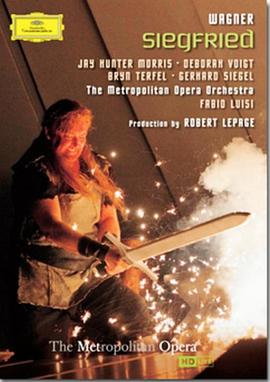
齐格弗里德 2011年大都会歌剧团版 [演出] 豆瓣
所属 演出: 齐格弗里德
语言: german 德语 剧团: Metropolitan Opera Orchestra 大都会歌剧团管弦乐团 剧院: Metropolitan Opera House 大都会歌剧院 导演: Robert Lepage
其它标题: 2011年大都会歌剧团版 编剧: Richard Wagner 作曲: Richard Wagner 演员: Jay Hunter Morris / Deborah Voigt
Act 1
Scene 1
A cave in rocks in the forest. An orchestral introduction includes references to leitmotifs including themes relating to the original hoard plundered by the Nibelung Alberich, and one in B-flat minor associated with the Nibelungs themselves. As the curtain rises, Alberich's brother, the dwarf Mime, is forging a sword. Mime is plotting to obtain the ring of power originally created by his brother Alberich. He has raised the human boy Siegfried as a foster child, to kill Fafner, who obtained the ring and other treasures in the opera Das Rheingold and has since transformed himself from a giant to a dragon. Mime needs a sword for Siegfried to use, but the youth has contemptuously broken every sword Mime has made. Siegfried returns from his wanderings in the forest with a wild bear in tow, and immediately breaks the new sword. After a whining speech by Mime about ingratitude, and how Mime has brought him up from a mewling infant ("Als zullendes Kind"), Siegfried senses why he keeps coming back to Mime although he despises him: he wants to know his parentage. Mime is forced to explain how he took in Siegfried's mother, Sieglinde, who then died giving birth to Siegfried. He shows Siegfried the broken pieces of the sword Nothung, which Mime had obtained from her. Siegfried orders him to reforge the sword; Mime, however, is unable to accomplish this. Siegfried departs, leaving Mime in despair.
Scene 2
An old man (Wotan in disguise) arrives at the door and introduces himself as the Wanderer. In return for the hospitality due a guest, he wagers his head on answering any three questions of Mime. The dwarf asks the Wanderer to name the races that live beneath the ground, on the earth, and in the skies. These are the Nibelung, the Giants, and the Gods, as the Wanderer answers correctly. The Wanderer then induces Mime to wager his own head on three further riddles: the race most beloved of Wotan, but most harshly treated; the name of the sword that can destroy Fafner; and the person who can repair the sword. Mime answers the first two questions: the Wälsungs (Siegmund and Sieglinde whose tale is told in the opera Die Walküre) and Nothung. However, he cannot answer the last. Wotan spares Mime, telling him that only "he who does not know fear" can reforge Nothung, and leaves Mime's head forfeit to that person.
Scene 3
Mime despairs as he imagines the ferocity of the dragon Fafner, while "the orchestra paints a dazzling picture of flickering lights and roaring flames". Siegfried returns and is annoyed by Mime's lack of progress. Mime realizes that Siegfried is "the one who does not know fear" and that unless he can instill fear in him, Siegfried will kill him as the Wanderer foretold. He tells Siegfried that fear is an essential craft; Siegfried is eager to learn it, and Mime promises to teach him by taking him to Fafner. Since Mime was unable to forge Nothung, Siegfried decides to do it himself. He succeeds by shredding the metal, melting it, and casting it anew. In the meantime, Mime brews a poisoned drink to offer Siegfried after the youth has defeated the dragon. After he finishes forging the sword, Siegfried demonstrates its strength by chopping the anvil in half with it.
Act 2
Scene 1
Deep in the forest. The Wanderer arrives at the entrance to Fafner's cave, where Alberich is keeping vigil. The two enemies recognize each other. Alberich boasts of his plans to regain the ring and rule the world. Wotan states that he does not intend to interfere, only to observe. He even offers to awaken the dragon so that Alberich can bargain with him. Alberich warns the dragon that a hero is coming to kill him, and offers to prevent the fight in exchange for the ring. Fafner dismisses the threat, declines Alberich's offer, and returns to sleep. Wotan leaves and Alberich withdraws, muttering threats.
Scene 2
At daybreak, Siegfried and Mime arrive. After assuring Siegfried that the dragon will teach him what fear is, Mime withdraws. As Siegfried waits for the dragon to appear, he hears a woodbird singing. He attempts to mimic the bird's song using a reed pipe, but is unsuccessful. He then plays a tune on his horn, which brings Fafner out of his cave. After a short exchange, they fight; Siegfried stabs Fafner in the heart with Nothung. In his last moments, Fafner learns Siegfried's name, and tells him to beware of treachery. When Siegfried withdraws his sword from Fafner's body, his hands are burned by the dragon's blood and he puts his finger in his mouth. On tasting the blood, he finds that he can understand the woodbird's song. Following its instructions, he takes the ring and the magic helmet Tarnhelm from Fafner's hoard.
Scene 3
Outside the cave, Alberich and Mime quarrel over the treasure. Alberich hides as Siegfried comes out of the cave. Siegfried complains to Mime that he has still not learned the meaning of fear. Mime offers him the poisoned drink; however, the magic power of the dragon's blood allows Siegfried to read Mime's treacherous thoughts, and he stabs him to death. He throws Mime's body into the treasure cave and places Fafner's body in the cave entrance to block it. The woodbird now sings of a woman sleeping on a rock surrounded by magic fire. Siegfried, wondering if he can learn fear from this woman, follows the bird towards the rock.
Act 3
Scene 1
At the foot of Brünnhilde's rock. The Wanderer summons Erda, the earth goddess. Erda, appearing confused, is unable to offer any advice. Wotan informs her that he no longer fears the end of the gods; indeed, it is his desire. His heritage will be left to Siegfried the Wälsung, and Brünnhilde (Erda's and Wotan's child), who will "work the deed that redeems the World." Dismissed, Erda sinks back into the earth.
Scene 2
Siegfried arrives, and the Wanderer questions the youth. Siegfried, who does not recognize his grandfather, answers insolently and starts down the path toward Brünnhilde's rock. The Wanderer blocks his path, but Siegfried mocks him, laughing at his floppy hat and his missing eye, and breaks his spear (the symbol of Wotan's authority) with a blow from Nothung. Wotan calmly gathers up the pieces and vanishes.
Scene 3
Siegfried passes through the ring of fire, emerging on Brünnhilde's rock. At first, he thinks the sleeping armored figure is a man. However, when he removes the armor, he finds a woman beneath. At the sight of the first woman he has ever seen, Siegfried at last experiences fear. In desperation, he kisses Brünnhilde, waking her from her magic sleep. Hesitant at first, Brünnhilde is won over by Siegfried's love, and renounces the world of the gods. Together, they hail "light-bringing love, and laughing death."