other title:
干城章嘉峰
/
Kanchanjungha
…
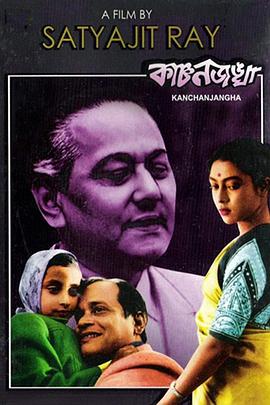
A wealthy family from Calcutta is on the last day of their vacation in Darjeeling, a hill station at the foot of Mount Kanchenjungha, t he second highest peak of the Himalayas. Until now, they have been unable to catch a glimpse of the peak Kanchenjungha.The family members are dominated by the father, Indranath (Chhabi Biswas), an industrialist. He wants his daughter to marry a man of his choice and hopes that the man will propose if they are left together alone for some time.
Several long walks and long conversations form the main body of the film. The real-time drama unfolds the daughter's feelings about her father's idea, and the negative reactions to this by her mother and others.
By accident, she meets an outsider, Ashoke, a young student who has refused a job offer from Indranath. Though nothing develops between them, his presence coupled with the setting of mountains and the failure of her sister's marriage, prompt her to reject the proposed suitor.
At the end of his walk, the industrialist arrives at a rendezvous point, expecting to meet his family and the successful suitor. None of them is present to greet him. As the mist clears, the peak of Kanchenjungha is revealed in its full glory. But Indranath is too pre-occupied to admire it.
Kanchenjungha was Ray's first original screenplay and for the first time, he was shooting in color. The film shows about 100 minutes (in real time) in the life of a group of rich Bengalis on vacation.Unlike the usual Ray films, it has a fragmented narrative with no central characters, and no straight narrative in the classical sense.
It is a very structured and composed film that uses color and nature to heighten the drama. Ray told his biographer Andrew Robinson: "The idea was to have the film starting with sunlight. Then clouds coming, then mist rising, and then mist disappearing, the cloud disappearing, and then the sun shining on the snow-peaks. There is an independent progression to Nature itself, and the story reflects this."
As the weather becomes misty - the young daughter and the suitor part at that point, Indranath meets Ashoke, and the elder daughter, Amina and her husband have a bitter moment between them. And then when the sun appears again - Amina's daughter comes back to her parents and they accept her, the misunderstanding is cleared up, and the younger daughter and Ashoke develop a tentative relationship with a hint of future prospects.
The characters and the Nature are interrelated in mood. In his later film Asani Sanket (Distant Thunder, 1973), Ray attempted quite the opposite. While the Nature is shown in its full glory and lushness, in contrast, the characters starve and do inhuman things.
As the characters do not change the clothes during the film (it being depiction of a real time event that happens in 100 odd minutes), the colors of clothes too add a dimension to the characters.
About Kanchenjungha, Ray told in an interview to Cineaste magazine, "(It was) a very personal film. It was a good ten to fifteen years ahead of its time... Kanchenjungha told the story of several groups of characters and it went back and forth. ... It's a very musical form, but it wasn't liked. The reaction was stupid. Even the reviews were not interesting. But, looking back now, I find that it is a very interesting film."