斯蒂芬·博伊德 — 作者 (7)
Introduction to Applied Linear Algebra [图书] 豆瓣 Goodreads
作者: Stephen Boyd / Lieven Vandenberghe 出版社: Cambridge University Press 2018 - 6 其它标题: Introduction to Applied Linear Algebra: Vectors, Matrices, and Least Squares
This book is meant to provide an introduction to vectors, matrices, and least squares methods, basic topics in applied linear algebra. Our goal is to give the beginning student, with little or no prior exposure to linear algebra, a good grounding in the basic ideas, as well as an appreciation for how they are used in many applications, including data fitting, machine learning and artificial intelligence, to-mography, navigation, image processing, finance, and automatic control systems.
The background required of the reader is familiarity with basic mathematical notation. We use calculus in just a few places, but it does not play a critical role and is not a strict prerequisite. Even though the book covers many topics that are traditionally taught as part of probability and statistics, such as fitting mathematical models to data, no knowledge of or background in probability and statistics is needed.
The book covers less mathematics than a typical text on applied linear algebra. We use only one theoretical concept from linear algebra, linear independence, and only one computational tool, the QR factorization; our approach to most applications relies on only one method, least squares (or some extension). In this sense we aim for intellectual economy: With just a few basic mathematical ideas, con-cepts, and methods, we cover many applications. The mathematics we do present, however, is complete, in that we carefully justify every mathematical statement. In contrast to most introductory linear algebra texts, however, we describe many applications, including some that are typically considered advanced topics, like document classification, control, state estimation, and portfolio optimization.
The book does not require any knowledge of computer programming, and can be used as a conventional textbook, by reading the chapters and working the exercises that do not involve numerical computation. This approach however misses out on one of the most compelling reasons to learn the material: You can use the ideas and methods described in this book to do practical things like build a prediction model from data, enhance images, or optimize an investment portfolio. The growing power of computers, together with the development of high level computer languages and packages that support vector and matrix computation, have made it easy to use the methods described in this book for real applications. For this reason we hope that every student of this book will complement their study with computer programming exercises and projects, including some that involve real data. This book includes some generic exercises that require computation; additional ones, and the associated data files and language-specific resources, are available online.
If you read the whole book, work some of the exercises, and carry out computer exercises to implement or use the ideas and methods, you will learn a lot. While there will still be much for you to learn, you will have seen many of the basic ideas behind modern data science and other application areas. We hope you will be empowered to use the methods for your own applications.
The book is divided into three parts. Part I introduces the reader to vectors, and various vector operations and functions like addition, inner product, distance, and angle. We also describe how vectors are used in applications to represent word counts in a document, time series, attributes of a patient, sales of a product, an audio track, an image, or a portfolio of investments. Part II does the same for matrices, culminating with matrix inverses and methods for solving linear equa-tions. Part III, on least squares, is the payoff, at least in terms of the applications. We show how the simple and natural idea of approximately solving a set of over-determined equations, and a few extensions of this basic idea, can be used to solve many practical problems.
The whole book can be covered in a 15 week (semester) course; a 10 week (quarter) course can cover most of the material, by skipping a few applications and perhaps the last two chapters on nonlinear least squares. The book can also be used for self-study, complemented with material available online. By design, the pace of the book accelerates a bit, with many details and simple examples in parts I and II, and more advanced examples and applications in part III. A course for students with little or no background in linear algebra can focus on parts I and II, and cover just a few of the more advanced applications in part III. A more advanced course on applied linear algebra can quickly cover parts I and II as review, and then focus on the applications in part III, as well as additional topics.
We are grateful to many of our colleagues, teaching assistants, and students for helpful suggestions and discussions during the development of this book and the associated courses. We especially thank our colleagues Trevor Hastie, Rob Tibshirani, and Sanjay Lall, as well as Nick Boyd, for discussions about data fitting and classification, and Jenny Hong, Ahmed Bou-Rabee, Keegan Go, David Zeng, and Jaehyun Park, Stanford undergraduates who helped create and teach the course EE103. We thank David Tse, Alex Lemon, Neal Parikh, and Julie Lancashire for carefully reading drafts of this book and making many good suggestions.
Convex Optimization [图书] 豆瓣 Goodreads
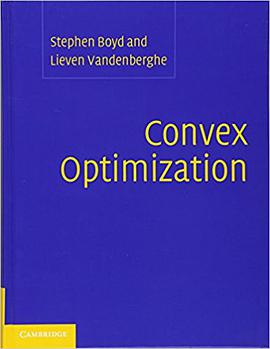
Convex Optimization
8.0 (5 个评分) 作者: Stephen Boyd / Lieven Vandenberghe 出版社: Cambridge University Press 2004 - 3
Convex optimization problems arise frequently in many different fields. This book provides a comprehensive introduction to the subject, and shows in detail how such problems can be solved numerically with great efficiency. The book begins with the basic elements of convex sets and functions, and then describes various classes of convex optimization problems. Duality and approximation techniques are then covered, as are statistical estimation techniques. Various geometrical problems are then presented, and there is detailed discussion of unconstrained and constrained minimization problems, and interior-point methods. The focus of the book is on recognizing convex optimization problems and then finding the most appropriate technique for solving them. It contains many worked examples and homework exercises and will appeal to students, researchers and practitioners in fields such as engineering, computer science, mathematics, statistics, finance and economics.
凸优化 [图书] 豆瓣
Convex Optimization
作者: Stephen Boyd / Lieven Vandenberghe 译者: 王书宁 / 许鋆 出版社: 清华大学出版社 2013 - 1
《信息技术和电气工程学科国际知名教材中译本系列:凸优化》内容非常丰富。理论部分由4章构成,不仅涵盖了凸优化的所有基本概念和主要结果,还详细介绍了几类基本的凸优化问题以及将特殊的优化问题表述为凸优化问题的变换方法,这些内容对灵活运用凸优化知识解决实际问题非常有用。应用部分由3章构成,分别介绍凸优化在解决逼近与拟合、统计估计和几何关系分析这三类实际问题中的应用。算法部分也由3章构成,依次介绍求解无约束凸优化模型、等式约束凸优化模型以及包含不等式约束的凸优化模型的经典数值方法,以及如何利用凸优化理论分析这些方法的收敛性质。通过阅读《信息技术和电气工程学科国际知名教材中译本系列:凸优化》,能够对凸优化理论和方法建立完整的认识。
Convex Optimization [图书] 豆瓣
作者: Stephen Boyd / Lieven Vandenberghe 出版社: Cambridge India 2016 - 1
Convex optimization problems arise frequently in many different fields. A comprehensive introduction to the subject, this book shows in detail how such problems can be solved numerically with great efficiency. The focus is on recognizing convex optimization problems and then finding the most appropriate technique for solving them. The text contains many worked examples and homework exercises and will appeal to students, researchers and practitioners in fields such as engineering, computer science, mathematics, statistics, finance, and economics.
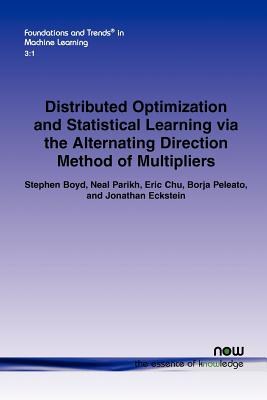
Distributed Optimization and Statistical Learning Via the Alternating Direction Method of Multipliers [图书] 豆瓣
作者: Stephen Boyd / Neal Parikh 出版社: Now Publishers Inc 2011
https://web.stanford.edu/~boyd/papers/admm_distr_stats.html
Many problems of recent interest in statistics and machine learning can be posed in the framework of convex optimization. Due to the explosion in size and complexity of modern datasets, it is increasingly important to be able to solve problems with a very large number of features or training examples. As a result, both the decentralized collection or storage of these datasets as well as accompanying distributed solution methods are either necessary or at least highly desirable. In this review, we argue that the alternating direction method of multipliers is well suited to distributed convex optimization, and in particular to large-scale problems arising in statistics, machine learning, and related areas. The method was developed in the 1970s, with roots in the 1950s, and is equivalent or closely related to many other algorithms, such as dual decomposition, the method of multipliers, Douglas–Rachford splitting, Spingarn's method of partial inverses, Dykstra's alternating projections, Bregman iterative algorithms for ℓ1 problems, proximal methods, and others. After briefly surveying the theory and history of the algorithm, we discuss applications to a wide variety of statistical and machine learning problems of recent interest, including the lasso, sparse logistic regression, basis pursuit, covariance selection, support vector machines, and many others. We also discuss general distributed optimization, extensions to the nonconvex setting, and efficient implementation, including some details on distributed MPI and Hadoop Map Reduce implementations.
Minimum-Distortion Embedding [图书] 豆瓣
作者: Akshay Agrawal / Alnur Ali 出版社: Now Publishers Inc
Akshay Agrawal, Alnur Ali and Stephen Boyd (2021), "Minimum-Distortion Embedding", Foundations and Trends® in Machine Learning: Vol. 14: No. 3, pp 211-378. http://dx.doi.org/10.1561/2200000090
https://www.nowpublishers.com/article/Details/MAL-090
https://arxiv.org/abs/2103.02559
Embeddings provide concrete numerical representations of otherwise abstract items, for use in downstream tasks. For example, a biologist might look for subfamilies of related cells by clustering embedding vectors associated with individual cells, while a machine learning practitioner might use vector representations of words as features for a classification task.
In this monograph the authors present a general framework for faithful embedding called minimum-distortion embedding (MDE) that generalizes the common cases in which similarities between items are described by weights or distances. The MDE framework is simple but general. It includes a wide variety of specific embedding methods, including spectral embedding, principal component analysis, multidimensional scaling, Euclidean distance problems, etc.
The authors provide a detailed description of minimum-distortion embedding problem and describe the theory behind creating solutions to all aspects. They also give describe in detail algorithms for computing minimum-distortion embeddings. Finally, they provide examples on how to approximately solve many MDE problems involving real datasets, including images, co-authorship networks, United States county demographics, population genetics, and single-cell mRNA transcriptomes.
An accompanying open-source software package, PyMDE, makes it easy for practitioners to experiment with different embeddings via different choices of distortion functions and constraint sets.
The theory and techniques described and illustrated in this book will be of interest to researchers and practitioners working on modern-day systems that look to adopt cutting-edge artificial intelligence.