Slavoj Žižek — 作者 (39)
暴力 [图书] 豆瓣
Violence: Six Sideways Reflections
8.9 (17 个评分) 作者: [斯洛文尼亚] 斯拉沃热·齐泽克 / Slavoj Žižek 译者: 唐健 / 张嘉荣 出版社: 中国法制出版社 2012 - 11
我们所能眼见的物理暴力往往是某种系统暴力的产物。这种系统暴力维持着我们身处其中的政治和经济体制。为此,人们看待暴力的方式本身就是被系统所塑造的。齐泽克诊断了人们认知并扭曲暴力现象的各种形式,试图颠覆自由资本主义-基督教意识形态主宰的那种认识暴力的图像,并以“神的暴力”超越主观暴力和系统暴力的合谋。齐泽克以一部小说的故事和一句带有智者风格的话结束了他对暴力的反思:在某个民主国家的选举中,70%的投票是弃权票;重新投票后更糟,有80%的票弃权。政府认定有反政府的阴谋,因此开始秘密逮捕和审讯,却一无所获。这导致政府将应对手段不断升级,直至宣布首都进入紧急状态、炮制阴谋……最终政府自己制造出恐怖分子。然而,首都却一直继续近乎正常地运作,民众以无法理解的和谐和非暴力的抵抗阻挡了政府每一波攻击。因此,“有时,什么都不做就是最暴力的行动。”
The Parallax View [图书] 豆瓣
作者: Slavoj Žižek 出版社: The MIT Press 2009 - 2
The Parallax View is Slavoj Zizek's most substantial theoretical work to appear in many years; Zizek himself describes it as his magnum opus. Parallax can be defined as the apparent displacement of an object, caused by a change in observational position. Zizek is interested in the "parallax gap" separating two points between which no synthesis or mediation is possible, linked by an "impossible short circuit" of levels that can never meet. From this consideration of parallax, Zizek begins a rehabilitation of dialectical materialism.Modes of parallax can be seen in different domains of today's theory, from the wave-particle duality in quantum physics to the parallax of the unconscious in Freudian psychoanalysis between interpretations of the formation of the unconscious and theories of drives. In The Parallax View, Zizek, with his usual astonishing erudition, focuses on three main modes of parallax: the ontological difference, the ultimate parallax that conditions our very access to reality; the scientific parallax, the irreducible gap between the phenomenal experience of reality and its scientific explanation, which reaches its apogee in today's brain sciences (according to which "nobody is home" in the skull, just stacks of brain meat--a condition Zizek calls "the unbearable lightness of being no one"); and the political parallax, the social antagonism that allows for no common ground. Between his discussions of these three modes, Zizek offers interludes that deal with more specific topics--including an ethical act in a novel by Henry James and anti-anti-Semitism.The Parallax View not only expands Zizek's Lacanian-Hegelian approach to new domains (notably cognitive brain sciences) but also provides the systematic exposition of the conceptual framework that underlies his entire work. Philosophical and theological analysis, detailed readings of literature, cinema, and music coexist with lively anecdotes and obscene jokes.
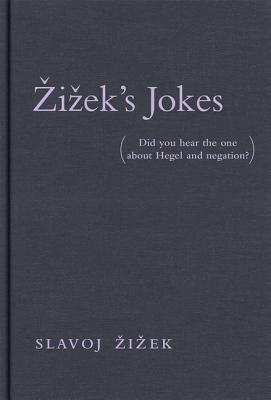
Žižek's Jokes [图书] 豆瓣
作者: Slavoj Žižek 出版社: The MIT Press 2018 - 2
Žižek as comedian: jokes in the service of philosophy.
“A serious and good philosophical work could be written consisting entirely of jokes.”―Ludwig Wittgenstein
The good news is that this book offers an entertaining but enlightening compilation of Žižekisms. Unlike any other book by Slavoj Žižek, this compact arrangement of jokes culled from his writings provides an index to certain philosophical, political, and sexual themes that preoccupy him. Žižek's Jokes contains the set-ups and punch lines―as well as the offenses and insults―that Žižek is famous for, all in less than 200 pages.
So what's the bad news? There is no bad news. There's just the inimitable Slavoj Žižek, disguised as an impossibly erudite, politically incorrect uncle, beginning a sentence, “There is an old Jewish joke, loved by Derrida...“ For Žižek, jokes are amusing stories that offer a shortcut to philosophical insight. He illustrates the logic of the Hegelian triad, for example, with three variations of the “Not tonight, dear, I have a headache” classic: first the wife claims a migraine; then the husband does; then the wife exclaims, “Darling, I have a terrible migraine, so let's have some sex to refresh me!” A punch line about a beer bottle provides a Lacanian lesson about one signifier. And a “truly obscene” version of the famous “aristocrats” joke has the family offering a short course in Hegelian thought rather than a display of unspeakables.
Žižek's Jokes contains every joke cited, paraphrased, or narrated in Žižek's work in English (including some in unpublished manuscripts), including different versions of the same joke that make different points in different contexts. The larger point being that comedy is central to Žižek's seriousness.
Mythology, Madness, and Laughter [图书] 豆瓣
作者: Markus Gabriel / Slavoj Žižek 出版社: Continuum 2009 - 10
This is a hugely important book that rediscovers three crucial, but long overlooked themes in German idealism: mythology, madness and laughter. "Mythology, Madness and Laughter: Subjectivity in German Idealism" explores some long neglected but crucial themes in German idealism. Markus Gabriel, one of the most exciting young voices in contemporary philosophy, and Slavoj Zizek, the celebrated contemporary philosopher and cultural critic, show how these themes impact on the problematic relations between being and appearance, reflection and the absolute, insight and ideology, contingency and necessity, subjectivity, truth, habit and freedom. Engaging with three central figures of the German idealist movement, Hegel, Schelling and Fichte, Gabriel and Zizek, who here shows himself to be one of the most erudite and important scholars of German idealism, ask how is it possible for Being to appear in reflection without falling back into traditional metaphysics. By applying idealistic theories of reflection and concrete subjectivity, including the problem of madness and everydayness in Hegel, this hugely important book aims to reinvigorate a philosophy of finitude and contingency, topics at the forefront of contemporary European philosophy.
Looking Awry [图书] 豆瓣
作者: Slavoj Žižek 出版社: The MIT Press 1991 - 5
Slavoj Zizek provides a virtuoso reading of the psychoanalytic theory of Jacques Lacan through the works of contemporary popular culture, from horror fiction and detective thrillers to popular romances and Hitchcock films.

這本書比較淺易,而且對一些精神分析的基本術語如欲望、驅力、幻象等等都有一些容易捕捉的界定,堪稱齊澤克入門。
The Parallax View [图书] 豆瓣 Goodreads
作者: Slavoj Žižek 出版社: The MIT Press 2006 - 2
The Parallax View is Slavoj Zizek's most substantial theoretical work to appear in many years; Zizek himself describes it as his magnum opus. Parallax can be defined as the apparent displacement of an object, caused by a change in observational position. Zizek is interested in the "parallax gap" separating two points between which no synthesis or mediation is possible, linked by an "impossible short circuit" of levels that can never meet. From this consideration of parallax, Zizek begins a rehabilitation of dialectical materialism.Modes of parallax can be seen in different domains of today's theory, from the wave-particle duality in quantum physics to the parallax of the unconscious in Freudian psychoanalysis between interpretations of the formation of the unconscious and theories of drives. In The Parallax View, Zizek, with his usual astonishing erudition, focuses on three main modes of parallax: the ontological difference, the ultimate parallax that conditions our very access to reality; the scientific parallax, the irreducible gap between the phenomenal experience of reality and its scientific explanation, which reaches its apogee in today's brain sciences (according to which "nobody is home" in the skull, just stacks of brain meat--a condition Zizek calls "the unbearable lightness of being no one"); and the political parallax, the social antagonism that allows for no common ground. Between his discussions of these three modes, Zizek offers interludes that deal with more specific topics--including an ethical act in a novel by Henry James and anti-anti-Semitism.The Parallax View not only expands Zizek's Lacanian-Hegelian approach to new domains (notably cognitive brain sciences) but also provides the systematic exposition of the conceptual framework that underlies his entire work. Philosophical and theological analysis, detailed readings of literature, cinema, and music coexist with lively anecdotes and obscene jokes.
Looking Awry [图书] 豆瓣
作者: Slavoj Žižek 出版社: The MIT Press 1992 - 9
Slavoj Zizek, a leading intellectual in the new social movements that are sweeping Eastern Europe, provides a virtuoso reading of Jacques Lacan. Zizek inverts current pedagogical strategies to explain the difficult philosophical underpinnings of the French theoretician and practician who revolutionized our view of psychoanalysis. He approaches Lacan through the motifs and works of contemporary popular culture, from Hitchcock's Vertigo to Stephen King's Pet Sematary, from McCullough's An Indecent Obsession to Romero's Return of the Living Dead - a strategy of "looking awry" that recalls the exhilarating and vital experience of Lacan.Zizek discovers fundamental Lacanian categories the triad Imaginary/Symbolic/Real, the object small a, the opposition of drive and desire, the split subject - at work in horror fiction, in detective thrillers, in romances, in the mass media's perception of ecological crisis, and, above all, in Alfred Hitchcock's films. The playfulness of Zizek's text, however, is entirely different from that associated with the deconstructive approach made famous by Derrida. By clarifying what Lacan is saying as well as what he is not saying, Zizek is uniquely able to distinguish Lacan from the poststructuralists who so often claim him.Slavoj Zizek is a Researcher in the Institute of Sociology at the University of Ljubljana, Yugoslavia. His work has been published in France and in Yugoslavia where, running as a proreform candidate, he narrowly missed being elected to the presidency of the republic of Slovenia.
Žižek's Jokes [图书] 豆瓣
作者: Slavoj Žižek / Audun Mortensen 出版社: The MIT Press 2014 - 3
“A serious and good philosophical work could be written consisting entirely of jokes."—Ludwig Wittgenstein
The good news is that this book offers an entertaining but enlightening compilation of Žižekisms. Unlike any other book by Slavoj Žižek, this compact arrangement of jokes culled from his writings provides an index to certain philosophical, political, and sexual themes that preoccupy him. Žižek’s Jokes contains the set-ups and punch lines—as well as the offenses and insults—that Žižek is famous for, all in less than 200 pages.
So what’s the bad news? There is no bad news. There’s just the inimitable Slavoj Žižek, disguised as an impossibly erudite, politically incorrect uncle, beginning a sentence, “There is an old Jewish joke, loved by Derrida . . .“ For Žižek, jokes are amusing stories that offer a shortcut to philosophical insight. He illustrates the logic of the Hegelian triad, for example, with three variations of the “Not tonight, dear, I have a headache" classic: first the wife claims a migraine; then the husband does; then the wife exclaims, “Darling, I have a terrible migraine, so let’s have some sex to refresh me!" A punch line about a beer bottle provides a Lacanian lesson about one signifier. And a “truly obscene" version of the famous “aristocrats" joke has the family offering a short course in Hegelian thought rather than a display of unspeakables.
Žižek’s Jokes contains every joke cited, paraphrased, or narrated in Žižek’s work in English (including some in unpublished manuscripts), including different versions of the same joke that make different points in different contexts. The larger point being that comedy is central to Žižek’s seriousness.
The Fright of Real Tears [图书] 豆瓣
作者: Slavoj Žižek 出版社: British Film Institute 2001 - 11
In this study the author challenges both cognitivist-historicist accounts of cinema and conventional film-theory. Arguing that the reading of Lacan operative in the 1970s and 1980s was particularly reductive, he asserts that there is "another Lacan" in reference to whom film theory, cultural studies and critical thought as such can be transformed and revitalized. He supports this argument with readings of Tarkovsky ("Stalker", "Nostalghia"), Kieslowski (the "Three Colours Trilogy") and Lynch ("Lost Highways"), demonstrating how their work can be saved from obscurantist analysis by Lacanian interpretation.
Zizek's Jokes [图书] 豆瓣 Goodreads 谷歌图书
7.7 (6 个评分) 作者: Slavoj Žižek 出版社: The MIT Press 2014 - 2
“A serious and good philosophical work could be written consisting entirely of jokes.”—Ludwig Wittgenstein
The good news is that this book offers an entertaining but enlightening compilation of Žižekisms. Unlike any other book by Slavoj Žižek, this compact arrangement of jokes culled from his writings provides an index to certain philosophical, political, and sexual themes that preoccupy him. Žižek’s Jokes contains the set-ups and punch lines—as well as the offenses and insults—that Žižek is famous for, all in less than 200 pages.
So what’s the bad news? There is no bad news. There’s just the inimitable Slavoj Žižek, disguised as an impossibly erudite, politically incorrect uncle, beginning a sentence, “There is an old Jewish joke, loved by Derrida . . .“ For Žižek, jokes are amusing stories that offer a shortcut to philosophical insight. He illustrates the logic of the Hegelian triad, for example, with three variations of the “Not tonight, dear, I have a headache” classic: first the wife claims a migraine; then the husband does; then the wife exclaims, “Darling, I have a terrible migraine, so let’s have some sex to refresh me!” A punch line about a beer bottle provides a Lacanian lesson about one signifier. And a “truly obscene” version of the famous “aristocrats” joke has the family offering a short course in Hegelian thought rather than a display of unspeakables.
Žižek’s Jokes contains every joke cited, paraphrased, or narrated in Žižek’s work in English (including some in unpublished manuscripts), including different versions of the same joke that make different points in different contexts. The larger point being that comedy is central to Žižek’s seriousness.
The Courage of Hopelessness [图书] 豆瓣
作者: Slavoj Žižek 出版社: Allen Lane 2017 - 5
In these troubled times, even the most pessimistic diagnosis of our future ends with an uplifting hint that things might not be as bad as all that, that there is light at the end of the tunnel.
Yet, argues Slavoj Žižek, it is only when we have admit to ourselves that our situation is completely hopeless - that the light at the end of the tunnel is in fact the headlight of a train approaching us from the opposite direction - that fundamental change can be brought about.
Surveying the various challenges in the world today, from mass migration and geopolitical tensions to terrorism, the explosion of rightist populism and the emergence of new radical politics - all of which, in their own way, express the impasses of global capitalism - Žižek explores whether there still remains the possibility for genuine change. Today, he proposes, the only true question is, or should be, this: do we endorse the predominant acceptance of capitalism as a fact of human nature, or does today's capitalism contain strong enough antagonisms to prevent its infinite reproduction? Can we, he asks, move beyond the failure of socialism, and beyond the current wave of populist rage, and initiate radical change before the train hits?
Like A Thief In Broad Daylight [图书] 豆瓣
作者: Slavoj Žižek 出版社: Allen Lane 2018 - 9
In recent years, techno-scientific progress has started to utterly transform our world - changing it almost beyond recognition. In this extraordinary new book, renowned philosopher Slavoj Zizek turns to look at the brave new world of Big Tech, revealing how, with each new wave of innovation, we find ourselves moving closer and closer to a bizarrely literal realisation of Marx's prediction that 'all that is solid melts into air.' With the automation of work, the virtualisation of money, the dissipation of class communities and the rise of immaterial, intellectual labour, the global capitalist edifice is beginning to crumble, more quickly than ever before-and it is now on the verge of vanishing entirely.
But what will come next? Against a backdrop of constant socio-technological upheaval, how could any kind of authentic change take place? In such a context, Zizek argues, there can be no great social triumph - because lasting revolution has already come into the scene, like a thief in broad daylight, stealing into sight right before our very eyes. What we must do now is wake up and see it.
Urgent as ever, Like a Thief in Broad Daylight illuminates the new dangers as well as the radical possibilities thrown up by today's technological and scientific advances, and their electrifying implications for us all.
Reading Hegel [图书] 豆瓣
作者: Slavoj Žižek / Frank Ruda 出版社: Polity 2022 - 2
A spirit is haunting contemporary thought – the spirit of Hegel. All the powers of academia have entered into a holy alliance to exorcize this spirit: Vitalists and Eschatologists, Transcendental Pragmatists and Speculative Realists, Historical Materialists and even ‘liberal Hegelians’.Which of these groups has not been denounced as metaphysically Hegelian by its opponents? And which has not hurled back the branding reproach of Hegelian metaphysics in its turn? Progressives, liberals and reactionaries alike receive this condemnation.In light of this situation, it is high time that true Hegelians should openly admit their allegiance and, without obfuscation, express the importance and validity of Hegelianism to the contemporary intellectual scene.To this end, a small group of Hegelians of different nationalities have assembled to sketch the following book – a book which addresses a number of pressing issues that a contemporary reading of Hegel allows a new perspective on: our relation to the future, our relation to nature and our relation to the absolute.
First as Tragedy, Then as Farce [图书]
First as Tragedy, Then as Farce
作者: Slavoj Žižek
Billions of dollars have been hastily poured into the global banking system in a frantic attempt at financial stabilization. So why has it not been possible to bring the same forces to bear in addressing world poverty and environmental crisis?
In this take-no-prisoners analysis, Slavoj Žižek frames the moral failures of the modern world in terms of the epoch-making events of the first decade of this century. What he finds is the old one-two punch of history: the jab of tragedy, the right hook of farce. In the attacks of 9/11 and the global credit crunch, liberalism dies twice: as a political doctrine, and as an economic theory.
is a call for the Left to reinvent itself in the light of our desperate historical situation. The time for liberal, moralistic blackmail is over.
Welcome to the Desert of the Real: Five Essays on September 11 and Related Dates [图书]
Welcome to the Desert of the Real: Five Essays on September 11 and Related Dates
作者: Slavoj Žižek 出版社: Verso 2002 - 10
Liberals and conservatives proclaim the end of the American holiday from history. Now the easy games are over; one should take sides. Žižek argues this is precisely the temptation to be resisted. In such moments of apparently clear choices, the real alternatives are most hidden.
steps back, complicating the choices imposed on us. It proposes that global capitalism is fundamentalist and that America was complicit in the rise of Muslim fundamentalism. It points to our dreaming about the catastrophe in numerous disaster movies before it happened, and explores the irony that the tragedy has been used to legitimize torture. Last but not least it analyzes the fiasco of the predominant leftist response to the events.
Pandemic! COVID-19 Shakes the World [图书] 豆瓣
作者: Slavoj Žižek 出版社: OR Books
"We live in a moment when the greatest act of love is to stay distant from the object of your affection. When governments renowned for ruthless cuts in public spending can suddenly conjure up trillions. When toilet paper becomes a commodity as precious as diamonds. And when according to Zizek, a new form of communism may be the only way of averting a descent into global barbarism.
Written with his customary brio and love of analogies in popular culture (Quentin Tarantino and H. G. Wells sit next to Hegel and Max in these pages), Žižek provides a concise and provocative snapshot of the crisis as it widens, engulfing us all."
Parallax [图书] 豆瓣
作者: Dominik Finkelde / Slavoj Žižek 出版社: Bloombury 2021 - 8
Parallax, or the change in the position of an object viewed along two different lines of sight and more precisely, the assumption that this adjustment is not only due to a change of focus, but a change in that object's ontological status has been a key philosophical concept throughout history.
Building upon Slavoj Žižek's The Parallax View, this volume shows how parallax is used as a figure of thought that proves how the incompatibility between the physical and the theoretical touches not only upon the ontological, but also politics and aesthetics. With articles written by internationally renowned philosophers such as Frank Ruda, Graham Harman, Paul Livingston and Zizek himself, this book shows how modes of parallax remain in numerous modern theoretical disciplines, such as the Marxian parallax in the critique of political economy and politics; and the Hegelian parallax in the concept of the work of art, while also being important to debates surrounding speculative realism and dialectical materialism. Spanning philosophy, parallax is then a rich and fruitful concept that can illuminate the studies of those working in epistemology, ontology, German Idealism, political philosophy and critical theory.