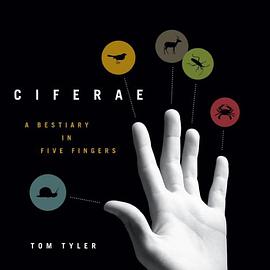
The Greek philosopher Protagoras, in the opening words of his lost book "Truth," famously asserted, "Man is the measure of all things." This contention--that humanity cannot know the world except by means of human aptitudes and abilities--has endured through the centuries in the work of diverse writers. In this bold and creative new investigation into the philosophical and intellectual parameters of the question of the animal, Tom Tyler explores a curious fact: in arguing or assuming that knowledge is characteristically human, thinkers have time and again employed animals as examples, metaphors, and fables. From Heidegger's lizard and Popper's bees to Saussure's ox and Freud's wolves, Tyler points out, "we find a multitude of brutes and beasts crowding into the texts to which they are supposedly unwelcome." Inspired by the medieval bestiaries, Tyler's book features an assortment of "wild animals" ("ferae")--both real and imaginary--who appear in the works of philosophy as mere "ciferae," or ciphers; each is there deployed as a placeholder, of no importance or worth in their own right. Examining the work of such figures as Bataille, Moore, Nietzsche, Kant, Whorf, Darwin, and Derrida, among others, Tyler identifies four ways in which these animals have been used and abused: as interchangeable ciphers; as instances of generalized animality; as anthropomorphic caricatures; and as repetitive stereotypes. Looking closer, however, he finds that these unruly beasts persistently and mischievously question the humanist assumptions of their would-be employers. Tyler ultimately challenges claims of human distinctiveness and superiority, which are so often represented by the supposedly unique and perfect human hand. Contrary to these claims, he contends that the hand is, in fact, a primitive organ, and one shared by many different creatures, thereby undercutting one of the foundations of anthropocentricism and opening up the possibility of nonhuman, or more-than-human, knowledge.