What if They Went to Moscow?
Douban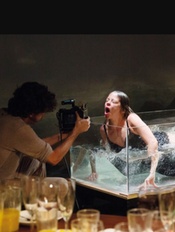
overview
”What With They Went to Moscow?” is the continuity of the research on the relation between theater and cinema on the scene, and of the transposition of the classics to the contemporary reality. The adaptation brings the protagonism of the play to focus on the characters of “The Three Sisters”. The basis of dramaturgy is the text of Anton Tchekhov “The Three Sisters” and the utopia they create about this “other place” called Moscow.
It is the mirror game between theater and cinema. Happening simultaneously in two distinct spaces, the cinematographic images are captured in the theater by three cameras that are integrated to the scene. The film is assembled live and sent to another space, a movie theater, the instant the audio is being mixed. Theater and cinema are happening in the present time, but seen in different spaces and viewpoints.
The challenge is to build two works that exist fully in their territories, but which complement each other when viewed by the same viewer as a unique work. The presence of the cameras needs to be absorbed by the dramaturgy of the scene, since the video projection happen in another environment.
Each camera is related to one of the sisters. Irina, the youngest, has a camera she herself uses, which is more documentary. Olga, the most static, has a camera that is only moved on the tripod and has the function of revealing the house – the architecture of the space and the most open frames – and Macha lovingly relates to her camera. In the theater, Macha’s relationship is with the cameraman, who looks through the viewer, so that in the cinema her look can be directed directly to the camera / lover. In this way, the look of this character, and his desire, is for what it is – for the public, for the cinema. The audience of the theater also has two layers of performance – real and fictional – as the actresses. The viewers are themselves and also the party guests – and sometimes movie extras. The technicians are also integrated into the action, and move the set / stage, the tripods and cables in the theater, being characters from the movie and from Irina’s party. Everything in the theater is apparent and in the service of the scene to realize the film, that has no pre-filmed image.
Premiered at Espaço Sesc Copacabana (Rio de Janeiro, march 2014) and at Sesc Belenzinho (São Paulo, july 2014). Won the awards Shell 2015 for best direction and best actress (Stella Rabello), APTR 2015 Award for best direction, Questão de crítica – best direction 2015, Questão de crítica – best show 2015.