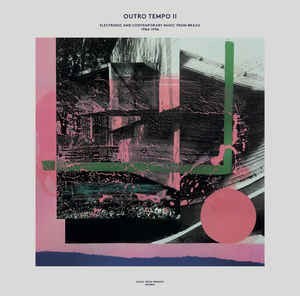
In Brazilian political history, 1985 marks a turning point, the year a 21-year-old dictatorship gave way to the Nova República. In his liner notes for Outro Tempo II: Electronic And Contemporary Music from Brazil, 1984-1996, the London-based DJ John Gómez points out that young, middle-class musicians who came of age during this period could no longer identify with the social messages of the then-dominant MPB (AKA música popular brasileira), a style of music from the '60s that pulled from bossa nova, samba, baião and other traditional genres, often using lyrics for a political twist. The Brazilian cultural historian Marcos Napolitano writes that, by hiding in plain sight within the atmosphere of censorship and suppression in '70s Brazil, MPB helped "to build a meaning for the social experience of resistance to the military regime," using a "poetic-musical synthesis." Gilberto Gil, one of MPB's most recognizable artists, was imprisoned by the regime in 1969 without reason, presumably for the latent political content of his music. The liberalization of the regime and its eventual fall in 1985 provided a respite from these cultural battlegrounds, and the art of encoded resistance gave way to more explicit modes of counter-cultural expression. At first glance, it seems like the new social order sent artists in two directions: into the jungle, to explore the ideas and sounds of the country's indigenous cultures, and into the cities, where they had access to new electronic equipment and imported records from around the world.
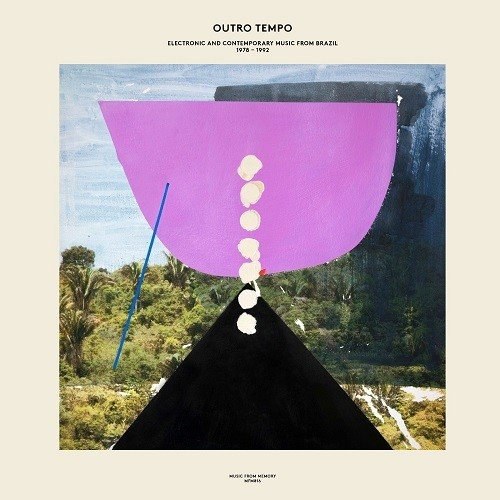
Spanning 20 tracks across two LPs, Outro Tempo II is the second compilation of rare Brazilian music from Gómez and the Amsterdam label Music From Memory. Rather than picking up where the first instalment left off, it begins and ends a few years later. (The first Outro Tempo spans 1978 through 1992.) Overlapping in both era and influences, Outro Tempo II widens the scope of the type of projects that were sprouting from Brazil's fertile underground scene, while also acknowledging the interconnectedness of seemingly independent sounds.
Although Gómez writes that the music on Outro Tempo II signifies a "drifting away from the rainforest and into the pulsating heart of Brazil's immense and overpowering cities," he acknowledges that much of it still indicates "a pull towards the environment." The compilation does well not to pit these two absolutes against each other, instead revealing the mix of artists and movements drawing from urban centers and forest fringes who could freely exchange ideas and drift between genres.
The first track, May East's "Maraka," is a synth pop jam situating the album firmly in the middle of São Paulo's nascent electronic music scene. Originally from her debut album, Remota Batucada, it features keyboard synthesizers, drum machines and a catchy chorus. Akira S serves up more indelible '80s synth sounds on "Tokei," though there's a relationship between the two artists that goes beyond sonic similarity. Akira S played a central role in producing May East's second album, Tabaporã, which focused more explicitly on indigenous cultures and brought both artists' respective takes on '80s electrónica into the forest. Although no tracks from this album feature on Outro Tempo II, the presence of the two collaborators points to the multitude of unique identities forming in these circles.
Akira S appears again on Outro Tempo II playing the surdo, a large bass drum used in samba, on "Samba Do Morro" by the one-hit-wonder band Chance. Synthesizers add a darkly modern twist to accompanying maracas and shakers. It's a melancholic take on the traditional rhythms that first rose to national prominence in the '60s and '70s. This song isn't quite a bottom-of-the-crate find, as it's been included on at least two compilations put out by European labels in the past. In fact, Não Wave: Brazilian Post Punk 1982-1988 and The Sexual Lives Of Savages: Underground Post-Punk from São Paulo, Brazil, both released in 2005, overlap sonically with Outro Tempo II. They present a narrower definition of underground music from that period, but are good resources for those who want to hear more from the explicitly no wave-influenced scene.
Just as no wave and contemporary art went hand in hand in '70s and '80s New York, São Paulo's art scene fostered projects at the most experimental end of the spectrum. The electronic duo Dequinha E Zaba would perform in gallery spaces, uttering monotone incantations over synthesizers in a way that brought together poetry, music and shamanism. Gómez highlights the importance of context for some of these musicians' live performances. Fausto Fawcett, who features twice on Outro Tempo II, would perform from his album of "porno-futuristic opera" music to the accompaniment of video art.
Outro Tempo II ends on a joyful note with Tião Neto's "Carrousel." The off-kilter and stuttered sampling of children's voices brings to mind Psychic TV's 1990 cover of "Are You Experienced" by Jimi Hendrix, which featured vocals by Genesis P-Orridge's daughter. That said, "Carrousel" shirks heavy psychedelia for a bouncing kalimba melody. It's a weird and wonderful finale to a compilation that demonstrates the diversity of Brazilian music.
The end of Brazil's military regime didn't mean an end to art with messages of political resistance. It also didn't signify a radical break from the sounds of the past—the influence of boss nova and samba instrumentals are evident in this compilation. Napolitano, the Brazilian cultural historian, described popular music as a field "for reflection on social history." If this is the case, then Outro Tempo II reflects a society seeking to hear sounds previously silenced, from urban noise to indigenous melodies, while establishing an irreverence toward the mores of their past.