中国佛教
Readings of the Platform Sutra 豆瓣
作者: Morten Schlütter / Stephen Teiser 出版社: Columbia University Press 2012 - 3
The Platform Sutra comprises a wide range of important Chan/Zen Buddhist teachings. Purported to contain the autobiography and sermons of Huineng (638--713), the legendary Sixth Patriarch of Chan, the sutra has been popular among monastics and the educated elite for centuries. The first study of its kind in English, this volume offers essays that introduce the history and ideas of the sutra to a general audience and interpret its practices. Leading specialists on Buddhism discuss the text's historical background and its vaunted legacy in Chinese culture. Incorporating recent scholarship and theory, chapters include an overview of Chinese Buddhism, the crucial role of the Platform Sutra in the Chan tradition, and the dynamics of Huineng's biography. They probe the sutra's key philosophical arguments, its paradoxical teachings about transmission, and its position on ordination and other institutions. The book includes a character glossary and extensive bibliography, with helpful references for students, general readers, and specialists throughout. The editors and contributors are among the most respected scholars in the study of Buddhism, and they assess the place of the Platform Sutra in the broader context of Chinese thought, opening the text to all readers interested in Asian culture, literature, spirituality, and religion.
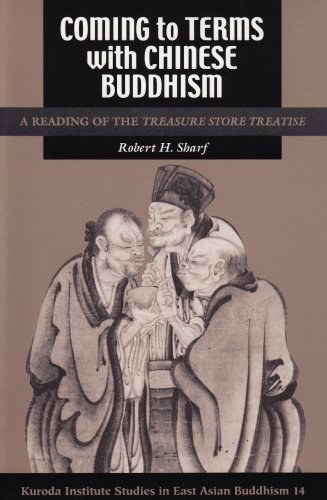
Coming to Terms with Chinese Buddhism 豆瓣
寶藏論
作者: Robert H. Sharf 出版社: University of Hawaii Press 2005 - 11
Chinese Buddhism is often portrayed as the product of a protracted encounter between Indian Buddhism and Chinese civilization, an encounter that led to the "sinification" of Buddhist teachings and practices. In a masterful display of scholarship, Robert Sharf makes a major contribution to the re-evaluation of the encounter. He shows that, although the Chinese were cognizant of the foreign origins of Buddhism, their actual exposure to South Asian clerics and Sanskrit texts was limited throughout medieval times. For the most part, Sharf argues, the Chinese dialogue with Buddhism took place among the Chinese themselves. That being the case, Chinese Buddhism is more properly approached as a product of sinitic culture, not a distorted reflection of normative Indian Buddhist prototypes. Sharf draws his argument in part from a close analysis of an obscure, nominally Buddhist text, the Treasure Store Treatise (Pao-tsang lun). The book begins with a careful reconstruction of historical and religious provenance of the text. It next turns to an analysis of internal evidence to demonstrate the close affinity between the Treatise and texts associated with Ox-head Ch'an and Twofold-Mystery Taoism. There follows a fascinating discussion of the metaphysical underpinnings of the Treatise in Chinese "correlative cosmology", in which Sharf points out the degree to which the metaphysical notion of "sympathetic resonance" (kan-ying) structured the medieval Chinese understanding of virtually all aspects of Buddhist doctrine, ritual, and soteriology. The introductory section is followed by a translation of the three chapters of the Treatise, including lengthy annotation that provides extended philologicaland philosophical discussion of dozens of key terms and concepts. The study concludes with a critical analysis of the place of Tantric, or Esoteric, Buddhism within the Chinese Buddhist tradition.
Spreading Buddha's Word in East Asia 豆瓣
作者: Jiang Wu / Lucille Chia 出版社: Columbia University Press 2015
A monumental work in the history of religion, the history of the book, the study of politics, and bibliographical research, this volume follows the making of the Chinese Buddhist canon from the fourth century to the digital era. Approaching the subject from a historical perspective, it ties the religious, social, and textual practices of canon formation to the development of East Asian Buddhist culture and enlivens Chinese Buddhist texts for readers interested in the evolution of Chinese writing and the Confucian and Daoist traditions.
The collection undertakes extensive readings of major scriptural catalogs from the early manuscript era as well as major printed editions, including the Kaibao Canon, Qisha Canon, Goryeo Canon, and Taisho Canon. Contributors add fascinating depth to such understudied issues as the historical process of compilation, textual manipulation, physical production and management, sponsorship, the dissemination of various editions, cultic activities surrounding the canon, and the canon's reception in different East Asian societies. The Chinese Buddhist canon is one of the most enduring textual traditions in East Asian religion and culture, and through this exhaustive, multifaceted effort, an essential body of work becomes part of a new, versatile narrative of East Asian Buddhism that has far-reaching implications for world history.