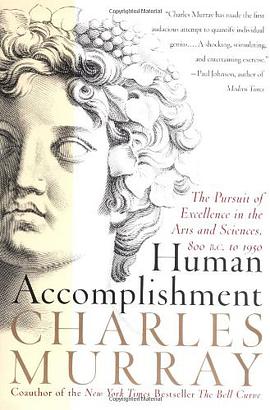
Human Accomplishment 豆瓣 Goodreads
作者:
Charles Murray
出版社:
Harper Perennial
2004
- 11
A sweeping cultural survey reminiscent of Barzun's From Dawn to Decadence . "At irregular times and in scattered settings, human beings have achieved great things. Human Accomplishment is about those great things, falling in the domains known as the arts and sciences, and the people who did them.' So begins Charles Murray's unique account of human excellence, from the age of Homer to our own time. Employing techniques that historians have developed over the last century but that have rarely been applied to books written for the general public, Murray compiles inventories of the people who have been essential to the stories of literature, music, art, philosophy, and the sciences—a total of 4,002 men and women from around the world, ranked according to their eminence. The heart of Human Accomplishment is a series of enthralling descriptive chapters: on the giants in the arts and what sets them apart from the merely great; on the differences between great achievement in the arts and in the sciences; on the meta-inventions, 14 crucial leaps in human capacity to create great art and science; and on the patterns and trajectories of accomplishment across time and geography. Straightforwardly and undogmatically, Charles Murray takes on some controversial questions. Why has accomplishment been so concentrated in Europe? Among men? Since 1400? He presents evidence that the rate of great accomplishment has been declining in the last century, asks what it means, and offers a rich framework for thinking about the conditions under which the human spirit has expressed itself most gloriously. Eye-opening and humbling, Human Accomplishment is a fascinating work that describes what humans at their best can achieve, provides tools for exploring its wellsprings, and celebrates the continuing common quest of humans everywhere to discover truths, create beauty, and apprehend the good.