列文森中国研究书籍奖
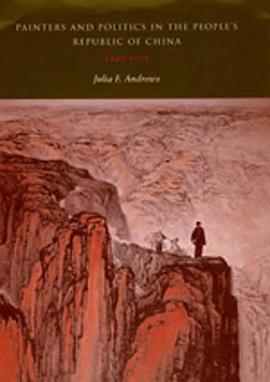
Painters and Politics in the People's Republic of China, 1949-1979 豆瓣
作者: Julia F. Andrews 出版社: University of California Press 1995 - 1
Julia Andrews's extraordinary study of art, artists, and artistic policy during the first three decades of the People's Republic of China makes a major contribution to our understanding of modern China. From 1949 to 1979 the Chinese government controlled the lives and work of the country's artists—these were also years of extreme isolation from international artistic dialogue. During this period the Chinese Communist Party succeeded in eradicating most of the artistic styles and techniques it found politically repugnant. By 1979, traditional landscape painting had been replaced by a new style and subject that was strikingly different from both contemporary Western art and that of other Chinese areas such as Taiwan, Hong Kong, and Singapore.
Through vivid firsthand accounts, Andrews recreates the careers of many individual artists who were forced to submit to a vacillating policy regarding style, technique, medium, and genre. She discusses the cultural controls that the government used, the ways in which artists responded, and the works of art that emerged as a result. She particularly emphasizes the influence of the Soviet Union on Chinese art and the problems it created for the practice of traditional painting.
This book opens the way to new, stimulating comparisons of Western and Eastern cultures and will be welcomed by art historians, political scientists, and scholars of Asia.
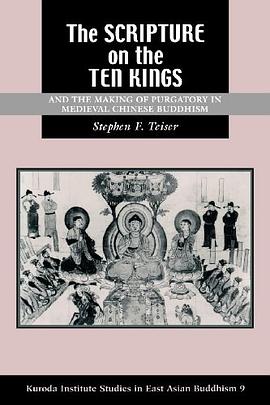
The Scripture on the Ten Kings and the Making of Purgatory in Medieval Chinese Buddhism 豆瓣
作者: Stephen F. Teiser 出版社: University of Hawaii Press 2003 - 4
Between the seventh and ninth centuries, the Chinese mind became preoccupied with a concept of the afterlife that persists into modern times. To be reborn, the deceased must successfully negotiate passage through ten courts of law, each ruled by a magistrate or king. The pains of transition from death to rebirth can be alleviated by the intercession of the living with contributions to the Buddhist church and bribes of spirit money. The cosmology, morality, and rituals of the ten kings are described for the first time in surviving sources in an illustrated text, The Scripture on the Ten Kings, which is here translated for the first time.
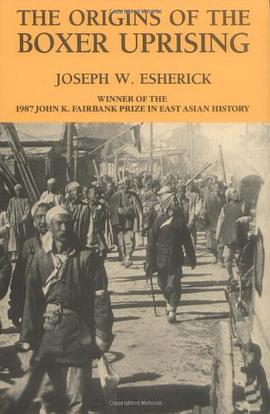
The Origins of the Boxer Uprising 豆瓣 Goodreads
作者: Joseph W. Esherick 出版社: University of California Press 1988 - 8
In the summer of 1900, bands of peasant youths from the villages of north China streamed into Beijing to besiege the foreign legations, attracting the attention of the entire world. Joseph Esherick reconstructs the early history of the Boxers, challenging the traditional view that they grew from earlier anti-dynastic sects, and stressing instead the impact of social ecology and popular culture.
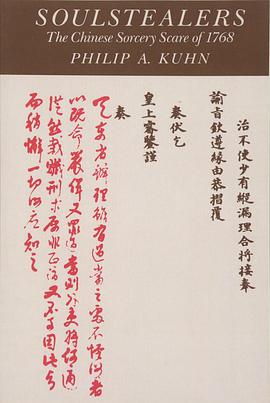
Soulstealers 豆瓣
作者: Philip A. Kuhn 出版社: Harvard University Press 2006 - 11
Midway through the reign of Ch'ien-lung emperor, Hungli, mass hysteria broke out. It was feared that sorcerers were roaming the land clipping off the ends of men's queues (braids worn by royal decree) and chanting magical incantations over them in order to steal the souls of their owners. In this book, Kuhn chronicles this epidemic of fear and the official prosecution of soulstealers that ensued, so opening up a window on 18th-century China. The book raises questions not just about China, but also about past human behaviour in general and it demonstates how in any society, a provincial panic can become a national witch-hunt.
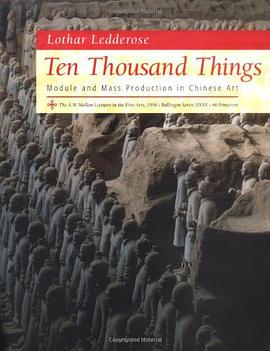
Ten Thousand Things 豆瓣
作者: Lothar Ledderose 出版社: Princeton University Press 2001 - 7
Chinese workers in the third century b.c. created seven thousand life-sized terracotta soldiers to guard the tomb of the First Emperor. In the eleventh century a.d., Chinese builders constructed a pagoda from as many as thirty thousand separately carved wooden pieces. In the seventeenth and eighteenth centuries, China exported more than a hundred million pieces of porcelain to the West. As these examples show, the Chinese throughout history have produced works of art in astonishing quantities - and have done so without sacrificing quality, affordability, or speed of manufacture. How have they managed this? Lothar Ledderose takes us on a remarkable tour of Chinese art and culture to explain how artists used complex systems of mass production to assemble extraordinary objects from standardized parts or modules. As he reveals, these systems have deep roots in Chinese thought - in the idea that the universe consists of ten thousand categories of things, for example - and reflect characteristically Chinese modes of social organization. Ledderose begins with the modular system par excellence: Chinese script, an ancient system of fifty thousand characters produced from a repertoire of only about two hundred components. He shows how Chinese artists used related modular systems to create ritual bronzes, to produce the First Emperor's terracotta army, and to develop the world's first printing systems. He explores the dazzling variety of lacquerware and porcelain that the West found so seductive, and examines how works as diverse as imperial palaces and paintings of hell relied on elegant variation of standardized components. Ledderose explains that Chinese artists, unlike their Western counterparts, did not seek to reproduce individual objects of nature faithfully, but sought instead to mimic nature's ability to produce limitless numbers of objects. He shows as well how modular patterns of thought run through Chinese ideas about personal freedom, China's culture of bureaucracy, Chinese religion, and even the organization of Chinese restaurants. Originally presented as a series of Mellon lectures at the National Gallery of Art, "Ten Thousand Things" combines keen aesthetic and cultural insights with a rich variety of illustrations to make a profound new statement about Chinese art and society.
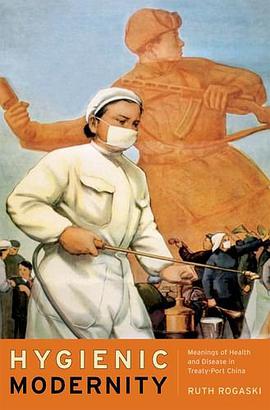
Hygienic Modernity 豆瓣
9.5 (6 个评分) 作者: Ruth Rogaski 出版社: University of California Press 2004 - 11
Placing meanings of health and disease at the center of modern Chinese consciousness, Ruth Rogaski reveals how hygiene became a crucial element in the formulation of Chinese modernity in the nineteenth and twentieth centuries. Rogaski focuses on multiple manifestations across time of a single Chinese concept, weisheng—which has been rendered into English as "hygiene," "sanitary," "health," or "public health"—as it emerged in the complex treaty-port environment of Tianjin. Before the late nineteenth century, weisheng was associated with diverse regimens of diet, meditation, and self-medication. Hygienic Modernity reveals how meanings of weisheng, with the arrival of violent imperialism, shifted from Chinese cosmology to encompass such ideas as national sovereignty, laboratory knowledge, the cleanliness of bodies, and the fitness of races: categories in which the Chinese were often deemed lacking by foreign observers and Chinese elites alike.
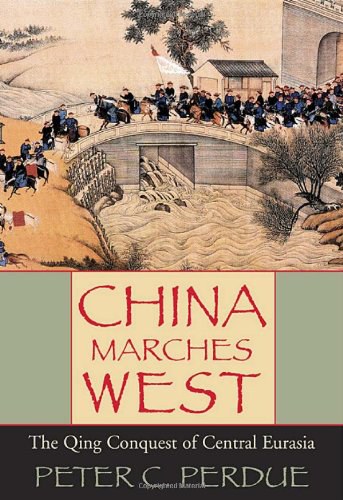
China Marches West 豆瓣 Goodreads
作者: Peter C. Perdue 出版社: Belknap Press of Harvard University Press 2005 - 4
From about 1600 to 1800, the Qing empire of China expanded to unprecedented size. Through astute diplomacy, economic investment, and a series of ambitious military campaigns into the heart of Central Eurasia, the Manchu rulers defeated the Zunghar Mongols, and brought all of modern Xinjiang and Mongolia under their control, while gaining dominant influence in Tibet. The China we know is a product of these vast conquests.<br /><br /><br /><br />Peter C. Perdue chronicles this little-known story of China's expansion into the northwestern frontier. Unlike previous Chinese dynasties, the Qing achieved lasting domination over the eastern half of the Eurasian continent. Rulers used forcible repression when faced with resistance, but also aimed to win over subject peoples by peaceful means. They invested heavily in the economic and administrative development of the frontier, promoted trade networks, and adapted ceremonies to the distinct regional cultures.<br /><br /><br /><br />Perdue thus illuminates how China came to rule Central Eurasia and how it justifies that control, what holds the Chinese nation together, and how its relations with the Islamic world and Mongolia developed. He offers valuable comparisons to other colonial empires and discusses the legacy left by China's frontier expansion. The Beijing government today faces unrest on its frontiers from peoples who reject its autocratic rule. At the same time, China has launched an ambitious development program in its interior that in many ways echoes the old Qing policies.<br /><br /><br /><br />China Marches West is a tour de force that will fundamentally alter the way we understand Central Eurasia.
Statesmen and Gentlemen 豆瓣
作者: Robert Hymes 出版社: Cambridge University Press 1987 - 4
Statesmen and Gentlemen is an important study of the way in which, during the twelfth- and thirteenth-centuries, China's ruling meritocracy was transformed into a locally rooted elite whose principal aim was the consolidation of their power, wealth and influence on a local as opposed to a national and dynastic basis. Professor Hymes offers a remarkable picture of the institutional and social changes this process entailed, but he also examines in detail the subtle ways in which the elite's perception of itself and its social role changed and it came to offer powerful support to local self-defence, social welfare, religious cults and temple-building.