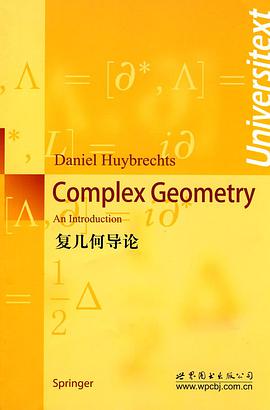
复几何
复几何导论 豆瓣
Complex Geometry: An Introduction
作者: [德] Daniel Huybrechts 出版社: 世界图书出版公司 2010 - 1
《复几何导论(英文版)》内容简介:Complex geometry is a highly attractive branch of modern mathematics that has witnessed many years of active and successful research and that has recently obtained new impetus from physicists' interest in questions related to mirror symmetry. Due to its interactions with various other fields (differential, algebraic, and arithmetic geometry, but also string theory and conformal field theory), it has become an area with many facets. Also, there are a number of challenging open problems which contribute to the subject's attraction. The most famous among them is the Hodge conjecture, one of the seven one-million dollar millennium problems of the Clay Mathematics Institute. So, it seems likely t at this area will fascinate new generations for many years to come.

代数曲线 豆瓣
作者: P.格列菲斯 出版社: 北京大学出版社 2000 - 6
本书是根据美国科学院院士,著名数学家P·格列菲斯在北京大学讲课的讲稿整理写成的。本书篇幅虽不大,但内容丰富,阐述精炼,引人入胜。书中深入浅出地介绍了正则化定理,Riemann-Roch定理,Abel定理等代数曲线论的重要结果,以及这些定理的应用和重要的几何事实。读者只要具有大学复变函数论和抽象代数的基础知识即可阅读此书。 本书可作为大学数学系高年级学生和研究生教材,也可供数学工作者参考。
代数几何原理 豆瓣
作者: 格里菲思(Griffiths.P.) / 哈里斯(Harris.J) 出版社: 世界图书出版公司 2007 - 5
《代数几何原理》主要内容:A third general principle was that this volume should be stir-contained.In particular any "hard" result that would be utilized should be fullyproved. A difficulty a student often faces in a subject as diverse as algebraic geometry is the profusion of cross-references, and this is one reason for attempting to be self-contained. Similarly, we have attempted to avoid allusions to, or statements without proofs of, related results. This book is in no way meant to be a survey of algebraic geometry, but rather is designed to develop a working facility with specific geometric questions.Our approach to the subject is initially analytic: Chapters 0 and 1 treat the basic techniques and results of complex manifold theory, with some emphasis on results applicable to projective varieties. Beginning in Chapter 2 with the theory of Riemann surfaces and algebraic curves, and continu-ing in Chapters 4 and 6 on algebraic surfaces and the quadric line complex, our treatment becomes increasingly geometric along classicallines. Chapters 3 and 5 continue the analytic approach, progressing to more special topics in complex manifolds.