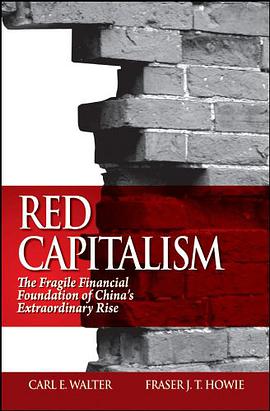
Red Capitalism 豆瓣
作者:
Carl E. Walter
/
Fraser J. T. Howie
出版社:
Wiley
2011
- 2
For many years now China's economy has seemed unstoppable. A slow appreciation of the renminbi in 2007 brought wave upon wave of liquidity into China and allowed its companies and banks to raise hundreds of billions in dollars via stock market listings. State banks that had started the new century as bankrupt relics of a communist past became the darlings of international investors.
Even the collapse of Lehman Brothers in 2008 and the ensuing global financial crisis seemed to have little impact on China as the government quickly responded with a huge stimulus package. But the Lehman collapse was a dramatic wake up call to the Chinese leadership. This model of bank and capital market reform had been studiously emulated for more than a decade and had brought great benefits to China. But now, although they believed it to be bankrupt, the Chinese government were bereft of new ideas. In the face of the global financial crisis the government returned to what it knows best, massive state intervention via the banking system. Ten years of banking and capital market reforms were dead.
In Red Capitalism, Carl Walter and Fraser Howie detail how the Chinese government reformed and modeled its financial system in the 30 years since it began its policy of engagement with the west. Instead of a stable series of policies producing steady growth, China's financial sector has boomed and gone bust with regularity in each decade. The latest decade is little different. Chinese banks have become objects of political struggle while they totter under balance sheets bloated by the excessive state-directed lending and bond issuance of 2009.
Looking forward, the government's response to the global financial crisis has created a banking system the stability of which can be maintained only behind the walls of a non-convertible currency, a myriad of off-balance sheet arrangements with non-public state entities and the strong support of its best borrowers--the politically potent National Champions--who are the greatest beneficiaries of the financial status quo.
China's financial system is not a model for the west and, indeed, is not a sustainable arrangement for China itself as it seeks increasingly to assert its influence internationally. This is not a story of impending collapse, but of frustrated reforms that suggests that any full opening and meaningful reform of the financial sector is not, indeed cannot be, on the government's agenda anytime soon.
Even the collapse of Lehman Brothers in 2008 and the ensuing global financial crisis seemed to have little impact on China as the government quickly responded with a huge stimulus package. But the Lehman collapse was a dramatic wake up call to the Chinese leadership. This model of bank and capital market reform had been studiously emulated for more than a decade and had brought great benefits to China. But now, although they believed it to be bankrupt, the Chinese government were bereft of new ideas. In the face of the global financial crisis the government returned to what it knows best, massive state intervention via the banking system. Ten years of banking and capital market reforms were dead.
In Red Capitalism, Carl Walter and Fraser Howie detail how the Chinese government reformed and modeled its financial system in the 30 years since it began its policy of engagement with the west. Instead of a stable series of policies producing steady growth, China's financial sector has boomed and gone bust with regularity in each decade. The latest decade is little different. Chinese banks have become objects of political struggle while they totter under balance sheets bloated by the excessive state-directed lending and bond issuance of 2009.
Looking forward, the government's response to the global financial crisis has created a banking system the stability of which can be maintained only behind the walls of a non-convertible currency, a myriad of off-balance sheet arrangements with non-public state entities and the strong support of its best borrowers--the politically potent National Champions--who are the greatest beneficiaries of the financial status quo.
China's financial system is not a model for the west and, indeed, is not a sustainable arrangement for China itself as it seeks increasingly to assert its influence internationally. This is not a story of impending collapse, but of frustrated reforms that suggests that any full opening and meaningful reform of the financial sector is not, indeed cannot be, on the government's agenda anytime soon.