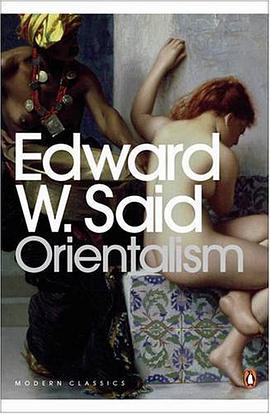
Orientalism 豆瓣
作者:
Edward W. Said
出版社:
Penguin Classics
2007
- 6
Said is best known for describing and critiquing "Orientalism", which he perceived as a constellation of false assumptions underlying Western attitudes toward the East. In Orientalism (1978), Said described the "subtle and persistent Eurocentric prejudice against Arabo-Islamic peoples and their culture."[12] He argued that a long tradition of false and romanticized images of Asia and the Middle East in Western culture had served as an implicit justification for Europe and America's colonial and imperial ambitions. Just as fiercely, he denounced the practice of Arab elites who internalized the American and British orientalists' ideas of Arabic culture.
In 1980 Said criticized what he regarded as poor understanding of the Arab culture in the West:
“ So far as the United States seems to be concerned, it is only a slight overstatement to say that Moslems and Arabs are essentially seen as either oil suppliers or potential terrorists. Very little of the detail, the human density, the passion of Arab-Moslem life has entered the awareness of even those people whose profession it is to report the Arab world. What we have instead is a series of crude, essentialized caricatures of the Islamic world presented in such a way as to make that world vulnerable to military aggression.[13] ”
[edit] The argument
Orientalism has had a significant impact on the fields of literary theory, cultural studies and human geography, and to a lesser extent on those of history and oriental studies. Taking his cue from the work of Jacques Derrida and Michel Foucault, and from earlier critics of western Orientalism such as A. L. Tibawi,[14] Anouar Abdel-Malek,[15] Maxime Rodinson,[16] and Richard William Southern,[17] Said argued that Western writings on the Orient, and the perceptions of the East purveyed in them, are suspect, and cannot be taken at face value. According to Said, the history of European colonial rule and political domination over the East distorts the writings of even the most knowledgeable, well-meaning and sympathetic Western ‘Orientalists’ (a term that he transformed into a pejorative):
“ I doubt if it is controversial, for example, to say that an Englishman in India or Egypt in the later nineteenth century took an interest in those countries which was never far from their status in his mind as British colonies. To say this may seem quite different from saying that all academic knowledge about India and Egypt is somehow tinged and impressed with, violated by, the gross political fact – and yet that is what I am saying in this study of Orientalism. (Said, Orientalism 11) ”
Said contended that Europe had dominated Asia politically so completely for so long that even the most outwardly objective Western texts on the East were permeated with a bias that even most Western scholars could not recognise. His contention was not only that the West has conquered the East politically but also that Western scholars have appropriated the exploration and interpretation of the Orient’s languages, history and culture for themselves. They have written Asia’s past and constructed its modern identities from a perspective that takes Europe as the norm, from which the "exotic", "inscrutable" Orient deviates.
Said concludes that Western writings about the Orient depict it as an irrational, weak, feminised "Other", contrasted with the rational, strong, masculine West, a contrast he suggests derives from the need to create "difference" between West and East that can be attributed to immutable "essences" in the Oriental make-up. In 1978, when the book was first published, with memories of the Yom Kippur war and the OPEC crisis still fresh, Said argued that these attitudes still permeated the Western media and academia. After stating the central thesis, Orientalism consists mainly of supporting examples from Western texts.
In 1980 Said criticized what he regarded as poor understanding of the Arab culture in the West:
“ So far as the United States seems to be concerned, it is only a slight overstatement to say that Moslems and Arabs are essentially seen as either oil suppliers or potential terrorists. Very little of the detail, the human density, the passion of Arab-Moslem life has entered the awareness of even those people whose profession it is to report the Arab world. What we have instead is a series of crude, essentialized caricatures of the Islamic world presented in such a way as to make that world vulnerable to military aggression.[13] ”
[edit] The argument
Orientalism has had a significant impact on the fields of literary theory, cultural studies and human geography, and to a lesser extent on those of history and oriental studies. Taking his cue from the work of Jacques Derrida and Michel Foucault, and from earlier critics of western Orientalism such as A. L. Tibawi,[14] Anouar Abdel-Malek,[15] Maxime Rodinson,[16] and Richard William Southern,[17] Said argued that Western writings on the Orient, and the perceptions of the East purveyed in them, are suspect, and cannot be taken at face value. According to Said, the history of European colonial rule and political domination over the East distorts the writings of even the most knowledgeable, well-meaning and sympathetic Western ‘Orientalists’ (a term that he transformed into a pejorative):
“ I doubt if it is controversial, for example, to say that an Englishman in India or Egypt in the later nineteenth century took an interest in those countries which was never far from their status in his mind as British colonies. To say this may seem quite different from saying that all academic knowledge about India and Egypt is somehow tinged and impressed with, violated by, the gross political fact – and yet that is what I am saying in this study of Orientalism. (Said, Orientalism 11) ”
Said contended that Europe had dominated Asia politically so completely for so long that even the most outwardly objective Western texts on the East were permeated with a bias that even most Western scholars could not recognise. His contention was not only that the West has conquered the East politically but also that Western scholars have appropriated the exploration and interpretation of the Orient’s languages, history and culture for themselves. They have written Asia’s past and constructed its modern identities from a perspective that takes Europe as the norm, from which the "exotic", "inscrutable" Orient deviates.
Said concludes that Western writings about the Orient depict it as an irrational, weak, feminised "Other", contrasted with the rational, strong, masculine West, a contrast he suggests derives from the need to create "difference" between West and East that can be attributed to immutable "essences" in the Oriental make-up. In 1978, when the book was first published, with memories of the Yom Kippur war and the OPEC crisis still fresh, Said argued that these attitudes still permeated the Western media and academia. After stating the central thesis, Orientalism consists mainly of supporting examples from Western texts.