早期近代
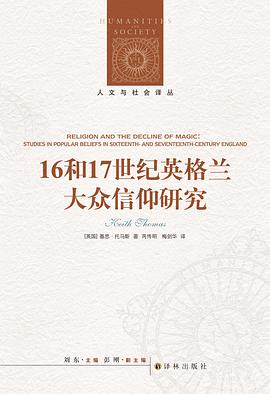
16和17世纪英格兰大众信仰研究 豆瓣
Religion and the Decline of Magic: Studies in Popular Beliefs in Sixteenth- and Seventeenth-Century England
10.0 (5 个评分) 作者: [英] 基思·托马斯 (Keith Thomas) 译者: 芮传明 / 梅剑华 出版社: 译林出版社 2019 - 8
比故事还精彩的史学经典,一览英格兰巫术众生相
Religion and the Decline of Magic
●首届沃尔夫森历史奖获奖作品
●20世纪史学经典,历史人类学流派开山之作
●启蒙运动的另一个维度,科学和理性如何战胜了巫术?
●锁线胶订,经得起反复翻阅
在16和17世纪,妖术、占星术、巫术疗法等大众迷信几乎遍及英格兰的每一个角落,人们相信国王的触摸可以治病,而护身符可以抵御恶灵的侵袭。与此同时,宗教改革试图将巫术从中教会仪式中剥离出来,科学家也不断发现解释万物的全新理论。
托马斯深入英格兰各地档案,用海量的例证和审慎的分析带领我们进入早期现代人类的心智,向我们展示科学和理性如何同古老的信仰体系争夺关于世界的解释权,而基督教又如何跟随大众心智的启蒙,完成了自身的现代化。
具有里程碑意义……每一页都是人间宝藏,这大概是我这辈子最热情地向他人推荐的作品。
——希拉里·曼特尔(《狼厅》作者、两次布克奖得主),《纽约书评》
本书为社会人类学家和历史学家打开了一个广阔的领域……彻底改变了我们对早期现代英国的理解……书中用精彩的论述和丰富的案例,展现了“世界的祛魅”这一韦伯经典命题。
——艾伦·麦克法兰,《今日历史》
一项重大历史成就……范围之广博令人叹为观止,洞见之深刻令人耳目一新……那段历史因为本书而彻底改变。
——《经济史评论》
The Globalization of Knowledge in History 豆瓣
作者: Jürgen Renn 出版社: epubli 2012 - 7
Today scientific, technological and cultural knowledge is shared worldwide. The extent to which globalized knowledge also existed in the past is an open question and, moreover, a question that is important for understanding present processes of globalization. This book, the first volume of the series "Studies" of the "Max Planck Research Library for the History and Development of Knowledge," the result of an interdisciplinary cooperation launched in 2007 by a Dahlem Conference, offers surprising answers to this question.
Long-distance and intercontinental connections with an attendant spread of knowledge are as old as Homo sapiens themselves. Since its inception, the globalization of knowledge has been a process with its own dynamics, interfering significantly with other processes of intercultural transmission. The four parts of this volume address historical phases in which the production, transmission and transformation of knowledge were crucial for advancing these processes. Part 1 investigates a series of processes in the very early phases of globalization, from the transmission of practical knowledge to the emergence of science. Part 2 explores how knowledge was disseminated as a consequence of the spread of power and belief structures. Part 3 deals with the encounters between culturally specific knowledge and globalized knowledge. Part 4 is dedicated to the globalization of modern science and to the great challenges, such as energy supply and climate change, that humanity faces when dealing with knowledge today
The 97th Dahlem Workshop:
The present volume is based on the 97th Dahlem Workshop on Globalization of Knowledge and its Consequences, Berlin, 18–23 November 2007, coordinated by Katharina Ochse.
Participants:
Ian Baldwin, Angelo Baracca, Fabio Bevilacqua, Maria Emilia Beyer, Hans-Peter Blossfeld, Gianluca Bocchi, István M. Bodnár, Jens Erland Braarvig, Chiara Brambilla, Eva Cancik-Kirschbaum, Jacob Dahl, Peter Damerow, Hansjörg Dilger, Kostas Gavroglu, Matteo Gerlini, Denise Gimpel, Gerd Graßhoff, Hans Falk Hoffmann, Dirk Hofäcker, Jarita C. Holbrook, Malcolm D. Hyman, Birgit Krawietz, Manfred Krebernik, Joachim Kurtz, Manolis Patiniotis, Albert Presas I Puig, Daniel T. Potts, Dhruv Raina, Jürgen Renn, Richard Rottenburg, Dagmar Schäfer, Matthias Schemmel, Mark Schiefsky, Meredith Schuman, Gebhard J. Selz, Martina Siebert, Circe Mary Silva da Silva, Ana Simões, Tzveta Sofronieva, Saran Solongo, Karin Tybjerg, Hans Ulrich Vogel, Milena Wazeck, Gerhard Wolf, Harriet T. Zurndorfer