自组织
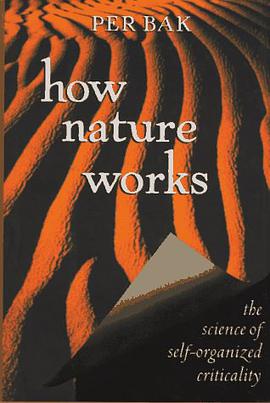
How Nature Works 豆瓣
作者: Per Bak 出版社: Copernicus 1996 - 6
This is a science book, intended for the general reader who is interested in science. The author is a physicist who is well-known for his development of the property called "self-organized Criticality", a property or phenomenon that lies at the heart of large dynamical systems. It can be used to analyse systems that are complicated, and which are part of the new science of complexity. It is a unifying concept that can be used to study phenomena in fields as diverse as economics, astronomy, the earth sciences, and physics. The author discusses his discovery of self-organized criticality; its relation to the world of classical physics; computer simulations and experiments which aid scientist's understanding of the property; and the relation of the subject to popular areas such as fractal geometry and power laws; cellular automata, and a wide range of practical applications. The book is readable without a science background--below the level of Scientific American.
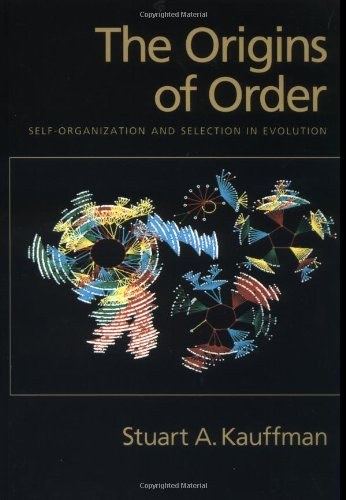
The Origins of Order: Self-Organization and Selection in Evolution Goodreads 豆瓣
作者: Stuart A. Kauffman 出版社: Oxford University Press, U.S.A. 1993 - 6 其它标题: The Origins of Order
Stuart Kauffman here presents a brilliant new paradigm for evolutionary biology, one that extends the basic concepts of Darwinian evolution to accommodate recent findings and perspectives from the fields of biology, physics, chemistry and mathematics. The book drives to the heart of the exciting debate on the origins of life and maintenance of order in complex biological systems. It focuses on the concept of the spontaneous emergence of order that is widely observed throughout nature Kauffman argues that self-organization plays an important role in the Darwinian process of natural selection. Yet until now no systematic effort has been made to incorporate the concept of self-organization into evolutionary theory. The construction requirements which permit complex systems to adapt are poorly understood, as is the extent to which selection itself can yield systems able to adapt more successfully. This book explores these themes. It shows how complex systems,
contrary to expectations, can spontaneously exhibit stunning degrees of order, and how this order, in turn, is essential for understanding the emergence and development of life on Earth. Topics include the new biotechnology of applied molecular evolution, with its important implications for developing new drugs and vaccines; the balance between order and chaos observed in many naturally occurring systems; new insights concerning the predictive power of statistical mechanics in biology; and other major issues. Indeed, the approaches investigated here may prove to be the new center around which biological science itself will evolve. The work is written for all those interested in the cutting edge of research in the life sciences.
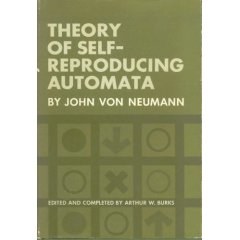
Theory of Self-Reproducing Automata 豆瓣
作者: John von Neumann / Edit by Arthur Burk 出版社: UMl Reprint University Illinois 1966 Ed 2002
该书是一本von Neumann关于“自复制自动机”的研究论文集,由von Neumann在密西根大学的助手Arthur Burk(大名鼎鼎的John Holland的博士导师)整理编辑。
这本书的意义不仅仅在于它实际上开创了“人工生命”、“细胞自动机”等多门复杂性研究的分支。更重要的是,该书将“自我复制”作为生命的一个本质特征加以数学建模的研究。而这套理论和可计算性理论、歌德尔定理以及热力学深深地联系到了一起。这一点也许对于我们研究复杂系统的人来说仍具有重要的意义。
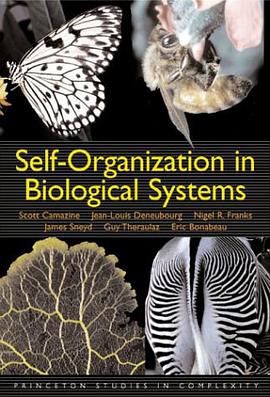
Self-Organization in Biological Systems 豆瓣
作者: Scott Camazine / Jean-Louis Deneubourg 出版社: Princeton University Press 2003 - 8
The synchronized flashing of fireflies at night. The spiraling patterns of an aggregating slime mold. The anastomosing network of army-ant trails. The coordinated movements of a school of fish. Researchers are finding in such patterns - phenomena that have fascinated naturalists for centuries - a fertile new approach to understanding biological systems: the study of self-organization. This book, a primer on self-organization in biological systems for students and other enthusiasts, introduces readers to the basic concepts and tools for studying self-organization and then examines numerous examples of self-organization in the natural world. Self-organization refers to diverse pattern formation processes in the physical and biological world, from sand grains assembling into rippled dunes to cells combining to create highly structured tissues to individual insects working to create sophisticated societies. What these diverse systems hold in common is the proximate means by which they acquire order and structure. In self-organizing systems, pattern at the global level emerges solely from interactions among lower-level components. Remarkably, even very complex structures result from the iteration of surprisingly simple behaviors performed by individuals relying on only local information. This striking conclusion suggests important lines of inquiry: to what degree is environmental rather than individual complexity responsible for group complexity? To what extent have widely differing organisms adopted similar, convergent strategies of pattern formation? How, specifically, has natural selection determined the rules governing interactions within biological systems? Broad in scope, thorough yet accessible, this book is a self-contained introduction to self-organization and complexity in biology - a field of study at the forefront of life sciences research.