<p align="left">
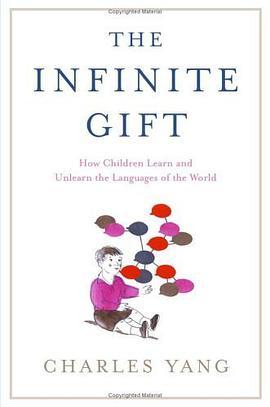
A child's very first word is a miraculous sound, the opening note in a lifelong symphony. Most parents never forget the moment. But that first word is soon followed by a second and a third, and by the age of three, children are typically learning ten new words every day and speaking in complete sentences. The process seems effortless, and for children, it is. But how exactly does it happen? How do children learn language? And why is it so much harder to do later in life?
</p>
<p align="left">
Drawing on cutting-edge developments in biology, neurology, psychology, and linguistics, Charles Yang's The Infinite Gift takes us inside the astonishingly complex but largely subconscious process by which children learn to talk and to understand the spoken word.
</p>
<p align="left">
Yang illuminates the rich mysteries of language: why French newborns already prefer the sound of French to English; why baby-talk, though often unintelligible, makes perfect linguistic sense; why babies born deaf still babble -- but with their hands; why the grammars of some languages may be evolutionarily stronger than others; and why one of the brain's earliest achievements may in fact be its most complex.
</p>
<p align="left">
Yang also puts forth an exciting new theory. Building on Noam Chomsky's notion of a universal grammar -- the idea that every human being is born with an intuitive grasp of grammar -- Yang argues that we learn our native languages in part by unlearning the grammars of all the rest.
</p>
<p align="left">
This means that the next time you hear a child make a grammatical mistake, it may not be a mistake at all; his or her grammar may be perfectly correct in Chinese or Navajo or ancient Greek. This is the brain's way of testing its options as it searches for the local and thus correct grammar -- and then discards all the wrong ones.
</p>
<p align="left">
And we humans, Yang shows, are not the only creatures who learn this way. In fact, learning by unlearning may be an ancient evolutionary mechanism that runs throughout the animal kingdom. Thus, babies learn to talk in much the same way that birds learn to sing.
</p>
<p align="left">
Enlivened by Yang's experiences with his own young son, The Infinite Gift is as charming as it is challenging, as thoughtful as it is thought-provoking. An absorbing read for parents, educators, and anyone who has ever wondered about the origins of that uniquely human gift: our ability to speak and, just as miraculous, to understand one another.
</p>