语言/符号/认知
How the Brain Got Language 豆瓣
作者: Michael A. Arbib 出版社: OUP USA 2012 - 7
This book explains how the human brain evolved to make language possible and how cultural evolution took over from biological evolution during the transition from basic forms of communication to fully fledged languages. Basing his argument on the latest research in neuroscience, linguistics, and primatology, Michael Arbib presents an up-to-the-minute version of a theory that offers insights into the evolutionary importance of the brain's mirror neurons that enable monkeys, chimps, and humans to recognize the actions of others. Only in humans have these evolved to allow the "complex imitation" which supports the breakthrough to language. This theory, he shows, lights the path from the simple manual gesture we share with apes, to the imitation of manual skills and pantomime, and to the development of sign language and speech. It also explains why we can learn sign languages as easily as we can learn to speak. The author looks at how the brain mechanisms that made the original emergence of fully-fledged languages possible are still active in the ways that children acquire language today and sign languages continue to emerge. He also shows their crucial role in the processes by which languages change on time scales from decades to centuries. This book explains how the brain evolved to make language Michael Arbib provides nonspecialist readers with all the necessary background in primatology, neuroscience, and linguistics. His compelling account of this fascinating subject is fully accessible to a general audience.
Why Red Doesn't Sound Like a Bell 豆瓣
作者: J. Kevin O'Regan 出版社: Oxford University Press 2011 - 6
This book proposes a novel view to explain how we as humans -- contrary to current robots -- can have the impression of consciously feeling things: for example the red of a sunset, the smell of a rose, the sound of a symphony, or a pain. The book starts off by looking at visual perception. Our ability to see turns out to be much more mysterious than one might think. The eye contains many defects which should seriously interfere with vision. Yet we have the impression of seeing the world in glorious panavision and technicolor. Explaining how this can be the case leads to a new idea about what seeing really is. Seeing is not passively receiving information in the brain, but rather a way of interacting with the world. The role of the brain is not to create visual sensation, but to enable the necessary interactions with the world. This new approach to seeing is extended in the second part of the book to encompass the other senses: hearing, touch, taste and smell. Taking sensory experiences to be modes of interacting with the world explains why these experiences are different in the way they are. It also explains why thoughts or automatic functions in the body, and indeed the vast majority brain functions, are not accompanied by any real feeling. The "sensorimotor" approach is not simply a philosophical argument: It leads to scientifically verifiable predictions and new research directions. Among these are the phenomena of change blindness, sensory substitution, "looked but failed to see", as well as results on color naming and color perception and the localisation of touch on the body. The approach is relevant to the question of what animals and babies can feel, and to understanding what will be necessary for robots to become conscious.
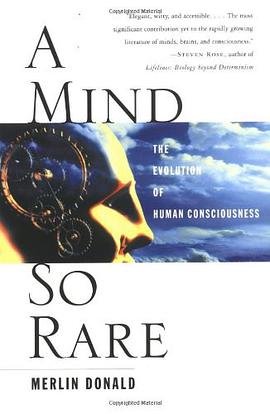
A Mind So Rare 豆瓣
作者: Merlin Donald 出版社: W. W. Norton & Company 2002 - 6
Drawing on his theory of the origins of the modern mind, Merlin Donald's thesis presents the forces, both cultural and neuronal, that power our distinctively human modes of awareness. Donald proposes that the human mind is a hybrid product of interweaving a supercomplex form of matter (the brain) with an invisible symbolic web (culture) to form a "distributed" cognitive network. This hybrid mind, Donald suggests, is our main evolutionary advantage, for it allowed humanity as a species to break free of the limitations of the mammalian brain.
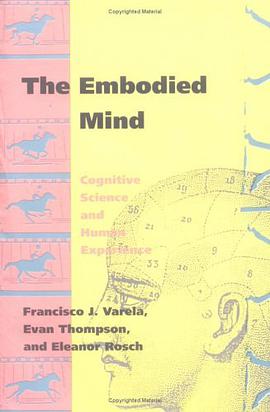
The Embodied Mind 豆瓣
作者: Francisco J. Varela / Evan T. Thompson 出版社: The MIT Press 1992 - 11
The Embodied Mind provides a unique, sophisticated treatment of the spontaneous and reflective dimension of human experience. The authors - argue that only by having a sense of common ground between mind in Science and mind in experience can our understanding of cognition be more complete. Toward that end, they develop a dialogue between cognitive science and Buddhist meditative psychology and situate it in relation to other traditions such as phenomenology and psychoanalysis.Francisco Varela is Director of Research at the Centre National de Recherche Scientifique and Professor of Cognitive Science and Epistemology, CREA, at the Ecole Polytechnique in Paris. Evan Thompson is Assistant Professor of Philosophy at the University of Toronto. Eleanor Rosch is Professor of Psychology at the University of California, Berkeley.
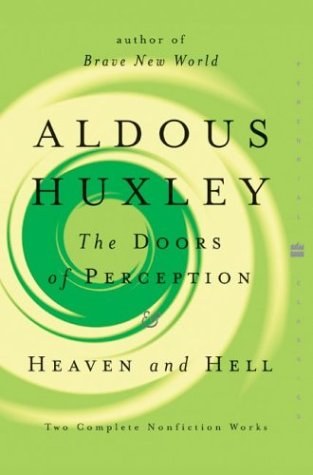
The Doors of Perception and Heaven and Hell (Perennial Classics) 豆瓣 Goodreads
作者: Aldous Huxley 出版社: Harper Perennial Modern Classics 2004 - 5 其它标题: The Doors of Perception & Heaven and Hell
Two classic complete books -- The Doors of Perception (originally published in 1954) and Heaven and Hell (originally published in 1956) -- in which Aldous Huxley, author of the bestselling Brave New World, explores, as only he can, the mind's remote frontiers and the unmapped areas of human consciousness. These two astounding essays are among the most profound studies of the effects of mind-expanding drugs written in the twentieth century. These two books became essential for the counterculture during the 1960s and influenced a generation's perception of life.</p>
Mirrors in the Brain 豆瓣
作者: Giacomo Rizzolatti / Corrado Sinigaglia 译者: Frances Anderson 出版社: Oxford University Press, USA 2008 - 2
Emotions and actions are powerfully contagious; when we see someone laugh, cry, show disgust, or experience pain, in some sense, we share that emotion. When we see someone in distress, we share that distress. When we see a great actor, musician or sportsperson perform at the peak of their abilities, it can feel like we are experiencing just something of what they are experiencing. Yet only recently, with the discover of mirror neurons, has it become clear just how this powerful sharing of experience is realised within the human brain. This book provides, for the first time, a systematic overview of mirror neurons, written by the man who first discovered them. In the early 1990's Giacomo Rizzolatti and his co-workers at the University of Parma discovered that some neurons had a surprising property. They responded not only when a subject performed a given action, but also when the subject oberved someone else performing that same action. These results had a deep impact on cognitive neuroscience, leading the neuroscientist VS Ramachandran to predict that 'mirror neurons would do for psychology what DNA did for biology'.The unexpected properties of these neurons have not only attracted the attention of neuroscientists. Many sociologists, anthropologists, and even artists have been fascinated by mirror neurons. The director and playwright Peter Brook stated that mirror neurons throw new light on the mysterious link that is created each time actors take the stage and face their audience - the sight of a great actor performing activates in the brain of the observer the very same areas that are active in the performer - including both their actions and their emotions. Written in a highly accessible style, that conveys something of the excitement of this groundbreaking theory, Mirrors in the brain is the definitive account of one the major scientific discoveries of the past 50 years.