CCP
Making It Count 豆瓣
作者: Arunabh Ghosh 出版社: Princeton University Press 2020 - 3
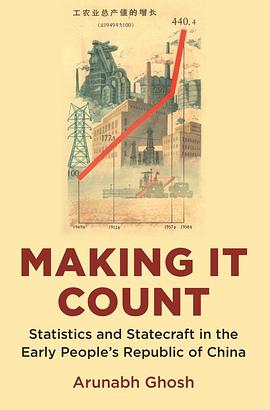
In 1949, at the end of a long period of wars, one of the biggest challenges facing leaders of the new People’s Republic of China was how much they did not know. The government of one of the world’s largest nations was committed to fundamentally reengineering its society and economy via socialist planning while having almost no reliable statistical data about their own country. Making It Count is the history of efforts to resolve this “crisis in counting.” Drawing on a wealth of sources culled from China, India, and the United States, Arunabh Ghosh explores the choices made by political leaders, statisticians, academics, statistical workers, and even literary figures in attempts to know the nation through numbers.
Ghosh shows that early reliance on Soviet-inspired methods of exhaustive enumeration became increasingly untenable in China by the mid-1950s. Unprecedented and unexpected exchanges with Indian statisticians followed, as the Chinese sought to learn about the then-exciting new technology of random sampling. These developments were overtaken by the tumult of the Great Leap Forward (1958–61), when probabilistic and exhaustive methods were rejected and statistics was refashioned into an ethnographic enterprise. By acknowledging Soviet and Indian influences, Ghosh not only revises existing models of Cold War science but also globalizes wider developments in the history of statistics and data.
Anchored in debates about statistics and its relationship to state building, Making It Count offers fresh perspectives on China’s transition to socialism.
Red at Heart 豆瓣
作者: Elizabeth McGuire 出版社: Oxford University Press 2017 - 11
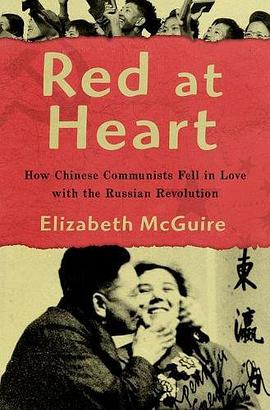
Beginning in the 1920s thousands of Chinese revolutionaries set out for Soviet Russia. Once there, they studied Russian language and experienced Soviet communism, but many also fell in love, got married, or had children. In this they were similar to other people from all over the world who were enchanted by the Russian Revolution and lured to Moscow by it.
The Chinese who traveled to live and study in Moscow in a steady stream over the course of decades were a key human interface between the two revolutions, and their stories show the emotional investment backing ideological, economic, and political change. They embodied an attraction strong enough to be felt by young people in their provincial hometowns, strong enough to pull them across Siberia to a place that had previously held no interest at all. After the Revolution, the Chinese went home, fought a war, and then, in the 1950s, carried out a revolution that was and still is the Soviet Union's most geopolitically significant legacy. They also sent their children to study in Moscow and passed on their affinities to millions of Chinese, who read Russia's novels, watched its movies, and learned its songs. Russian culture was woven into the memories of an entire generation that came of age in the 1950s - a connection that has outlasted not just the Chinese Cultural Revolution and the collapse of the Soviet Union, but also the subsequent erosion of socialist values and practices. This multi-generational personal experience has given China's relationship with Russia an emotional complexity and cultural depth that were lacking before the advent of twentieth century communism - and have survived its demise. If the Chinese eventually helped to lead a revolution that resembled Russia's in remarkable ways, it was not only because class struggle intensified in China due to international imperialism as Lenin had predicted it would, or because Bolsheviks arrived in China to ensure that it did. It was also because as young people, they had been captivated by the potential of the Russian Revolution to help them to become new people and to create a new China.
This richly crafted and narrated book uses the metaphor of a life-long romance to tell a new story about the relationship between Russia and China. These lives were marked by an emotional engagement that often took the form of a romance: love affairs, marriages, divorces, and
China's Hukou System 豆瓣
作者: Jason Young 出版社: Palgrave Macmillan 2014 - 6
With the move to a market-oriented economy, the growth of large scale internal migration has created new forces for institutional change in China. By 2010, 260 million citizens were living outside of their permanent hukou (household registration) location, a major challenge to the constrictive Mao-era system of migration and settlement planning and the rigid intuitional division of rural and urban China. Jason Young shows how these new forces have been received by the state through analysis of major hukou reforms. He documents the dynamic process of institutional change and explains the ongoing importance of China's enduring hukou system to socioeconomic and political development in the world's largest developing country.