CharlesRosen
Piano Notes 豆瓣
作者: 查尔斯·罗森 出版社: Free Press 2004 - 2
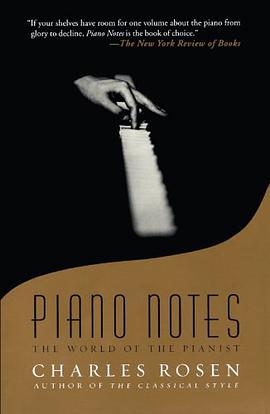
Among the world's instruments, the piano stands out as the most versatile, powerful, and misunderstood -- even by those who have spent much of their lives learning to play. In Piano Notes, a finalist for a 2003 National Book Critics Circle Award, Charles Rosen, one of the world's most talented pianists, distills a lifetime of wisdom and lore into an unforgettable tour of the hidden world of piano playing. You'll read about how a note is produced, why a chord can move us, why the piano -- "hero and villain" of tonality -- has shaped the course of Western music, and why it is growing obsolete. Rosen explains what it means that Beethoven composed in his head whereas Mozart would never dream of doing so, why there are no fortissimos in the works of Ravel, and why a piano player's acrobatics have an important dramatic effect but nothing more. Ending on a contemplative note, Piano Notes offers an elegant argument that piano music "is not just sound or even significant sound" but a mechanical, physical, and fetishistic experience that faces new challenges in an era of recorded music. Rosen ponders whether piano playing will ever again be the same, and his insights astonish.
The Romantic Generation 豆瓣 Goodreads
The Romantic Generation
作者: 查尔斯·罗森 出版社: Harvard University Press 1998 - 9
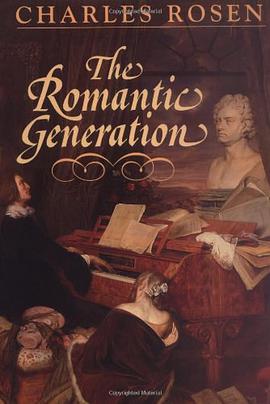
What Charles Rosen's celebrated book "The Classical Style" did for music of the Classical period, this new, much-awaited volume brilliantly does for the Romantic era. An exhilarating exploration of the musical language, forms, and styles of the Romantic period, it captures the spirit that enlivened a generation of composers and musicians, and in doing so it conveys the very sense of Romantic music. In readings uniquely informed by his performing experience, Rosen offers consistently acute and thoroughly engaging analyses of works by Schubert, Schumann, Mendelssohn, Bellini, Liszt, and Berlioz, and he presents a new view of Chopin as a master of polyphony and large-scale form. He adeptly integrates his observations on the music with reflections on the art, literature, drama, and philosophy of the time, and thus shows us the major figures of Romantic music within their intellectual and cultural context. Rosen covers a remarkably broad range of music history and considers the importance to nineteenth-century music of other cultural developments: the art of landscape, a changed approach to the sacred, the literary fragment as a Romantic art form. He sheds new light on the musical sensibilities of each composer, studies the important genres from nocturnes and songs to symphonies and operas, explains musical principles such as the relation between a musical idea and its realization in sound and the interplay between music and text, and traces the origins of musical ideas prevalent in the Romantic period. Rich with striking descriptions and telling analogies, Rosen's overview of Romantic music is an accomplishment without parallel in the literature, a consummate performance by a master pianist and music historian.