Cognition
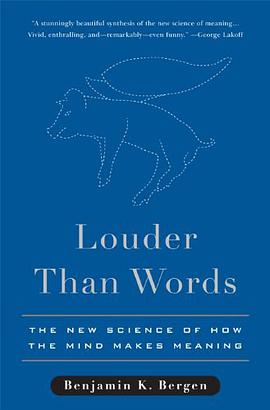
Louder Than Words 豆瓣
作者: Benjamin K. Bergen 出版社: Basic Books 2012 - 10
Whether it's brusque, convincing, fraught with emotion, or dripping with innuendo, language is fundamentally a tool for conveying meaning--a uniquely human magic trick in which you vibrate your vocal cords to make your innermost thoughts pop up in someone else's mind. You can use it to talk about all sorts of things--from your new labradoodle puppy to the expansive gardens at Versailles, from Roger Federer's backhand to things that don't exist at all, like flying pigs. And when you talk, your listener fills in lots of details you didn't mention--the curliness of the dog's fur or the vast statuary on the grounds of the French palace. What's the trick behind this magic? How does meaning work? In "Louder than Words," cognitive scientist Benjamin Bergen draws together a decade's worth of research in psychology, linguistics, and neuroscience to offer a new theory of how our minds make meaning. When we hear words and sentences, Bergen contends, we engage the parts of our brain that we use for perception and action, repurposing these evolutionarily older networks to create simulations in our minds. These embodied simulations, as they're called, are what makes it possible for us to become better baseball players by merely visualizing a well-executed swing; what allows us to remember which cupboard the diapers are in without looking, and what makes it so hard to talk on a cell phone while we're driving on the highway. Meaning is more than just knowing definitions of words, as others have previously argued. In understanding language, our brains engage in a creative process of constructing rich mental worlds in which we see, hear, feel, and act. Through whimsical examples and ingenious experiments, Bergen leads us on a virtual tour of the new science of embodied cognition. A brilliant account of our human capacity to understand language, "Louder than Words" will profoundly change how you read, speak, and listen.
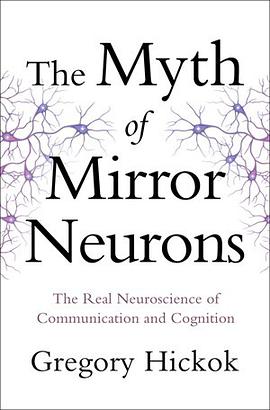
The Myth of Mirror Neurons 豆瓣
作者: Gregory Hickok 出版社: W. W. Norton & Company 2014 - 8
An essential reconsideration of one of the most far-reaching theories in modern neuroscience and psychology.
In 1992, a group of neuroscientists from Parma, Italy, reported a new class of brain cells discovered in the motor cortex of the macaque monkey. These cells, later dubbed mirror neurons, responded equally well during the monkey’s own motor actions, such as grabbing an object, and while the monkey watched someone else perform similar motor actions. Researchers speculated that the neurons allowed the monkey to understand others by simulating their actions in its own brain.
Mirror neurons soon jumped species and took human neuroscience and psychology by storm. In the late 1990s theorists showed how the cells provided an elegantly simple new way to explain the evolution of language, the development of human empathy, and the neural foundation of autism. In the years that followed, a stream of scientific studies implicated mirror neurons in everything from schizophrenia and drug abuse to sexual orientation and contagious yawning.
In The Myth of Mirror Neurons, neuroscientist Gregory Hickok reexamines the mirror neuron story and finds that it is built on a tenuous foundation—a pair of codependent assumptions about mirror neuron activity and human understanding. Drawing on a broad range of observations from work on animal behavior, modern neuroimaging, neurological disorders, and more, Hickok argues that the foundational assumptions fall flat in light of the facts. He then explores alternative explanations of mirror neuron function while illuminating crucial questions about human cognition and brain function: Why do humans imitate so prodigiously? How different are the left and right hemispheres of the brain? Why do we have two visual systems? Do we need to be able to talk to understand speech? What’s going wrong in autism? Can humans read minds?
The Myth of Mirror Neurons not only delivers an instructive tale about the course of scientific progress—from discovery to theory to revision—but also provides deep insights into the organization and function of the human brain and the nature of communication and cognition.