Computation
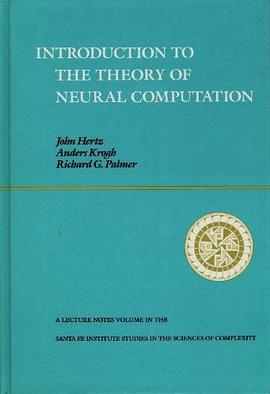
Introduction To The Theory Of Neural Computation, Volume I 豆瓣
作者: John A. Hertz 出版社: Westview Press 1991 - 6
This book comprehensively discusses the neural network models from a statistical mechanics perspective. It starts with one of the most influential developments in the theory of neural networks: Hopfield's analysis of networks with symmetric connections using the spin system approach and using the notion of an energy function from physics. Introduction to the Theory of Neural Computation uses these powerful tools to analyze neural networks as associative memory stores and solvers of optimization problems. A detailed analysis of multi-layer networks and recurrent networks follow. The book ends with chapters on unsupervised learning and a formal treatment of the relationship between statistical mechanics and neural networks. Little information is provided about applications and implementations, and the treatment of the material reflects the background of the authors as physicists. However the book is essential for a solid understanding of the computational potential of neural networks. Introduction to the Theory of Neural Computation assumes that the reader is familiar with undergraduate level mathematics, but does not have any background in physics. All of the necessary tools are introduced in the book.
Computational complexity: A modern approach 豆瓣
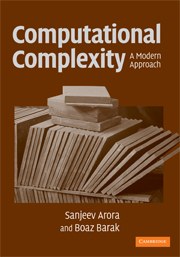
作者: Sanjeev Arora / Boaz Barak 出版社: Cambridge University Press 2009
This beginning graduate textbook describes both recent achievements and classical results of computational complexity theory. Requiring essentially no background apart from mathematical maturity, the book can be used as a reference for self-study for anyone interested in complexity, including physicists, mathematicians, and other scientists, as well as a textbook for a variety of courses and seminars. More than 300 exercises are included with a selected hint set.
Contents
Part I. Basic Complexity Classes: 1. The computational model - and why it doesn’t matter; 2. NP and NP completeness; 3. Diagonalization; 4. Space complexity; 5. The polynomial hierarchy and alternations; 6. Boolean circuits; 7. Randomized computation; 8. Interactive proofs; 9. Cryptography; 10. Quantum computation; 11. PCP theorem and hardness of approximation: an introduction; Part II. Lower Bounds for Concrete Computational Models: 12. Decision trees; 13. Communication complexity; 14. Circuit lower bounds; 15. Proof complexity; 16. Algebraic computation models; Part III. Advanced Topics: 17. Complexity of counting; 18. Average case complexity: Levin’s theory; 19. Hardness amplification and error correcting codes; 20. Derandomization; 21. Pseudorandom constructions: expanders and extractors; 22. Proofs of PCP theorems and the Fourier transform technique; 23. Why are circuit lower bounds so difficult?; Appendix A: mathematical background.
Reviews
Pre-Publication Review: "This text is a major achievement that brings together all of the important developments in complexity theory. Student and researchers alike will find it to be an immensely useful resource."
Michael Sipser, MIT, author of Introduction to the Theory of Computation
Pre-Publication Review: "Computational complexity theory is at the core of theoretical computer science research. This book contains essentially all of the (many) exciting developments of the last two decades, with high level intuition and detailed technical proofs. It is a must for everyone interested in this field."
Avi Wigderson, Professor, Institute for Advanced Study, Princeton
Pre-Publication Review: "This book by two leading theoretical computer scientists provides a comprehensive,insightful and mathematically precise overview of computational complexity theory, ranging from early foundational work to emerging areas such as quantum computation and hardness of approximation. It will serve the needs of a wide audience, ranging from experienced researchers to graduate students and ambitious undergraduates seeking an introduction to the mathematical foundations of computer science. I will keep it at my side as a useful reference for my own teaching and research."
Richard M. Karp, University Professor, University of California at Berkeley