GameTheory
Game Theory 豆瓣
作者: Steven Tadelis 出版社: Princeton University Press 2013 - 1
This comprehensive textbook introduces readers to the principal ideas and applications of game theory, in a style that combines rigor with accessibility. Steven Tadelis begins with a concise description of rational decision making, and goes on to discuss strategic and extensive form games with complete information, Bayesian games, and extensive form games with imperfect information. He covers a host of topics, including multistage and repeated games, bargaining theory, auctions, rent-seeking games, mechanism design, signaling games, reputation building, and information transmission games. Unlike other books on game theory, this one begins with the idea of rationality and explores its implications for multiperson decision problems through concepts like dominated strategies and rationalizability. Only then does it present the subject of Nash equilibrium and its derivatives. "Game Theory" is the ideal textbook for advanced undergraduate and beginning graduate students. Throughout, concepts and methods are explained using real-world examples backed by precise analytic material. The book features many important applications to economics and political science, as well as numerous exercises that focus on how to formalize informal situations and then analyze them. It introduces the core ideas and applications of game theory. It covers static and dynamic games, with complete and incomplete information. It features a variety of examples, applications, and exercises. Topics include repeated games, bargaining, auctions, signaling, reputation, and information transmission. It is ideal for advanced undergraduate and beginning graduate students. Complete solutions available to teachers and selected solutions available to students.
Game Theory 豆瓣
作者: Roger B. Myerson 出版社: Harvard University Press 1997 - 9
Product Description
Eminently suited to classroom use as well as individual study, Roger Myerson's introductory text provides a clear and thorough examination of the models, solution concepts, results, and methodological principles of noncooperative and cooperative game theory. Myerson introduces, clarifies, and synthesizes the extraordinary advances made in the subject over the past fifteen years, presents an overview of decision theory, and comprehensively reviews the development of the fundamental models: games in extensive form and strategic form, and Bayesian games with incomplete information.
Game Theory will be useful for students at the graduate level in economics, political science, operations research, and applied mathematics. Everyone who uses game theory in research will find this book essential.
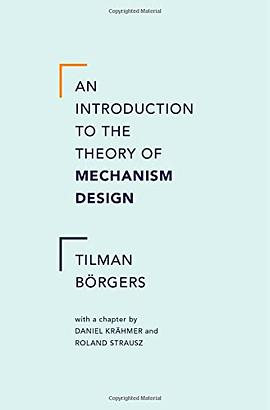
An Introduction to the Theory of Mechanism Design 豆瓣
作者: Tilman Borgers / Daniel Krahmer 出版社: Oxford University Press 2015 - 6
What is the best way to auction an asset? How should a group of people organize themselves to ensure the best provision of public goods? How should exchanges be organized? In An Introduction to the Theory of Mechanism Design, Tilman Börgers addresses these questions and more through an exploration of the economic theory of mechanism design. Mechanism design is reverse game theory. Whereas game theory takes the rules of the game as a given and makes predictions about the behavior of strategic players, the theory of mechanism design goes a step further and selects the optimal rules of the game.
A relatively new economic theory, mechanism design studies the instrument itself as well as the results of the instrument. An Introduction to the Theory of Mechanism Design provides rigorous but accessible explanations of classic results in the theory of mechanism design, such as Myerson's theorem on expected revenue maximizing auctions, Myerson and Satterthwaite's theorem on the impossibility of ex post efficient bilateral trade with asymmetric information, and Gibbard and Satterthwaite's theorem on the non-existence of dominant strategy voting mechanisms. Börgers also provides an examination of the frontiers of current research in the area with an original and unified perspective that will appeal to advanced students of economics.
"Tilman Borgers offers the first book-length introduction into the theory of mechanism design. Written in a very personal and masterful style, he carefully covers the main developments in theory of mechanism design-the theory of how to choose the rules of the game-over the past decades. It will be an ideal textbook for advanced undergraduate and graduate courses for many years to come."
Dirk Bergemann, Douglass and Marion Campbell Professor of Economics and Chair, Yale University
"Tilman Borgers gives a beautifully lucid and elegant development of mechanism design in this wonderful book. His masterful exposition provides a unified and cohesive treatment of modern mechanism design, starting from first principles and working through topics at the leading edge of the research frontier. This book is a delight and an invaluable resource for those new to the field and experts alike."
Chris Shannon, Richard and Lisa Steiny Professor of Economics and Professor of Mathematics, University of California, Berkeley
"This book provides an integrated treatment of the theory of mechanism design by a leading practitioner in this area. It covers the core theory together with chapters on recent developments in robust mechanism design and dynamic mechanism design. The core theory is built up in an original and pedagogically successful way, starting with screening in chapter 2 and immediately using those tools to develop leading applications of Bayesian mechanism design-auctions, bilateral trade, and public goods-in chapter 3. These results can then naturally be adapted to dominant strategies in chapter 4. Chapters 5, 6, and 7 then deal with the general theories of incentive compatibility, Bayesian mechanism design, and dominant strategy mechanism design.
The first seven chapters of the book focus on the quasi-linear environments studied in most economic applications, with more general environments ('non-transferable utility') postponed to chapter 8. This ordering of material reflects not the historical development of the subject but a natural and effective path to learn the material. Borgers develops a unified treatment of core material without attempting to be exhaustive. Valuable endnotes at the end of each chapter then explain the historical context and relation to the literature more broadly. It will serve as an excellent textbook for graduate students and advanced undergraduates, and an invaluable reference for researchers."
Stephen Morris, Professor of Economics, Princeton University
A Primer in Game Theory 豆瓣
作者: Robert Gibbons 出版社: Pearson Academic 1992 - 6
Game theory has revolutionized economics research and teaching during the past two decades. There are few undergraduate or graduate courses in which it does not form a core component. Game theory is the study of multi-decision problems and such problems occur frequently in economics. Industrial organization provides many examples where firms must consider the reactions of others. But there are many other areas in which it is applicable - from individual workers vying for promotion to countries competing or colluding to choose trade policies. Bob Gibbons provides an introduction to the branches of game theory that have been widely applied in economics. He emphasizes the applications as much as the pure theory. This not only helps to teach the theory, but also illustrates the process of model building - the process of translating an informal description of a multi-person decision situation into a formal, game theoretic problem to be analyzed. The approach aims to serve as both an introduction to those who will go on to specialize as pure game-theorists. It also introduces game theory to those who will later construct (or at least use) game-theoretic models in applied fields of economics.
Game Theory 豆瓣
作者: Drew Fudenberg / Jean Tirole 出版社: The MIT Press 1991 - 8
This advanced text introduces the principles of noncooperative game theory - including strategic form games, Nash equilibria, subgame perfection, repeated games, and games of incomplete information - in a direct and uncomplicated style that will acquaint students with the broad spectrum of the field while highlighting and explaining what they need to know at any given point. The analytic material is accompanied by many applications, examples, and exercises.The theory of noncooperative games studies the behavior of agents in any situation where each agent's optimal choice may depend on a forecast of the opponents' choices. "Noncooperative" refers to choices that are based on the participant's perceived selfinterest. Although game theory has been applied to many fields, Fudenberg and Tirole focus on the kinds of game theory that have been most useful in the study of economic problems. They also include some applications to political science. The fourteen chapters are grouped in parts that cover static games of complete information, dynamic games of complete information, static games of incomplete information, dynamic games of incomplete information, and advanced topics.Drew Fudenberg and Jean Tirole are Professors of Economics at MIT.
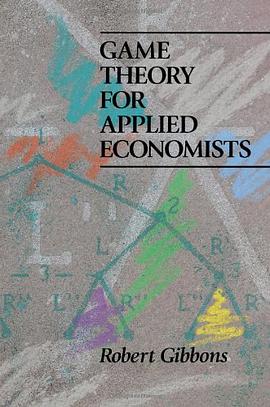
Game Theory for Applied Economists 豆瓣
作者: Robert Gibbons 出版社: Princeton University Press 1992 - 7
This book introduces one of the most powerful tools of modern economics to a wide audience: those who will later construct or consume game-theoretic models. Robert Gibbons addresses scholars in applied fields within economics who want a serious and thorough discussion of game theory but who may have found other works overly abstract. Gibbons emphasizes the economic applications of the theory at least as much as the pure theory itself; formal arguments about abstract games play a minor role. The applications illustrate the process of model building--of translating an informal description of a multi-person decision situation into a formal game-theoretic problem to be analyzed. Also, the variety of applications shows that similar issues arise in different areas of economics, and that the same game-theoretic tools can be applied in each setting. In order to emphasize the broad potential scope of the theory, conventional applications from industrial organization have been largely replaced by applications from labor, macro, and other applied fields in economics. The book covers four classes of games, and four corresponding notions of equilibrium: static games of complete information and Nash equilibrium, dynamic games of complete information and subgame-perfect Nash equilibrium, static games of incomplete information and Bayesian Nash equilibrium, and dynamic games of incomplete information and perfect Bayesian equilibrium.
Natural Justice 豆瓣
作者: Ken Binmore 出版社: Oxford University Press, USA 2005 - 2
This book lays out foundations for a "science of morals." Binmore uses game theory as a systematic tool for investigating ethical matters. He reinterprets classical social contract ideas within a game-theory framework and generates new insights into the fundamental questions of social philosophy. In contrast to the previous writing in moral philosophy that relied on vague notion such as " societal well-being" and "moral duty," Binmore begins with individuals; rational decision-makers with the ability to emphasize with one another. Any social arrangement that prescribes them to act against their interests will become unstable and eventually will be replaced by another, until one is found that includes worthwhile actions for all individuals involved.
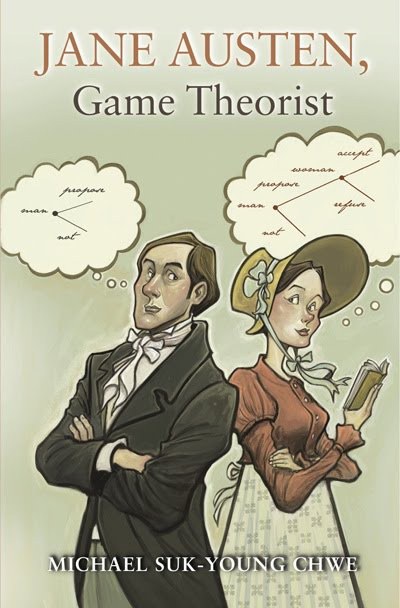
Jane Austen, Game Theorist 豆瓣
作者: Michael Suk-Young Chwe 出版社: Princeton University Press 2013 - 4
Game theory--the study of how people make choices while interacting with others--is one of the most popular technical approaches in social science today. But as Michael Chwe reveals in his insightful new book, Jane Austen explored game theory's core ideas in her six novels roughly two hundred years ago. Jane Austen, Game Theorist shows how this beloved writer theorized choice and preferences, prized strategic thinking, argued that jointly strategizing with a partner is the surest foundation for intimacy, and analyzed why superiors are often strategically clueless about inferiors. With a diverse range of literature and folktales, this book illustrates the wide relevance of game theory and how, fundamentally, we are all strategic thinkers. Although game theory's mathematical development began in the Cold War 1950s, Chwe finds that game theory has earlier subversive historical roots in Austen's novels and in "folk game theory" traditions, including African American folktales. Chwe makes the case that these literary forebears are game theory's true scientific predecessors. He considers how Austen in particular analyzed "cluelessness"--the conspicuous absence of strategic thinking--and how her sharp observations apply to a variety of situations, including U.S. military blunders in Iraq and Vietnam. Jane Austen, Game Theorist brings together the study of literature and social science in an original and surprising way.