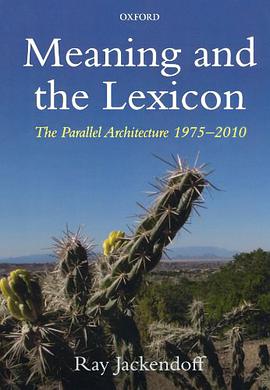
Meaning and the Lexicon brings together 35 years of pathbreaking work on language by Ray Jackendoff. It traces the development of his Parallel Architecture, in which phonology, syntax, and semantics are independent generative components, and in which knowledge of language consists of a repertoire of stored structures. Some of these structures, such as words and morphemes, are idiosyncratic mappings between phonology, syntax, and meaning; some, such as idioms, attach meaning to larger syntactic structures; other structures are purely syntactic or morphosyntactic; and yet others are pieces of meaning with no syntactic or phonological form. The Parallel Architecture also seeks to explain and understand how language is integrated with human cognition, particularly with vision. Professor Jackendoff examines inherently meaningful syntactic constructions, incorporating insights from Construction Grammar; and he looks at how aspects of meaning can be unexpressed but nevertheless understood, integrating approaches from Generative Lexicon theory. A recurring focus is the balance in grammar between idiosyncrasy, regularity, and semiregularity. The chapters cover a wide range of phenomena, from well-studied domains such as the mass-count distinction, event structure, resultatives, and noun-noun compounds, to offbeat aspects of English grammar such as the time-away construction (We're twistin' the night away), contrastive focus reduplication (Do you LIKE-him-like him?) and the noun-preposition-noun construction (week after week). Ray Jackendoff draws on work in a wide range of fields, including linguistics, cognitive science, and philosophy. His writing combines depth of thought with clarity and wit. Meaning and the Lexicon will be read and enjoyed by linguists of all theoretical persuasions, and will be of great interest to cognitive scientists, philosophers, and anyone interested in how language operates in the mind, brain, and human communication.